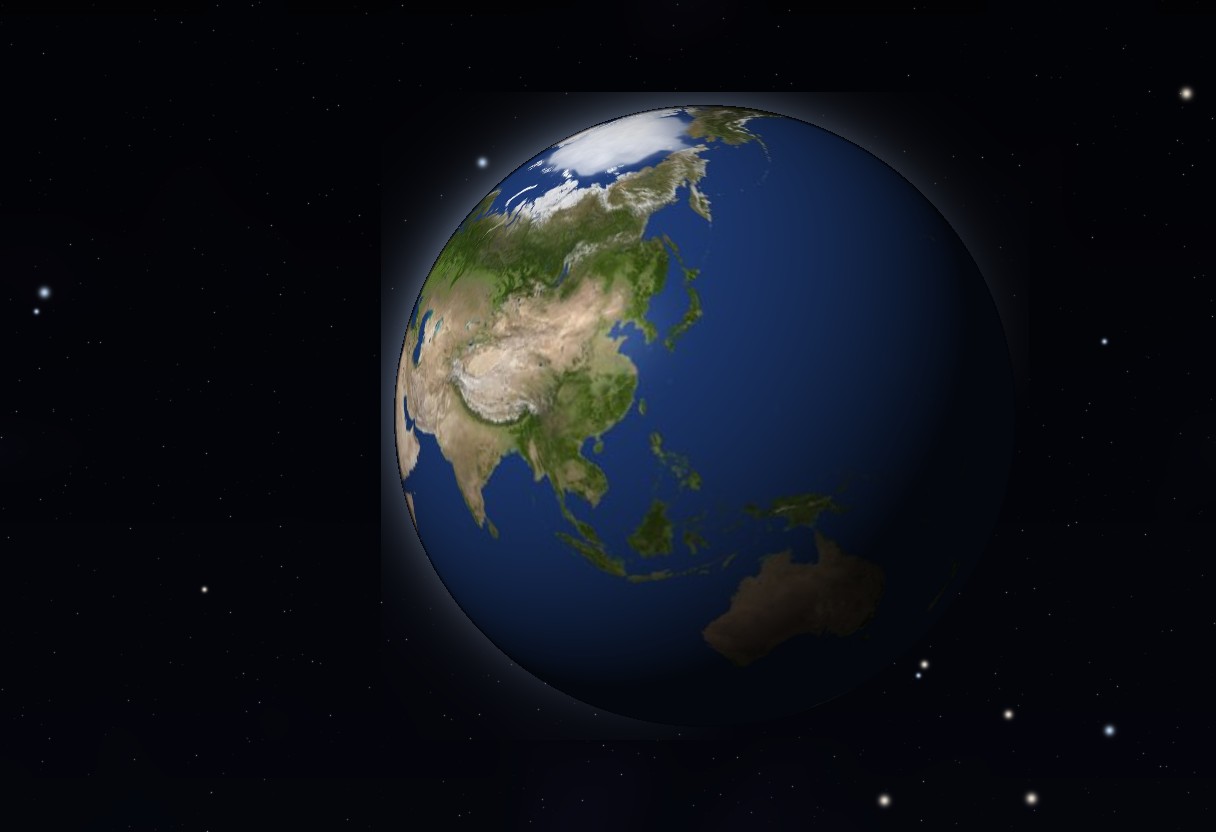
Earth is a rocky planet orbiting the Sun at a mean distance of 1 AU, completing one orbit every 365.3 days. With a mean radius of 6,371 km, a surface gravity of 9.81 m/s², and a mean surface temperature of 288 K (15 °C), it is the densest planet in the Solar System at 5,514 kg/m³ — a figure that reflects the compression of its deep interior under its own weight. It is the only planet in the Solar System currently known to bear active plate tectonics, a liquid-water ocean, and a biosphere estimated at roughly 8.7 million species.
Key facts
- Mass: 1 Earth masses (1× Earth)
- Body type: planet
- Radius: 6,371 km (1× Earth)
- Surface gravity: 9.81 m/s² (1× Earth)
- Density: 5,514 kg/m³ (1× Earth)
- Temperature: 288 K (15 °C)
- Orbital period: 365.3 days
- Rotation period: 23.9 h
- Semi-major axis: 1 AU
- Orbital eccentricity: 0.02
Orbit and Rotation
Earth follows a nearly circular path around the Sun: its orbital eccentricity is only 0.02, meaning the orbit deviates from a perfect circle by about two percent. The practical consequence is modest but real — at aphelion in July, Earth is far enough from the Sun that it receives about 7 percent less solar energy than at perihelion in January. A common inference is that this distance variation drives the seasons, but it does not. Seasons are caused by Earth’s axial tilt of 23.5 degrees, which changes how directly sunlight strikes each hemisphere across the year.
A point on Earth’s equator moves at approximately 1,670 km/h (about 1,038 mph) as the planet spins, while near the poles that rotational speed approaches zero. Earth completes one rotation in 23.9 hours.
Interior Structure
Earth’s interior divides into four main shells. The crust — the outermost layer — ranges from about 5 km thick under the ocean floors, where it is composed largely of basalt, to about 70 km thick under continental mountain ranges, where granite dominates. Below the crust lies the mantle, approximately 2,900 km thick and making up roughly 84 percent of Earth’s total volume.
Beneath the mantle, beginning about 2,889 km below the surface, is the liquid outer core: a shell roughly 2,260 km thick composed mostly of iron and nickel. It stays liquid because the pressure at those depths, while enormous, is insufficient to force the iron-nickel alloy into a solid state. At the planet’s centre lies the solid inner core. It is slowly growing — liquid iron from the outer core freezes onto it at a rate of roughly 1 mm per year. Estimates suggest the inner core may be only about half a billion to two billion years old, far younger than Earth itself at 4.5 billion years.
Plate Tectonics
Earth’s lithosphere is broken into 7 major tectonic plates — the Pacific, North American, Eurasian, African, Antarctic, Indo-Australian, and South American — plus about 8 or more minor plates and dozens of microplates. The Pacific Plate is the largest, covering approximately 103,300,000 km². Together, the seven major plates cover nearly 95 percent of Earth’s surface. The process is driven by heat from radioactive processes within the interior, which causes plates to move toward, away from, or alongside one another — building mountain ranges, opening ocean basins, and generating earthquakes and volcanoes.
Earth is the only planet in the Solar System currently known to have active plate tectonics.
One peculiar consequence of subduction — where one plate dives beneath another — is the existence of deep-focus earthquakes. The USGS classifies events occurring between 300 and 700 km depth as deep-focus. At those depths, rock should deform plastically rather than rupture brittlely, yet in 2004 a magnitude-4.2 earthquake near Vanuatu was measured at 735 km depth, making it one of the deepest on record. The mechanism that allows brittle rupture under such pressure remains an open question in seismology.
Magnetic Field and Geodynamo
More than 90 percent of the magnetic field measured at Earth’s surface originates in the outer core through a process called the geodynamo. Convecting liquid iron, organised by Earth’s rotation into helical currents via the Coriolis force, induces electric currents that in turn sustain the magnetic field — a self-reinforcing loop that has persisted across geological time.
The magnetic field is not static. Earth’s poles have reversed many times throughout geological history, and the polarity record shows long intervals of relative stability interrupted by comparatively rapid flips. One of the most stable intervals is the Cretaceous Superchron, lasting approximately from 118 to 83 million years ago — a span of about 35 million years during which no reversal occurred.
The geodynamo also plays a direct role in making Earth habitable. The magnetosphere produced by the outer core deflects the solar wind, preventing it from stripping atmospheric gases. Mars, which has no global magnetic field, has lost most of its atmosphere to this process and retains only a thin, largely unprotected remnant.
Atmosphere
Earth’s atmosphere has a total mass of approximately 5.1 × 10¹⁸ kg — about one millionth of Earth’s total mass of 5.9722 × 10²⁴ kg, yet sufficient to shield the surface from lethal ultraviolet radiation and to maintain temperatures at which liquid water is stable. The mean surface temperature of 288 K (15 °C) is notably higher than Earth’s black-body temperature of 254.0 K, which is the temperature the planet would settle at with no atmospheric greenhouse effect. The difference reflects the warming contribution of atmospheric gases.
The atmosphere is structured in five major layers. The troposphere extends from the surface to an average of about 12 km and contains about 99 percent of all water vapour and aerosols. Above it sits the stratosphere, then the mesosphere, which occupies roughly 50 to 80 km altitude and is the coldest part of the Earth system, reaching an average temperature near its top of about −85 °C. Higher still lies the thermosphere, and finally the exosphere, Earth’s outermost layer, which fades into interplanetary space up to about 10,000 km above the surface.
Earth’s bond albedo — the fraction of incoming sunlight reflected back to space — stands at 0.294 according to the NASA Earth Fact Sheet. A 2005 report by the CERES Science Team published in the journal Science found that Earth’s shortwave albedo had been declining since satellite measurements began in February 2000, with a measured drop of 0.0027 over the 2000-to-2004 period. That drop corresponds to the planet retaining an additional 0.9 W/m² of energy.
The planet also hums electromagnetically. Lightning strikes worldwide maintain a standing electromagnetic wave in the cavity between Earth’s surface and the ionosphere. The fundamental observed frequency of this resonance is approximately 7.83 Hz, with harmonics at about 14.3, 20.8, 27.3, and 33.8 Hz. Physicist Winfried Otto Schumann first predicted this resonance in 1952; his initial theoretical calculation gave approximately 10 Hz, and the lower measured value arises because the dispersive character of the ionosphere effectively enlarges the cavity.
Oceans
Earth’s oceans hold a total volume of about 1.37 billion km³ of water, distributed unevenly across the hemispheres: 61 percent of the Northern Hemisphere is covered by ocean, compared with 81 percent of the Southern Hemisphere. Despite centuries of navigation and decades of satellite observation, as of April 2026 only 28.7 percent of the global seafloor had been mapped with modern high-resolution multibeam sonar, according to the Nippon Foundation-GEBCO Seabed 2030 project tracked by NOAA Ocean Exploration. More than 71 percent of the ocean floor still lacks a modern high-resolution map.
Geological History
Earth’s geological history is divided into four eons. The Hadean (4.6 to 4.0 billion years ago) covers the planet’s formation and the early bombardment period. The Archean (4.0 to 2.5 billion years ago) saw the first stable continental crust and the earliest microbial life. The Proterozoic (2.5 billion to 541 million years ago) brought the first persistently oxygenated atmosphere. The Phanerozoic (541 million years ago to the present) encompasses the rise of complex animal life. The three earliest eons are collectively known as the Precambrian supereon. The full geologic time scale is divided into four eons, ten eras, 22 periods, and several epochs.
The single most consequential chemical event in Earth’s history may be the Great Oxidation Event, approximately 2.4 billion years ago. Photosynthetic cyanobacteria had been producing oxygen for some time, but geological sinks — dissolved iron in seawater, reactive volcanic gases, and oxidisable rock — absorbed it as fast as microbes produced it. Around 2.4 billion years ago, those sinks were overwhelmed, and oxygen accumulated permanently in the atmosphere for the first time. The shift ended a methane-dominated greenhouse atmosphere and is thought to have triggered the Huronian glaciation, in which ice spread from the poles toward the tropics. It was toxic to most organisms then alive. Over billions of years, the accumulation of oxygen ultimately enabled the evolution of complex aerobic life.
Life
A 2011 Census of Marine Life study published in PLOS Biology estimated that there are approximately 8.7 million species on Earth (±1.3 million), with 6.5 million found on land and 2.2 million in the ocean. At the time of publication, 86 percent of land species and 91 percent of ocean species had not yet been discovered, described, or catalogued by science.
Measured by carbon mass rather than species count, the picture shifts dramatically. The total biomass of all humans on Earth is approximately 0.06 gigatons of carbon (Gt C), set against a total biomass of all living organisms estimated at roughly 550 Gt C. Humanity’s carbon mass is therefore about ten thousand times smaller than the combined carbon mass of all life on the planet.
Earth as a Measured Object — Early Science
Around 240 BC, the Greek scholar Eratosthenes, chief librarian at the Library of Alexandria, measured the angle of the noon shadow at Syene and Alexandria on the summer solstice. From the difference in shadow angles and the known road distance between the two cities, he calculated Earth’s circumference as 252,000 stadia — a figure within a few percent of the modern value of 40,008 km. The measurement used no instrument more sophisticated than a vertical stick.
Observation from Space — Photography and Remote Sensing
The first photograph of Earth from space was taken on October 24, 1946, by a 35-millimetre motion picture camera carried aboard a U.S. Army V-2 rocket launched from White Sands Missile Range, New Mexico. The rocket reached an altitude of 65 miles (105 km). The camera itself was destroyed on impact, but the steel film cassette survived, and the recovered frames showed grainy black-and-white images of the planet’s surface and cloud cover from above.
On December 24, 1968, astronaut William Anders, aboard NASA’s Apollo 8 spacecraft during its fourth orbit of the Moon, photographed Earth rising above the lunar horizon. The resulting image, known as ‘Earthrise’, is widely credited with shifting public perception of the planet by showing it as a small, isolated body against the surrounding void.
Systematic land remote sensing from orbit began on July 23, 1972, when NASA and the U.S. Geological Survey launched the first satellite of what became the Landsat program — originally designated the Earth Resources Technology Satellite (ERTS-1), later renamed Landsat 1. Landsat 8 and Landsat 9 both remained active as of 2026, giving the program a continuous data record stretching back over five decades.
On November 21, 2020, the Copernicus Sentinel-6 Michael Freilich satellite — a collaborative mission between ESA, the European Commission, EUMETSAT, NASA, and NOAA — launched aboard a SpaceX Falcon 9 rocket from Vandenberg, California, to measure sea-surface height. Its twin, Sentinel-6B, launched November 17, 2025, extending the continuous altimetry record until at least 2030.
On July 30, 2025, the NASA-ISRO Synthetic Aperture Radar satellite (NISAR) lifted off from Satish Dhawan Space Centre aboard ISRO’s GSLV-F16 rocket. Carrying both L-band and S-band radar, NISAR is designed to scan nearly all of Earth’s land and ice surfaces every 12 days, making it the first joint Earth-observation mission between NASA and India’s ISRO.
Looking further ahead, NASA and the German Aerospace Center (DLR) are developing GRACE-C (Gravity Recovery and Climate Experiment — Continuity), a pair of twin satellites scheduled for launch in December 2028 from Vandenberg Space Force Base, California. The mission will continue month-to-month measurements of changes in Earth’s gravity field — tracking shifts in ice sheets, glaciers, groundwater, and sea levels.
Did you know
- Earth’s atmosphere has a total mass of only about 5.1 × 10¹⁸ kg — roughly one millionth of Earth’s total mass of 5.9722 × 10²⁴ kg, yet it is sufficient to shield the surface from lethal ultraviolet radiation and maintain temperatures suitable for liquid water. (nssdc.gsfc.nasa.gov)
- The ‘Earthrise’ photograph, taken on December 24, 1968, by Apollo 8 astronaut William Anders, is widely credited with galvanising the modern environmental movement by showing humanity a fragile, isolated Earth from space for the first time. (smithsonianmag.com)
- Earth’s seven major tectonic plates — the Pacific, North American, Eurasian, African, Antarctic, Indo-Australian, and South American — together cover nearly 95 percent of Earth’s surface, and their heat-driven motion is what makes Earth the only planet in the Solar System currently known to have active plate tectonics. (worldatlas.com)
- The Great Oxidation Event approximately 2.4 billion years ago — when cyanobacteria flooded Earth’s atmosphere with oxygen for the first time — was toxic to most living organisms of the era, ended a methane-dominated greenhouse atmosphere, and triggered a global ice age, yet it ultimately made complex life possible. (genes.media)
- A 2011 Census of Marine Life estimate published in PLOS Biology put the total number of species on Earth at approximately 8.7 million, but at the time of publication 86 percent of land species and 91 percent of ocean species had never been described by science — meaning the vast majority of life on the planet remained unknown to researchers. (journals.plos.org)
- The total carbon biomass of all humans on Earth is approximately 0.06 gigatons of carbon, set against a total biomass of all living organisms estimated at roughly 550 Gt C. Humanity’s carbon mass is about ten thousand times smaller than the combined carbon mass of every bacterium, fungus, plant, and animal on the planet. (earthdate.org)
- Around 240 BC, the Greek librarian Eratosthenes calculated Earth’s circumference by comparing noon shadows in two Egyptian cities and arrived at 252,000 stadia — within a few percent of the modern value of 40,008 km — using nothing more than a vertical stick and geometric reasoning. (scienceabc.com)
- The Schumann resonance of 7.83 Hz — the primary electromagnetic signal generated by worldwide lightning strikes bouncing between Earth’s surface and the ionosphere — was first predicted by physicist Winfried Otto Schumann in 1952, but his initial theoretical calculation gave approximately 10 Hz. The lower observed value arises because the dispersive character of the ionosphere effectively enlarges the cavity. (nf-lab.org)
Data sources
- NASA NSSDC
- nssdc.gsfc.nasa.gov
- science.nasa.gov
- nasa.gov
- ebsco.com
- education.nationalgeographic.org
- spaceweather.com
- weather.gov
- worldatlas.com
- oceanservice.noaa.gov
- earthsky.org
- usgs.gov
- throughearth.com
- nps.gov
- astrobiology.nasa.gov
- earthdata.nasa.gov
- journals.plos.org
- argo.net
- rwu.pressbooks.pub
- genes.media
- sciencefocus.hkust.edu.hk
- scienceabc.com
- scienceinsights.org
- magmatribune.com
- arxiv.org
- nf-lab.org
- esa.int
- berkeleysciencereview.com
Where it appears
- Asteroid 2026 TB8 Passed Earth at 7.06 Lunar Distances October 31, 2026
- Asteroid 2026 UE skimmed Earth at just 5.25 lunar distances October 31, 2026
- House-sized asteroid passed Earth at 5.08 lunar distances, unseen October 30, 2026
- A House-Sized Asteroid Skimmed Past Earth at Five Moon-Distances October 30, 2026
- House-sized asteroid 2026 RF15 passed Earth at 5.53 lunar distances October 29, 2026
- K2-141 b finishes a full year in just 6.7 hours October 27, 2026
- Asteroid 2026 UE Passed Earth at 5.23 Times the Moon’s Distance October 27, 2026
- Asteroid 2026 TB2 Passed Earth at 4.95 Moon-Distances October 27, 2026
- Asteroid 2026 TB2 passed Earth at just 4.95 lunar distances October 25, 2026
Data updated: 2026-10-26