
A House-to-Jet-Sized Rock Slipped Past Earth at Five Times the Moon’s Distance
On October 25, 2026, at 05:51 UTC, an asteroid called 2026 UE made its closest approach to Earth, moving at about 9.9 miles (15.9 km) every second. Picture something between a house and a narrow-body jet, crossing the sky too fast to track by eye, and passing five Moon-distances away from where you’re standing. That’s the whole event.
The Moon as the Ruler
The miss distance was 0.01343 astronomical units, an astronomical unit being the average Earth-Sun distance, roughly 93 million miles, used here only to show how small a slice of it this gap actually is. In plainer terms, 2026 UE passed about 1.25 million miles (2.01 million km) from Earth. That number floats on its own, so put the one distance everyone has an actual feel for next to it: the Moon, on average, sits 238,900 miles (384,400 km) away, a trip the Apollo missions covered in roughly three days. 2026 UE’s gap was 5.23 times that distance, not one Moon-trip, but more than five of them, back to back, before you’d close the space between the asteroid and Earth.
How We Know
Nobody photographed 2026 UE arriving. The distance, the time down to the minute, and the speed all come from an orbit solution: survey telescopes tracked its position over time, and NASA’s Jet Propulsion Laboratory, through its Center for Near-Earth Object Studies (CNEOS), fits those positions into a trajectory and projects it forward to find the closest point. That’s what makes 05:51 UTC, 9.9 miles per second, and 1.25 million miles measured values rather than guesses, they’re the output of tracked positions, not an estimate dressed up as one. A separate asteroid-tracking archive that also draws on CNEOS data lists the same pass independently, rounding to 5.2 lunar distances and the same speed, which is a useful cross-check on the arithmetic. Which survey telescope first caught 2026 UE in its field isn’t something we could confirm, worth flagging as unverified rather than assumed.
How Big, Really?
Size is where this gets honest about its limits. Nobody has measured 2026 UE’s diameter, what exists is its absolute magnitude, a standardized measure of how bright an object would appear at a fixed reference distance, which came out to H = 25.83. Turning that brightness into a size means assuming an albedo, the fraction of sunlight a surface reflects, and asteroids vary enormously here: dark, carbon-rich rock might reflect as little as 5%, pale stony material closer to 25%. Run H = 25.83 through that whole range and you get a diameter estimate of roughly 59 to 135 feet (18 to 41 meters), something between a single-family house and a narrow-body airliner. The true figure sits somewhere in that band, and which end it’s nearer to depends entirely on a surface composition nobody has observed.
A Routine Pass, Filed Like Any Other
Five-point-two lunar distances sounds roomy, far enough that calling it a “close approach” seems almost dramatic. But CNEOS logs it exactly that way, filed in the same close-approach table as thousands of other small objects. That’s not a warning; it’s a correction to intuition. Rocks this size pass Earth within single-digit multiples of the Moon’s distance routinely, it’s closer to a Tuesday than an event. What’s actually surprising isn’t that 2026 UE came near. It’s that “near,” measured on the solar system’s terms, still leaves five empty Moon-gaps of space in between.
What We Don’t Have Yet
No radar echo bounced off 2026 UE. No infrared read of its surface temperature. Which means no confirmed shape, no spin rate, no composition, the albedo used above is an assumption standing in for a measurement that hasn’t been taken. The exact three-sigma uncertainty on that 0.01343 AU figure also isn’t something we could pin down from what’s public. None of that is a mystery being hyped; it’s just a column in a table that stays blank until someone points a radar dish at the next object like it.
The Picture
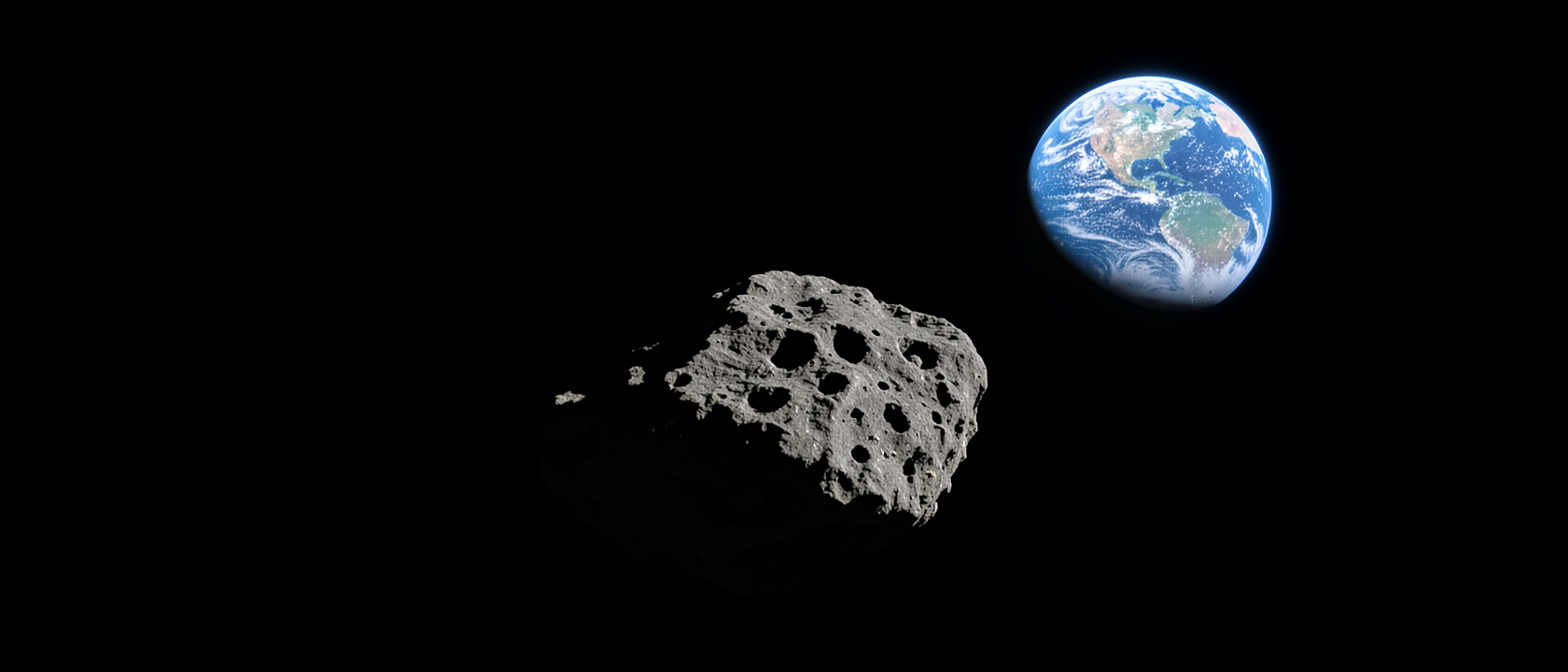
There is no photograph of 2026 UE. At roughly house-to-jet size and over a million miles out even at its nearest, it was never more than a point of light to the telescopes that tracked it, no instrument involved produces an image of the rock itself. If you see a graphic alongside this story, it’s a CNEOS orbit diagram or a close-approach visualization: a computer-plotted line showing the calculated path, built from the same tracking data behind every number here. It’s an illustration of a trajectory, not a picture of a rock, and for an object this size, that’s the only kind of picture that exists yet.