
A Year That Fits Inside a Work Shift
Clock in for an eight-hour shift and clock back out, tired. Or board a transatlantic flight, watch the in-flight movie, doze off, and land. Somewhere in that stretch of ordinary time, a small rocky planet called K2-141 b has already finished an entire year, start to finish, maybe two or three times over. Its orbit, the full lap around its star that counts as a “year,” takes just 24,220 seconds. That’s 6.7 hours.
The Measuring Stick
Earth‘s year, by the standard astronomical definition, runs 365.25 days, 31,557,600 seconds. Divide K2-141 b’s year into that and the ratio works out to about 7.675 × 10⁻⁴: its year lasts roughly 1,303 times less time than ours. Flip it around and the same fact reads differently, in the time Earth takes to complete one orbit, K2-141 b has already lapped its star something like 1,300 times. Both numbers are measured the same way, in the same units of time, so this is a clean ratio, not an estimate stacked on a guess.
How We Know
This figure comes from watching the star itself. K2-141 is a K7V dwarf star, cooler and redder than the Sun, and during a stretch of Kepler’s extended K2 mission, nicknamed “Second Light”, the telescope watched this patch of sky during what’s catalogued as Campaign 12. Every 6.7 hours, the star’s light dimmed by a tiny, repeating amount: a planet crossing in front of it, the transit method at work. Astronomers then turned the HARPS-N spectrograph on the star, splitting its light to catch the faint wobble a planet’s gravity causes as it swings around. Combining both datasets, a team led by astronomer Malavolta published the discovery in 2018, timing the orbital period at 24,220.03 seconds, one of the most directly measured numbers in this whole story, since it comes straight from timing the dimming itself, not from a model.
Why So Close, So Fast
K2-141 b orbits at just 0.00747 astronomical units from its star, an astronomical unit (AU) being the average Earth-Sun distance, about 93 million miles (150 million kilometers). That’s well under 1 percent of Earth’s distance from the Sun. The 2018 discovery paper actually measured a slightly tighter orbit, 0.00716 AU; the gap between the two is a reminder that catalog values like this get refined as more data comes in. Either way, the orbit is measured as perfectly circular, an eccentricity of exactly zero, so there’s no elliptical stretch adding variety to the heat. At that distance, the planet receives about 3,260 times the energy flux Earth gets from the Sun.
How Hot Is Hot
Modeling based on that energy flux puts K2-141 b’s equilibrium temperature at about 2,103 K, roughly 3,326°F (1,830°C). That’s an estimate, not a thermometer reading, it’s calculated from the planet’s distance and the starlight it intercepts, plus assumptions about how that heat spreads and radiates away. Because the planet is almost certainly tidally locked, with one face always turned toward the star, modeling of its phase curve, how its brightness changes over the orbit, built from Spitzer Space Telescope data, suggests the day side runs near 5,432°F (3,000°C), while the night side, getting no direct starlight and apparently little help redistributing heat, could sit around -328°F (-200°C). That gap is itself a clue to an open question: whether K2-141 b holds any real atmosphere. Observations so far rule out anything thick, though a thin veil of vaporized rock remains possible, unresolved, not settled.
The World Itself
K2-141 b’s radius measures about 1.51 times Earth’s, a radius, not a diameter. Its mass, in the current NASA Exoplanet Archive listing, comes out to 4.97 Earth masses (the 2018 discovery paper, using the radial-velocity wobble alone, measured 5.31 Earth masses, two independent solutions, not a contradiction). Mass, worth saying plainly, is not weight. Combine that mass with the planet’s volume and you get a bulk density around 8,200 kilograms per cubic meter, about 1.5 times Earth’s own 5,514 kilograms per cubic meter, dense enough that models suggest an iron core making up somewhere between 30 and 50 percent of the planet’s total mass. That’s an inference drawn from the density, not a direct measurement of what’s underneath.
No Photograph Exists
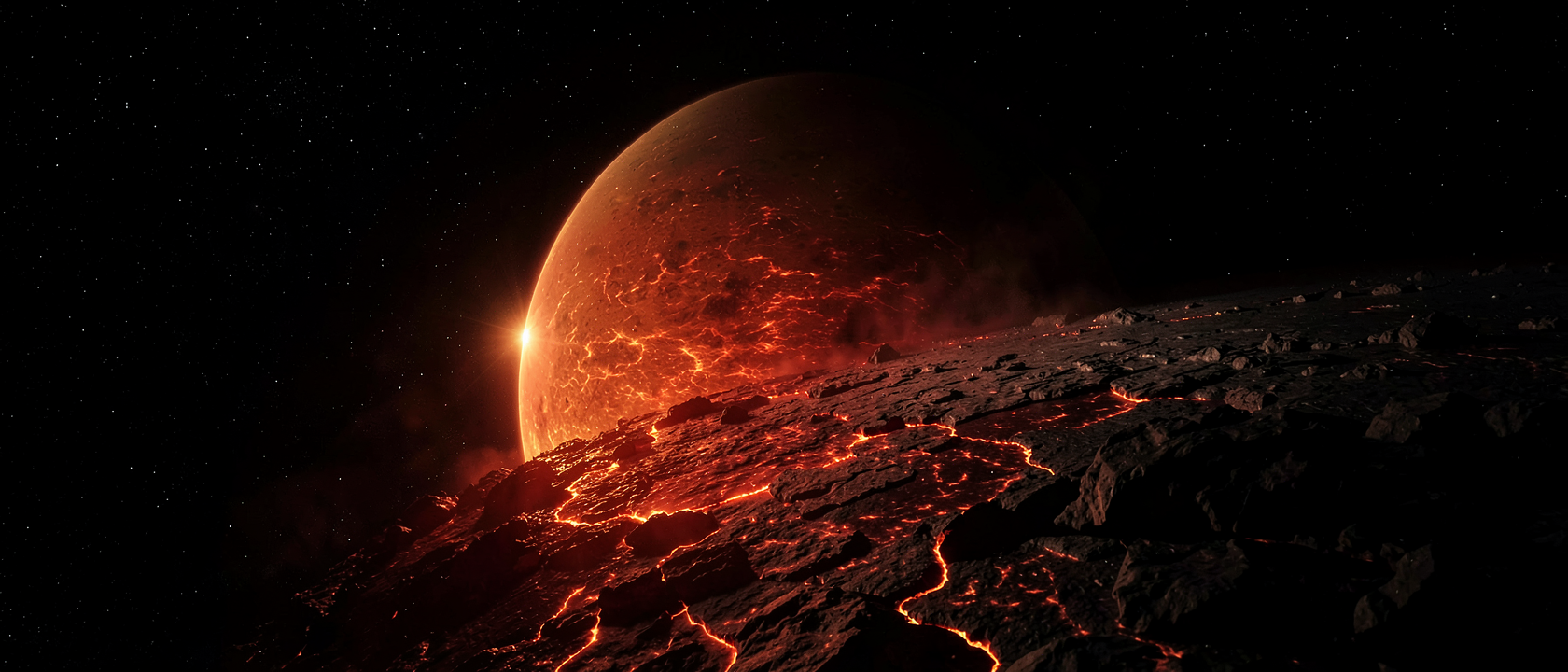
The K2-141 system sits about 202 light-years away, 61.87 parsecs, measured by the archive. No camera has photographed K2-141 b, and at this distance none will; it was found only through the rhythm of dimming starlight and a stellar wobble. Any image showing a molten, lava-streaked world is an artist’s illustration, not a photograph, built from the numbers above rather than a lens pointed at the planet itself. Even the heat source behind that molten look is still debated: tidal forces from the tight orbit are one candidate, but K2-141’s own strong magnetic activity might heat the planet through induction instead. Nobody has settled which, or whether it’s some mix of both.
In the time it takes you to celebrate one birthday, K2-141 b will have celebrated about 1,300 of its own.