TOI-6324 b: A Year Shorter Than a Workday
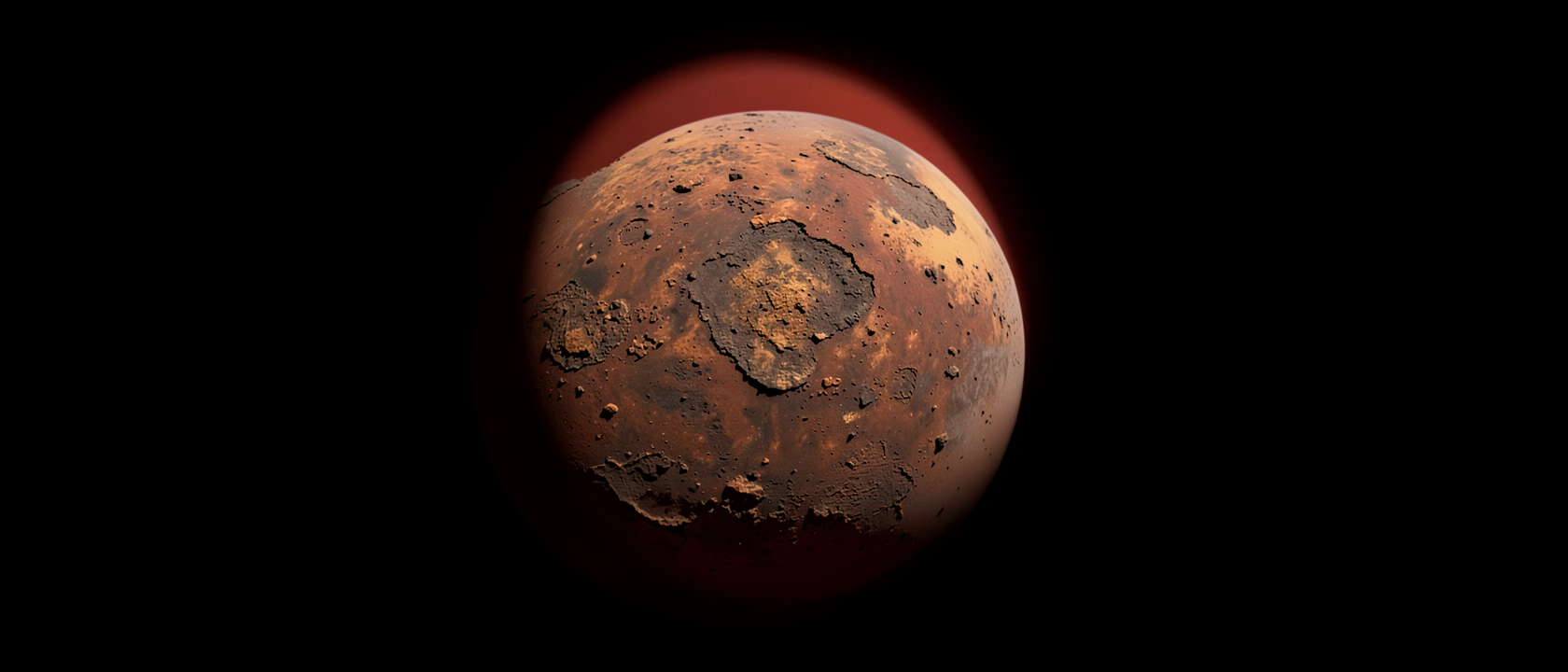
A rocky planet about the size of Earth orbits so close to a small, cool star, an M dwarf, a smaller, cooler class of star than the Sun, that it completes a full lap in 6.7 hours. Start an eight-hour shift, and the planet finishes an entire year before you clock out, with time to spare. No camera has ever photographed it, and none can yet; every image online labeled “TOI-6324 b” is an artist’s illustration, a guess built from measurements rather than a snapshot. At roughly 67 light-years away (about 6.34×10¹⁷ meters), it’s far too small, too dim, and too close to its star’s glare to appear as anything but a shadow crossing a light curve.
The Measuring Stick
The number that carries this story is 24,124.7 seconds, one full orbit, timed directly from how the star’s light dims and recovers as the planet passes in front of it. Divide by 3,600 and you get 6.7 hours. Earth’s year, measured the same way, runs 31,557,600 seconds, or 365.25 days. Set the two side by side, and TOI-6324 b’s year comes out to about 7.645×10⁻⁴ of Earth’s, roughly 1 part in 1,308. The exponent doesn’t mean much on its own; the eight-hour shift does. Four of them, laid end to end, and you’ve already outrun a thousand years on this planet.
How We Know
NASA’s TESS satellite watched the star across seven separate observing windows between September 2019 and May 2024, Sectors 16, 17, 18, 24, 58, 77, and 78. A search built for faint stars inside TESS’s own Quick-Look Pipeline first flagged the repeating dip, and the mission’s automated SPOC pipeline picked up a transit signature in every sector it measured. Timing the gap between dips gives the orbital period directly: no modeling required, just a stopwatch applied to starlight.
Mass and radius came from somewhere else: 77 spectra collected with the Keck Planet Finder instrument between 2023 and 2024, measuring the tiny back-and-forth wobble the planet’s gravity induces in its star, the radial velocity method. Combining that wobble with the transit depth gave astronomer Rena A. Lee and colleagues enough to publish TOI-6324 b in 2025, describing it as the closest match yet to an Earth-sized rocky planet in the “ultra-short-period” class, exoplanet shorthand for orbits under a day. One catalog, exoplanet.eu, lists 2024 as the discovery year instead; the confirmation paper and the NASA Exoplanet Archive both say 2025, a mismatch that comes down to how “discovery” gets counted, not a disagreement over the planet itself.
Earth-Like Numbers, Alien Address
TOI-6324 b has a mass of 1.17 Earth masses, about 6.99×10²⁴ kg, and a radius of 1.059 Earth radii, roughly 4,194 miles (6,750 km). Its modeled iron-core fraction comes out to 27%, with an uncertainty of ±37%, which still sits close enough to Earth’s own 33% to call the comparison reasonable. Before you factor in the orbit, this reads like one of the more convincing rocky Earth-twins on record.
Then there’s the address. Finishing an orbit in under seven hours means sitting close enough to the star that astronomers calculate an equilibrium temperature, not a thermometer reading, but a number derived from the starlight the planet absorbs and an assumed reflectivity (a Bond albedo of 0.1, meaning the model assumes the surface bounces back about a tenth of the light hitting it), of around 1,729°F (1,216 K) in the discovery paper’s figure, with other groups’ models landing as low as roughly 1,598°F (1,143 K). At temperatures like that, scientists expect any atmosphere thick enough to matter would long since have been stripped away by radiation, an expectation drawn from physics, not something measured directly on this particular planet. Same mass and radius as a rocky world like ours. A completely different place to stand.
What’s Still Open
The catalog lists this orbit’s eccentricity, how far it strays from a perfect circle, at exactly zero. That figure is fixed in the model fit rather than independently confirmed; with a transit-only solution this tight, a perfectly circular orbit is often just the simplest assumption that still matches the data, not proof that the real orbit has no stretch to it at all.
There’s also a faint brightening-and-dimming signal in the TESS data, about 42 parts per million, that might be light reflecting off the planet itself as it circles its star. The team that found it called the detection tentative, not confirmed. Whatever atmosphere, if any, survives on a world this irradiated remains unknown. The orbit is the one number here that needs no hedging: 6.7 hours, measured the same way Earth’s year is measured, just small enough to fit inside a single workday.