A Gas Giant You Could Float
Picture a world carrying eighteen and a half times Earth’s mass. Your arms brace for something you’d never lift. Now picture dropping it into an ocean large enough to hold it whole, and watching it float, the way a chunk of balsa wood bobs in a bathtub.
That’s TOI-791 c, a gas giant orbiting a star about 1,113 light-years away. A light-year is a distance, not a time: the distance light covers in a year, roughly 5.88 trillion miles (9.46 trillion km). Astronomers measured TOI-791 c’s mass at 18.6 times Earth’s, and its radius at 12.96 times Earth’s, a sphere with a diameter of about 102,600 miles (165,140 km). It’s physically bigger across than Jupiter, yet it carries just 5.9 percent of Jupiter’s mass, according to NASA’s own figures. Spread that much mass across that much volume, and the planet’s bulk density comes out to just 47 kilograms per cubic meter (kg/m³), a number calculated from the mass and radius above, not read off any instrument.
The Measuring Stick
Water is the baseline: a cubic meter of it weighs 1,000 kg. TOI-791 c’s material would come in under 5 percent of that. For something solid you’ve actually held, cork runs about 240 kg/m³, and balsa wood, the lightest timber most people have handled, sits around 160 kg/m³. TOI-791 c beats both: it’s about one-fifth the density of cork and less than a third the density of balsa.
Styrofoam turns up in a lot of writing about planets like this one, but it’s a sloppy stick to use. Packaging foam runs anywhere from about 11 to 50 kg/m³ depending on how it’s made, which puts 47 kg/m³ inside that range rather than clearly below it. NASA’s own release on this discovery skips foam and reaches for cotton candy instead, mostly air, barely holding together. At the far end of the scale, Earth’s sea-level air sits at about 1.2 kg/m³. TOI-791 c is around 39 times denser than that: thin, but very much not nothing.
How We Know
Nobody weighed this planet, and nobody has a photograph of it. NASA’s TESS spacecraft found it by watching the star TOI-791 dim on a repeating schedule as the planet crossed in front of it, the transit method. Pulling a reliable signal out of the data took 1,122 days of observation spread across seven years, long enough to separate TOI-791 c’s transits from those of a second planet, TOI-791 b, sharing the same system.
The amount of starlight blocked gives the radius directly. The mass took a different trick: the two planets tug on each other’s orbits, nudging each other’s transit times slightly off schedule. Astronomers tracked those shifts, called transit timing variations, and worked backward to the masses, arriving at 18.6 Earth masses for TOI-791 c. Only the last step, dividing mass by volume, was never measured by anything; it’s arithmetic built on two real measurements. The discovery landed in the NASA Exoplanet Archive on July 16, 2026, with the full analysis, led by a team at the University of Oxford, working with collaborators in France and at the University of Birmingham, published the same year in the Monthly Notices of the Royal Astronomical Society.
Why Your Gut Gets It Wrong
More mass should mean more density, that’s what every rock and bowling ball you’ve ever lifted has taught you. TOI-791 c breaks that rule because its volume outgrew its mass by a wide margin. The result sits at about 0.0085 times Earth’s own bulk density of 5,514 kg/m³, or roughly a 117th of it. TOI-791 c circles its star every 232 days at a distance of about 80.2 million miles (1.291 × 10^11 m), or 0.863 astronomical units, an astronomical unit, AU, being the average Earth-Sun distance, about 93 million miles (149.6 million km). That closeness gives it a modeled temperature around 193°F (363 K), an estimate built from starlight and orbital distance, not a thermometer reading. Planets built this way get a working name in the field: super-puffs, giants whose radius has swollen far past anything their mass would predict.
What We Still Don’t Know
What’s actually inside that bloated envelope, and how it’s layered, isn’t settled. Jon Jenkins, a researcher at NASA’s Ames Research Center who studies planets like these, has put it simply: nobody expected to find worlds like this at all, and how giant planets end up built like Jupiter, or like a super-puff, is still a puzzle researchers are working to solve.
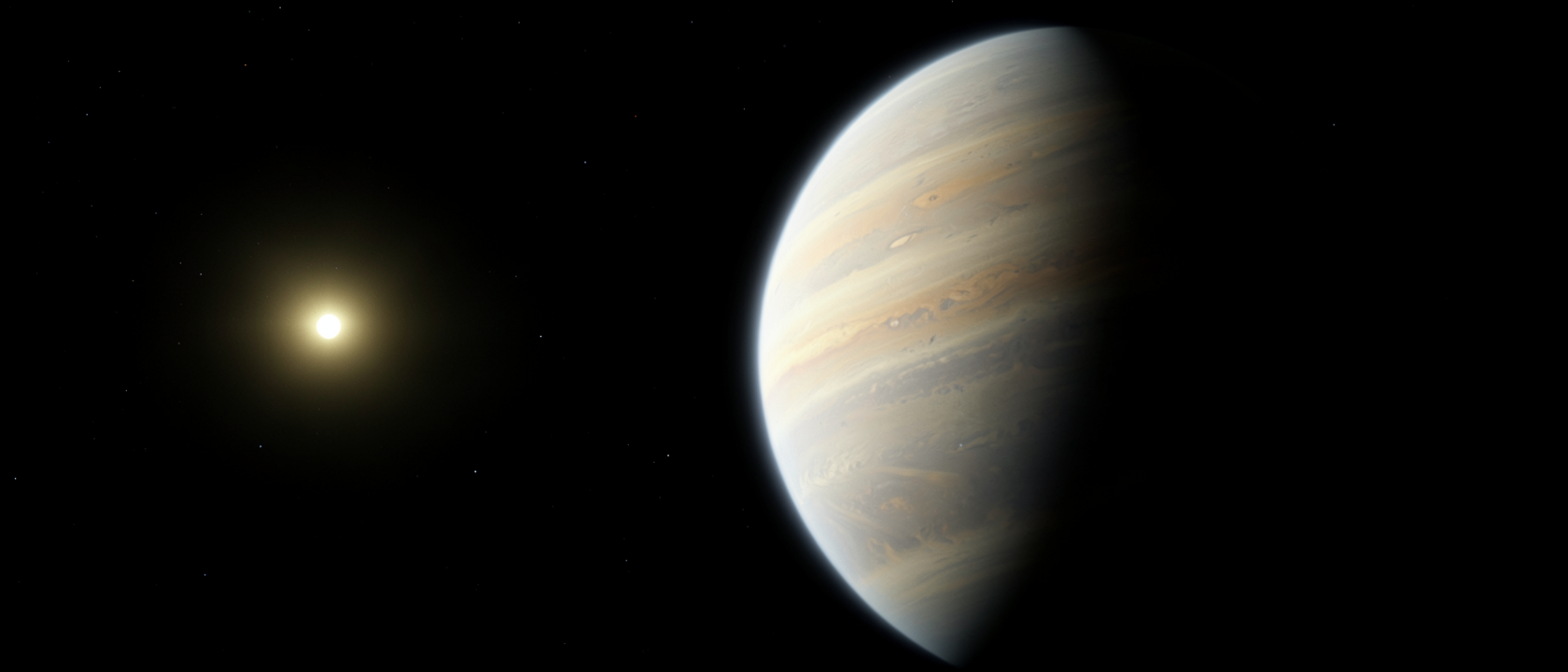
No photograph of TOI-791 c exists, and none is possible with current telescopes, it’s too small, too dim, and too far from its star to resolve as anything but a shadow. The only visual evidence is a light curve, the graph of starlight dipping as the planet crosses the star’s face. NASA has released an illustration of the TOI-791 system, credited to Daniel Rutter; it’s an artist’s interpretation built from that transit data, not a picture of the planet itself.