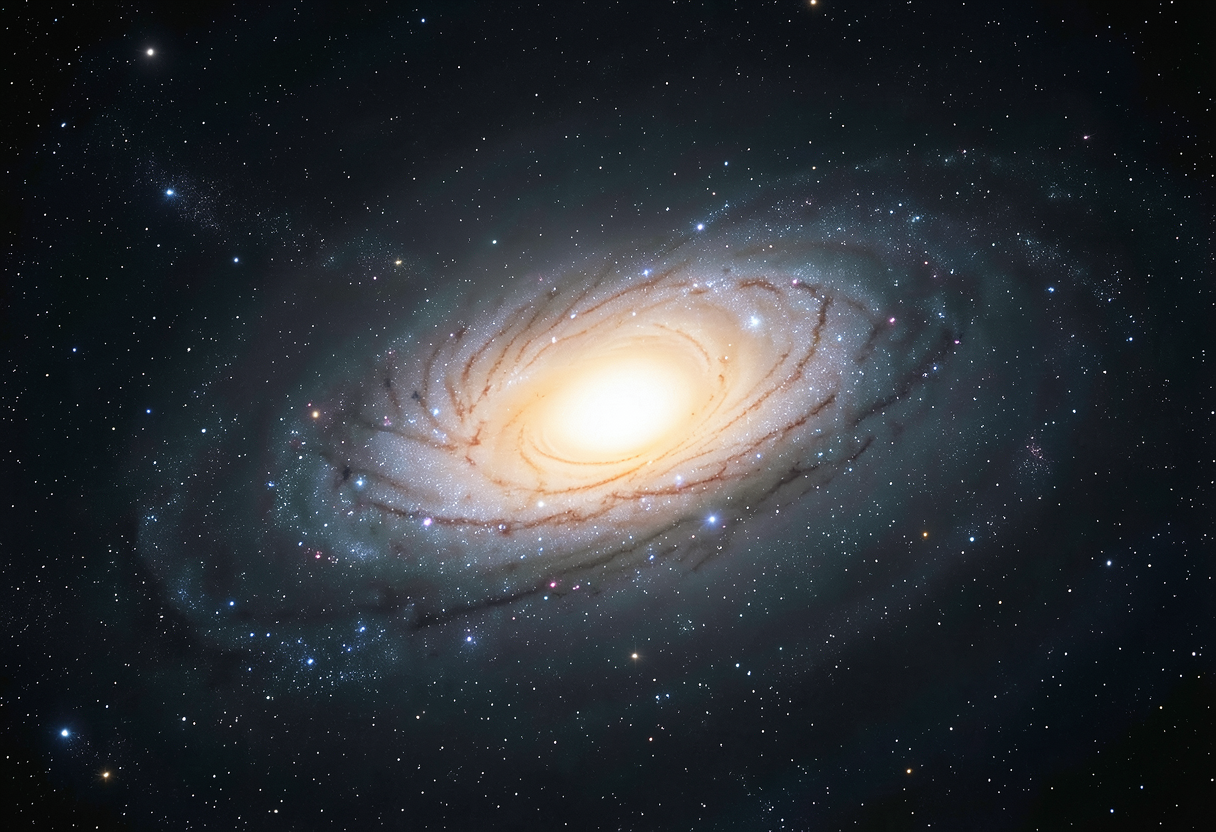
The Andromeda Galaxy is a spiral galaxy approximately 2,499,991.95 light-years from Earth, making it the closest major galaxy to the Milky Way and the largest member of the Local Group — a collection that includes the Triangulum Galaxy and more than forty other smaller galaxies. Its virial mass — roughly one trillion solar masses (2.0 × 10^42 kg) — places it in the same order of magnitude as the Milky Way, making the two galaxies genuine counterparts rather than host and dwarf. It was the first galaxy beyond the Milky Way to be recorded in human writing, a distinction it has held since 964 CE.
Key facts
- Body type: galaxy
- Distance: 2,499,991.95 light-years
Structure and physical characteristics
Andromeda shares the broad architecture of the Milky Way: a central bulge surrounded by a flat disk threaded with stars, gas, and dust, multiple spiral arms, and an extensive halo populated by globular clusters and dwarf satellite galaxies. With a diameter of approximately 220,000 light-years and an estimated one trillion stars, it is significantly wider than the Milky Way. Two Micron All-Sky Survey data revealed that the galaxy’s bulge has a box-like shape, which indicates that Andromeda is a barred spiral galaxy whose bar happens to be oriented almost directly along the line of sight from Earth — so the bar is seen nearly end-on rather than broadside, making it difficult to detect in ordinary images.
Seen from Earth, the galaxy is inclined at about 77 degrees to our line of sight, which gives it a strongly elongated appearance spanning roughly 190 by 60 arcminutes on the sky — an area far larger than the full Moon, though most of that extent is surface brightness too low to detect without a telescope. Only the bright central core is accessible to the naked eye under dark skies.
The galaxy is surrounded by a dark matter halo that accounts for the majority of its total mass. Studies indicate that this halo has a prolate, or elongated, shape rather than the roughly spherical shape often assumed in simpler models. Inside the halo, Andromeda’s disk contains a prominent ring of gas and dust around its centre, thought to have been carved by a collision with its companion satellite galaxy Messier 32 more than 200 million years ago.
The spiral arms themselves are not undisturbed: gravitational interactions with two orbiting companion galaxies — Messier 32 and Messier 110 — actively distort them. Deeper in the halo, the most prominent merger remnant in the entire Local Group is Andromeda’s Giant Stellar Stream, an arc of stars that Andromeda stripped from a neighbouring galaxy it consumed.
The double nucleus and central black hole
Andromeda’s core conceals a striking asymmetry. On July 20, 1993, NASA announced that the Hubble Space Telescope had discovered a double nucleus at the centre of the galaxy, with each of the two brightness peaks containing a few million densely packed stars. The two peaks are separated by only 5 light-years, yet they are quite different in character: the core also contains a ring of old, red stars and a separate disk of young, blue stars.
The true geometric centre of the galaxy sits at the dimmer of the two brightness peaks, where the central supermassive black hole designated M31* resides. Its mass is estimated at approximately 140 million times that of the Sun. The brighter peak is not the centre: it is an eccentric ring of old stars that orbit the black hole in elongated paths, spending more time near their farthest point and so appearing to concentrate there.
Formation and evolutionary history
Andromeda formed roughly 10 billion years ago through the collision and subsequent merger of smaller protogalaxies. That violent origin is thought to have produced most of what is now its galactic halo and extended disk, seeding both with stars that were already old at the time the galaxy assumed its present form.
The galaxy has continued accreting material since. Globular cluster G1 — suspected to be the stripped remnant core of a dwarf galaxy that Andromeda consumed — has twice the mass of Omega Centauri, the Milky Way’s largest globular cluster, and may harbour a central intermediate-mass black hole of about 2×10^4 solar masses.
Discovery and observational history
The earliest known written record of the Andromeda Galaxy comes from the Persian astronomer Abd al-Rahman al-Sufi, who described it as a ‘little cloud’ in his Book of Fixed Stars in 964 CE — more than six centuries before a telescope was trained on the sky. His work stands as the first known written reference to any galaxy other than the Milky Way.
The first documented telescopic observation followed on December 15, 1612, when German astronomer Simon Marius examined the object through his instrument and recorded what he saw. Charles Messier catalogued Andromeda as M31 on August 3, 1764; he credited Marius as the discoverer, apparently without knowledge of al-Sufi’s earlier description.
A turning point in understanding the galaxy’s true scale came in 1953, when observations made with the 200-inch telescope at Palomar Observatory established that two distinct types of Cepheid variable stars exist. That distinction had been conflated in earlier work, and correcting for it showed that the true distance to Andromeda is more than double the figure Edwin Hubble had originally estimated — confirming it as an independent galaxy of comparable stature to the Milky Way.
Future of Andromeda and the Milky Way
Hubble Space Telescope observations published in 2012 predicted a near-head-on collision between Andromeda and the Milky Way approximately 4 billion years from now, with the two galaxies merging into a single elliptical galaxy around 6 billion years from now.
A 2025 study published in Nature Astronomy introduced a substantial revision to that picture. The study found that uncertainties in the present positions, motions, and masses of all Local Group galaxies leave close to a 50% probability that no Milky Way–Andromeda merger will occur within the next 10 billion years. A key factor is the Large Magellanic Cloud, a satellite of the Milky Way whose orbit runs nearly perpendicular to the Milky Way–Andromeda orbit and whose gravitational pull could be sufficient to redirect Andromeda’s trajectory enough to prevent the encounter. Whether the two galaxies ultimately merge, pass by, or fall together on a longer timescale remains an open question.
Did you know
- The Andromeda Galaxy spans an apparent width on the sky roughly six times larger than the full Moon, yet only its bright central core is easily visible to the naked eye because its outer disk is too faint to see without a telescope. (messier-objects.com)
- Globular cluster G1 in Andromeda has twice the mass of the Milky Way’s largest globular cluster, Omega Centauri, and may harbor a central intermediate-mass black hole of about 2×10^4 solar masses; it is also suspected to be the stripped remnant core of a dwarf galaxy consumed by M31. (messier-objects.com)
- Although Andromeda appears to have two nucleus brightness peaks separated by only 5 light-years, the true geometric center of the galaxy lies at the dimmer of the two peaks — the brighter peak is an eccentric ring of old stars orbiting the central supermassive black hole. (sci.esa.int)
- The Persian astronomer Abd al-Rahman al-Sufi described the Andromeda Galaxy as “al-latka al-bayda” (“the little cloud”) in his Book of Fixed Stars in 964 CE — making it the first galaxy beyond the Milky Way to be recorded in human writing, more than six centuries before the invention of the telescope. (arxiv.org)
- A 2025 Nature Astronomy study found that the gravitational influence of the Large Magellanic Cloud — a satellite of the Milky Way — runs nearly perpendicular to the Milky Way–Andromeda orbit and could be sufficient to prevent the two galaxies from ever merging, giving roughly 50-50 odds for a collision within the next 10 billion years. (nature.com)
Data sources
- esahubble.org
- ebsco.com
- messier-objects.com
- gktoday.in
- arxiv.org
- sci.esa.int
- universetoday.com
- freestarcharts.com
- stsci.edu
- science.nasa.gov
- nature.com
- space-facts.com
Where it appears
Data updated: 2026-10-31