
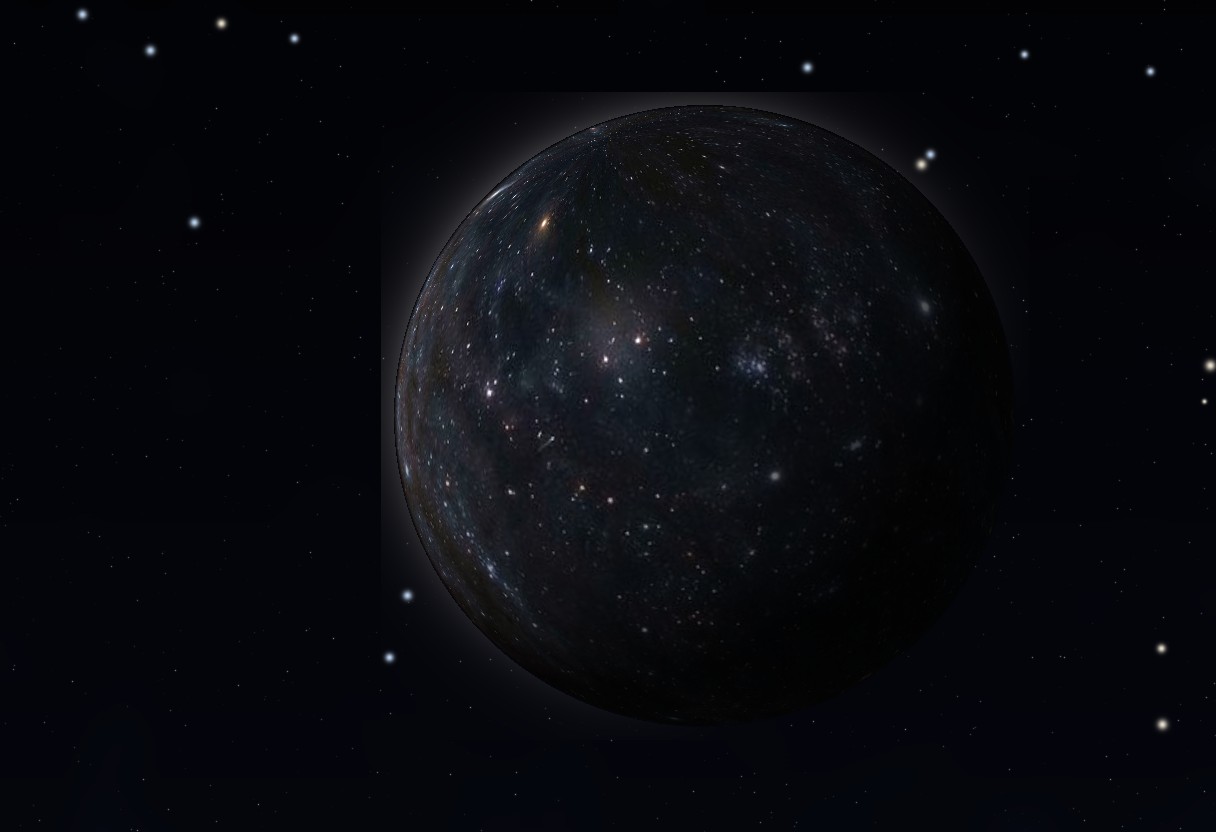
The Milky Way is the barred spiral galaxy that contains the Solar System, and the only galaxy whose individual stars, gas clouds, and structural arms can be studied one object at a time. It holds an estimated up to 400 billion stars arranged in a thin, warped disk with a stellar radius of about 50,000 light-years — a span so large that even light takes tens of thousands of years to cross it. Combined data from NASA’s Hubble Space Telescope and ESA’s Gaia satellite put the galaxy’s total mass, including dark matter, at approximately 1.5 trillion solar masses (1.5 × 10¹² times the mass of the Sun). The Sun sits about 26,000 light-years from the galactic center, in a minor feature called the Orion Arm, nowhere near the middle of anything.
Key facts
- Body type: galaxy
- Distance: 25,999.92 light-years
Structure and shape
The galaxy’s stellar disk has a radius of about 50,000 light-years and a vertical height of only 1,000 light-years. That extreme flatness makes it a markedly flattened structure by any astronomer’s standard.
The disk is not even flat: it curves upward on one side and downward on the other, a warp first detected in the late 1950s through neutral hydrogen radio observations. ESA’s Gaia satellite has since gathered data suggesting this warp is not static but slowly rotating, completing one full turn around the galactic center in 600 to 700 million years. Gaia data further suggest the warp may be driven by an ongoing collision with a smaller galaxy, sending long, slow ripples through the disk.
At the center sits a peanut-shaped bulge measuring about 10,000 light-years across, home to approximately 10 billion stars, most of them old red giants. Images from NASA’s Spitzer Space Telescope show that the Milky Way’s two major spiral arms — Scutum-Centaurus and Perseus — are rooted at the ends of a thick central bar that runs through this bulge. Two other features, the Norma and Sagittarius arms, are now classified as minor arms, filled primarily with gas and pockets of star-forming activity rather than the dense stellar populations of the two major arms.
The Sun occupies the Orion Arm (also called the Orion-Cygnus Arm), a minor arm roughly 10,000 light-years long that lies between the two major arms, at a distance of about 26,000 light-years from the galactic center — consistent with the independently sourced distance figure of 25,999.92 light-years cited by ESA Hubble.
The black hole at the center
Sagittarius A* (Sgr A*) is a supermassive black hole with a mass of approximately 4 million solar masses sitting at the geometric center of the Milky Way. Four million solar masses sounds large, but it amounts to a tiny fraction of the galaxy’s total estimated mass of 1.5 trillion solar masses — the black hole is gravitationally important locally but does not dominate the galaxy’s overall mass budget.
On May 12, 2022, the Event Horizon Telescope Collaboration released the first direct image of Sgr A*, produced by linking eight radio observatories distributed around Earth to form a single Earth-sized virtual telescope. The technique achieved the angular resolution needed to resolve a structure located about 26,000 light-years away.
Age and formation
Research published in Nature Communications in 2022 placed the formation of the Milky Way’s old thick disk at approximately 13 billion years ago, only 0.8 billion years after the Big Bang. That makes the thick disk — the older, vertically puffier component of the galactic disk — nearly as old as the universe.
The star HD 140283, located about 190 light-years from Earth, carries an estimated age of approximately 13.8 billion years, placing it at the very edge of the universe’s own age and making it the oldest known star in the galaxy.
The galaxy’s place in its neighbourhood
The Milky Way is one of the two largest members of the Local Group, a collection of more than 50 galaxies. Its principal companion is the Andromeda Galaxy, the other dominant member. The Local Group’s smaller galaxies are gravitationally bound to one or the other of these two.
The Milky Way’s two largest satellite galaxies, the Large Magellanic Cloud (approximately 160,000 light-years away) and the Small Magellanic Cloud (approximately 200,000 light-years away), are both visible to the naked eye from the Southern Hemisphere. Research from the Harvard-Smithsonian Center for Astrophysics indicates that both Magellanic Clouds are first-time visitors to the Milky Way’s neighbourhood rather than long-term companions.
A 2025 study using gravitational simulations found that including the Large Magellanic Cloud’s gravitational influence actually lowers the probability of an eventual Milky Way–Andromeda merger. The infalling cloud nudges the Milky Way’s trajectory away from Andromeda, while the Triangulum Galaxy’s gravitational pull works in the opposite direction. The outcome of that three-body interplay remains an open question.
Mapping the galaxy
On December 30, 1924, Edwin P. Hubble announced his discovery that the Andromeda spiral nebula is a separate galaxy, proving for the first time that the Milky Way is just one of many galaxies in the universe.
ESA’s Gaia spacecraft, launched in December 2013, spent roughly a decade scanning the sky and accumulated more than three trillion observations of about two billion stars and other objects before completing its sky-scanning phase. The result is the most detailed three-dimensional map of the Milky Way assembled to date, underpinning discoveries about the disk’s warp, the galaxy’s spiral structure, and the ages of its stellar populations.
Dark matter and total mass
The 1.5 trillion solar mass estimate for the Milky Way’s total mass comes from combining Hubble and Gaia data, and it includes the galaxy’s dark matter halo — a roughly spherical component extending far beyond the visible disk. Estimates place roughly 85 to 90 percent of the galaxy’s total mass within the virial radius in the form of dark matter, matter that has never been directly detected but whose gravitational effects on star and gas motions are well established. The visible stars, gas, and dust that make up everything astronomers can observe directly account for only the remaining 10 to 15 percent of that total.
Did you know
- The word “galaxy” derives from the ancient Greek word for milk, “gala,” making “Milky Way Galaxy” essentially a translation of “Milky Way” repeated in two languages. (mo-www.harvard.edu)
- The oldest known star in the Milky Way, HD 140283 — nicknamed the “Methuselah star” — sits only about 190 light-years from Earth, close enough to study in detail, yet carries an estimated age of approximately 13.8 billion years, nearly matching the age of the universe itself. (guinnessworldrecords.com)
- The Milky Way contains up to 400 billion stars, but on the clearest dark night, the naked eye can pick out only about 0.0000025 percent of that total at once. (eartheclipse.com)
- Estimates of the Milky Way’s total mass within its virial radius run between 1 and 1.5 trillion solar masses, and roughly 85 to 90 percent of that figure is dark matter — material that has never been directly detected by any instrument. (geographyebooks.com)
- A 2025 study found that including the gravitational influence of the Large Magellanic Cloud in merger simulations actually reduces the likelihood of a Milky Way–Andromeda collision: the infalling cloud deflects the Milky Way away from Andromeda, while the Triangulum Galaxy’s gravity pulls in the other direction. (nationalgeographic.com)
Data sources
- esahubble.org
- esa.int
- science.nasa.gov
- jpl.nasa.gov
- eventhorizontelescope.org
- ncbi.nlm.nih.gov
- cfa.harvard.edu
Where it appears
Data updated: 2026-10-31