
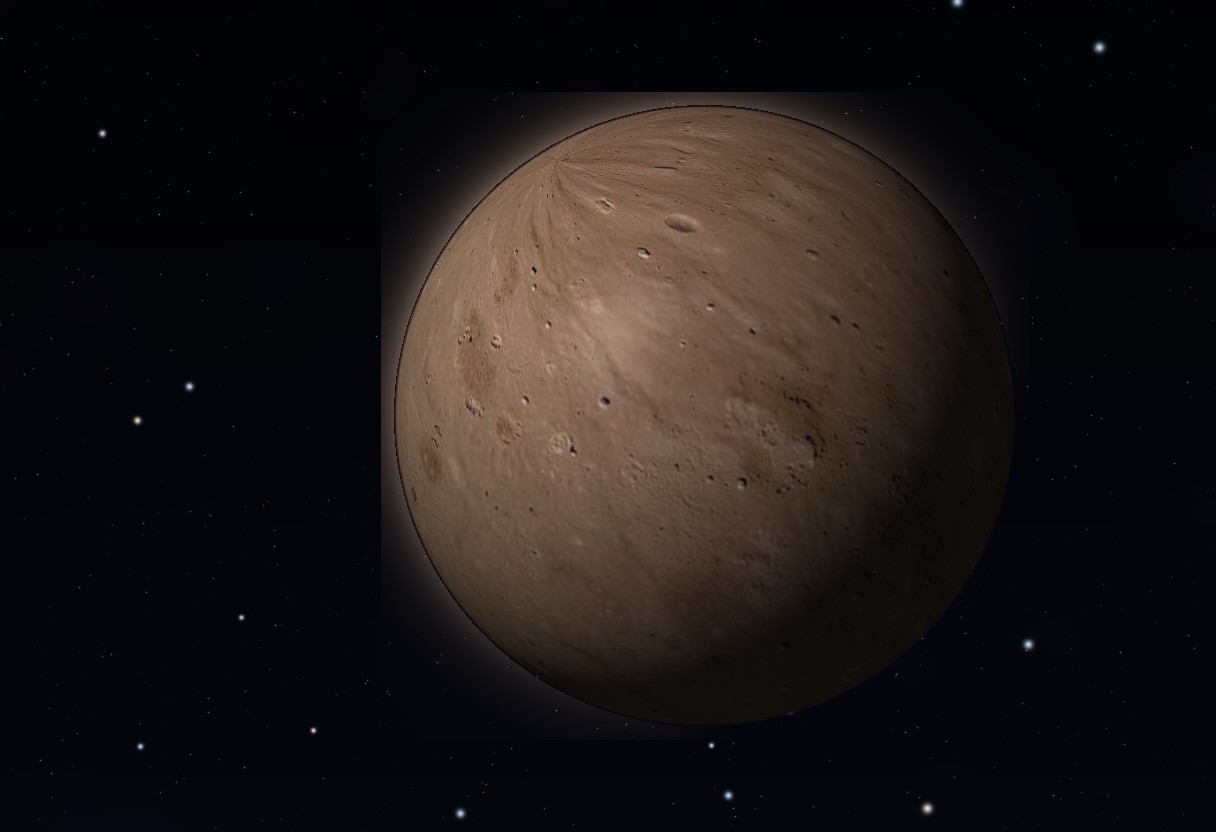
K2-301 c is an exoplanet with a radius 1.2 times that of Earth, completing a full orbit around its host star every 8.5 hours. That orbital period places it firmly in the category of ultra-short-period planets, a class whose extreme proximity to their stars makes them useful test beds for understanding how rocky worlds form and survive under intense tidal and thermal conditions. The planet was identified through the transit method, in which a slight, periodic dimming of the star’s light betrays a crossing body, and was formally announced on October 28, 2021, when it entered the NASA Exoplanet Archive as part of a batch of thirteen newly confirmed planets.
Key facts
- Body type: exoplanet
- Radius: 1.2 Earth radius
- Orbital period: 8.5 h
- Semi-major axis: 1,258,118 km
- Discovered: August 2021
- Discovery method: transit method
Orbital characteristics
K2-301 c orbits its star at a semi-major axis of 1,258,118 km — an extraordinarily compact orbit that keeps the planet in relentless proximity to its host star. At that separation, the planet completes each circuit in just 8.5 hours, a period so short that it would finish more than two full orbits within a single Earth day.
At such close separations, tidal forces from the star can approach the Roche limit — the distance at which those forces would disintegrate the planet. One leading formation model proposes that these planets did not originally sit this close to their stars. Instead, gravitational perturbations from an outer companion planet gradually excite orbital eccentricity, after which tidal dissipation bleeds energy from the orbit, causing it to shrink and circularize into the ultra-short-period configuration over geological timescales.
Physical properties
With a radius of 1.2 Earth radii, K2-301 c is a planet of near-terrestrial scale. Planets in this size range that survive ultra-short-period orbits are thought by researchers to have rocky, dense interiors. A composition denser than water is directly relevant to survival: the Roche limit depends on the ratio of the planet’s mean density to the star’s, so a denser, more compact body can endure tidal forces at orbital distances that would shred a lower-density object. At periods as short as a few hours, a rocky composition appears to be a prerequisite for a planet to remain intact.
Discovery and data history
The data underlying the discovery of K2-301 c were collected during K2 Campaign 3, which ran in 2014–2015. The photometric light curves from that campaign were archived and subsequently mined for planetary signals, but the planet now designated K2-301 c was not formally confirmed until October 28, 2021 — a gap of approximately six to seven years between the collection of the raw data and the public announcement of the planet.
When announced, K2-301 c was added to the NASA Exoplanet Archive under the alternate designations EPIC 206042996 c and EPIC 206042996.01, reflecting the catalog identifier of its host star. The simultaneous confirmation of thirteen planets in that batch illustrates how archival re-analysis and improved vetting pipelines continue to extract discoveries from data sets collected years earlier.
Did you know
- K2 Campaign 3, which produced the photometric data behind the discovery of K2-301 c, observed a patch of sky near Neptune. During those observations, Neptune itself and its moon Nereid were actually captured within the campaign’s field of view. (drewexmachina.com)
- Some ultra-short-period planets orbit so close to their host star that they approach the Roche limit — the distance at which the star’s tidal forces would pull the planet apart. A rocky composition, which is denser than water, raises the effective density ratio and allows such planets to survive at orbital periods as short as a few hours. (arxiv.org)
- The observations that revealed K2-301 c were made during 2014–2015, but the planet was not formally announced until October 28, 2021 — a gap of roughly six to seven years between data collection and confirmed discovery. (exoplanetarchive.ipac.caltech.edu)
Data sources
Data updated: 2026-10-29