
The Planet Whose Entire Year Fits Inside One Transatlantic Flight
One full year on TOI-6662 b takes 7.1 hours, shorter than a long-haul flight from New York to London, and shorter than Earth’s year by a staggering margin: ours runs 365.25 days, or 31,557,600 seconds. Set the two side by side and TOI-6662 b’s year comes out to about 8.05 × 10⁻⁴ of an Earth year, roughly eight hundredths of one percent of ours. Flip the ratio and Earth’s year is about 1,243 times longer. Run three full years on TOI-6662 b back to back, and you still haven’t used up one Earth day.
The measuring stick
The number, logged in NASA’s public exoplanet catalog, is exact: one orbit takes 25,397.291 seconds. Divide by 3,600 and you get about 7.1 hours. That’s the planet’s full year, measured the same way you’d time anything else that keeps a schedule, just compressed into a window shorter than most people’s workday.
How we know
This isn’t modeled from a distance, it’s timed. TOI-6662 b was found in 2026 using the transit method: a telescope watches a star’s brightness over long stretches, and when a planet crosses in front of it from our angle, the light dims by a small, repeating amount. Clock those dips against each other and the orbital period falls straight out of the data. The “TOI” in its name stands for TESS Object of Interest, and the NASA Exoplanet Archive logged TOI-6662 b in 2026 as part of a batch update titled “(More Than) One Thousand TESS Planets!”, one small, regular notch in a brightness record, repeating every 7.1 hours.
Why the bulk numbers mislead you
Here’s where instinct trips. TOI-6662 b’s radius is about 94% of Earth’s. Its mass is about 78% of Earth’s. On a spec sheet, that reads like a slightly smaller sibling of home, similar rock, similar build. None of that touches the orbit. A planet’s size and mass describe what it’s made of, not how close it sits to its star, and TOI-6662 b sits close: its measured orbital distance is 0.00588 astronomical units (an astronomical unit, or AU, is the average Earth-Sun distance, about 93 million miles, or 149.6 million km). That works out to roughly 546,000 miles (879,000 km) from its star, a tiny sliver of the distance separating Earth from the Sun. Pack a planet in that tight, and the clock that sets its year has nothing to do with its size. It’s distance and gravity alone.
What’s still open
The catalog lists TOI-6662 b’s orbital eccentricity at zero, meaning a perfect circle. For a planet orbiting this close to its star, a value that clean is often the simplest fit the available data allows rather than a precisely measured shape, so treat it as the current best read, not a closed case. Whether the planet always shows the same face to its star, tidally locked, the way the Moon faces Earth, hasn’t been determined. The spectral type of the host star itself is listed as blank in the catalog, an open field rather than a filled one. And the equilibrium temperature on record, about 1,545°F (840°C; 1,114 K), is a modeled estimate built from the star’s output and an assumed reflectivity, not a thermometer reading. It could shift once more data comes in.
The picture that isn’t a photograph
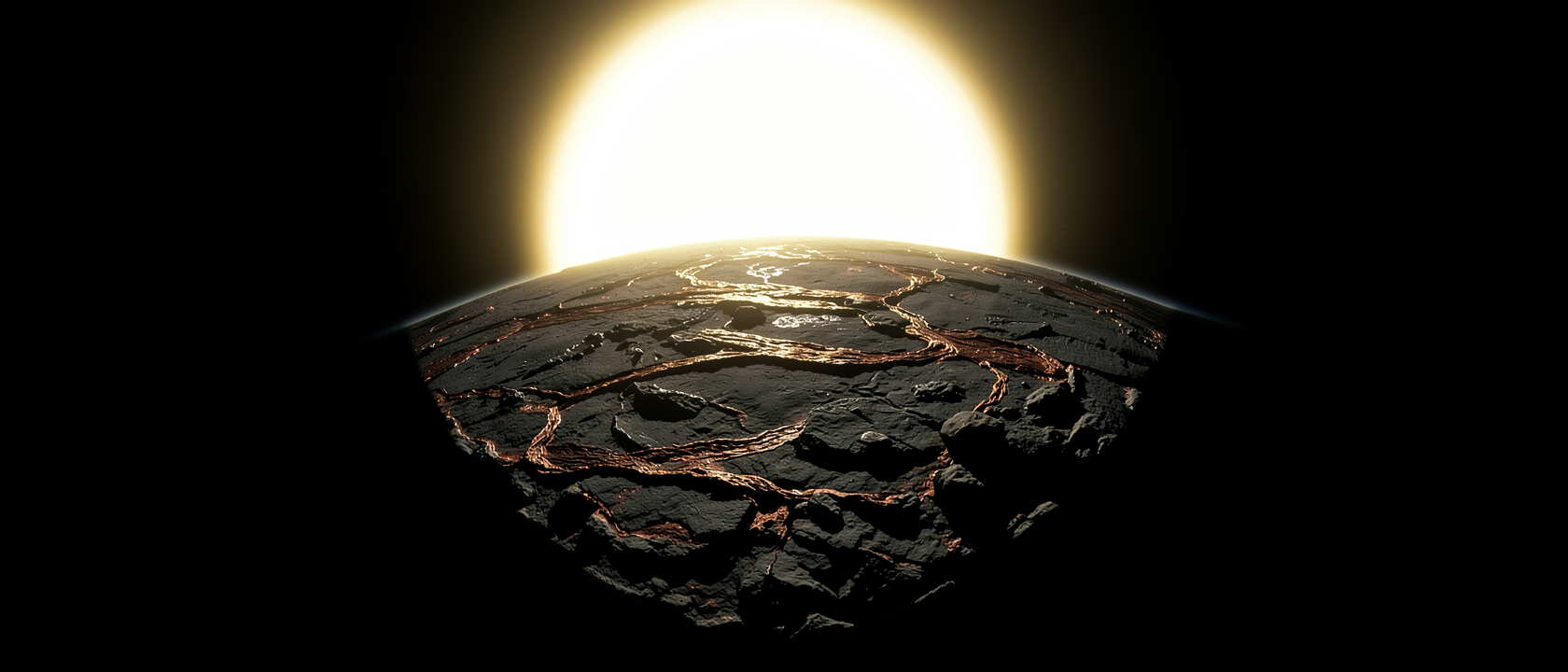
No telescope now or on the horizon can photograph TOI-6662 b directly, it’s too small, too close to its star, and too far from Earth for that kind of imaging. Any illustration showing a sunbaked world pressed close to its star is an artist’s concept, built from the measured numbers above, not a camera frame. The real data picture is plainer, and in its way stranger: a flat line of starlight with one small notch cut into it, repeating every 7.1 hours for as long as the telescope kept watching. That notch is the entire photograph anyone has of this world’s year.