A Planet Light Enough to Float
Line up nine Earths edge to edge and you’d just about match the width of Kepler-51 d. Add up everything the planet is made of, though, and it comes to only about 7.6 Earths’ worth of mass, mass, not weight; you can’t exactly put a planet on a bathroom scale. Spread that little material across a sphere that wide and the bulk density works out to roughly 46 kilograms per cubic meter (0.046 grams per cubic centimeter). Earth’s own bulk density averages about 5,514 kilograms per cubic meter, crust to core. Kepler-51 d comes in at around 1% of that, roughly a hundredth as dense as the ground under your feet.
The Measuring Stick
The planet’s radius is 9.7 times Earth’s, about 38,460 miles (61,900 km) from the center out to the cloud tops, against a mass of roughly 4.54 × 10^25 kilograms. Divide mass by volume and you land on that 46 kg/m³ figure. Set beside Earth’s 5,514 kg/m³, Kepler-51 d is about 0.008 to 0.01 times as dense, call it a hundredth. For a sense of where that sits on a more familiar scale, water runs about 1,000 kg/m³, so the planet is roughly 4.6% as dense as water, and sea-level air is about 1.2 kg/m³, meaning Kepler-51 d is still some 40 times denser than the air you’re breathing. Thin for a planet, nowhere close to as thin as a gas, but next to Earth, it barely registers. One comparison is missing on purpose: the “lighter than styrofoam” line that follows this planet around online. Styrofoam’s density depends entirely on the type and how it’s made, and no single figure for it holds up to scrutiny, so this piece sticks with water, air, and Earth, the numbers that are actually fixed.
How We Know
NASA’s Kepler space telescope found Kepler-51 d in 2014 by watching its host star dim by a sliver every time the planet crossed in front of it, a method called transit photometry, which measures how much starlight a passing planet blocks. That dimming is what gives you the radius. The mass came from an entirely different measurement: astronomers tracked how Kepler-51 d’s gravity tugs on its neighboring planets, nudging their transit times earlier or later by minutes, a technique called transit-timing variation. Two independent measurements, multiplied together, give you one density. The planet orbits every 130.2 days, about 1.125 × 10^7 seconds. It sits just 0.509 AU from its star, an astronomical unit being the average Earth-Sun distance, roughly 93 million miles (150 million km), which works out to about 47.3 million miles (76.2 million km), or roughly half of Earth’s distance from the Sun.
An Estimate, Not a Weigh-In
Nobody has scooped up a sample of Kepler-51 d. That 46 kg/m³ number, and the roughly 1% figure measured against Earth, are calculated, not measured directly: radius and mass each carry their own margin of error, and density is just one divided by the other. Published figures for this planet actually range from about 0.038 to 0.05 grams per cubic centimeter, depending on whose numbers you use, Masuda’s original 2014 study versus a 2020 reanalysis by Jessica Libby-Roberts and colleagues using Hubble Space Telescope data. Nudge either input in a future catalog update and both the raw density and the Earth comparison shift with it. Call 46 kg/m³, and the roughly 1-percent-of-Earth figure, the best current answer, not a fixed constant.
What’s Still Open
Nobody knows for certain what Kepler-51 d is made of. The leading idea is a small rocky core wrapped in a thick envelope of hydrogen and helium gas, puffed up by heat from a young star, Kepler-51 is only about 500 million years old. In June 2023, a Penn State and Osaka University team pointed the James Webb Space Telescope at the planet to look for that gas envelope’s chemistry, and nearly missed their transit window when the planet crossed its star two hours earlier than the models predicted. What they found was a haze thick enough to obscure the planet’s composition, and with it, any clear read on how it formed. Whether the planet’s atmosphere will hold up against its active host star’s stellar wind over the long run is also unresolved. Even the system’s distance from Earth isn’t fully settled: one source puts it at 2,615 light-years, another at roughly 2,557 light-years, the gap hasn’t been resolved yet, so treat either figure as provisional.
The Picture
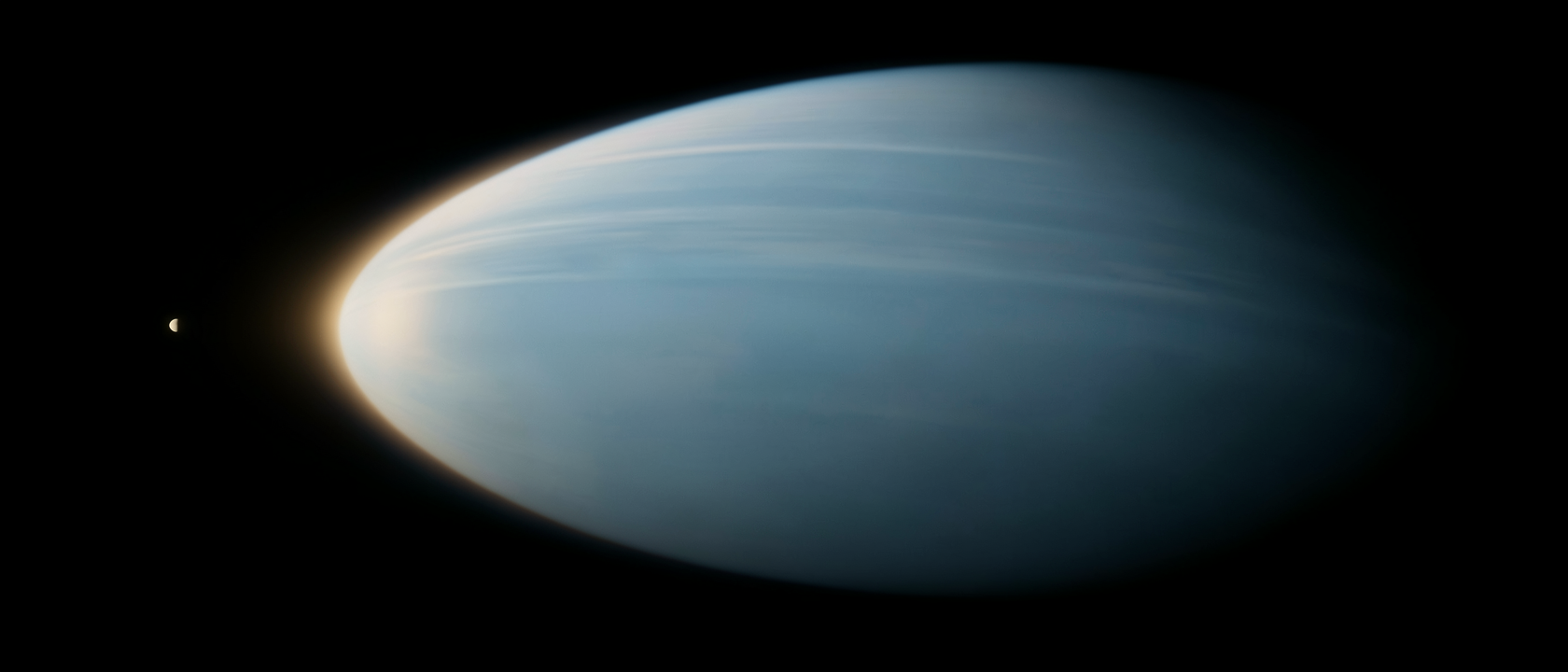
There’s no photograph of Kepler-51 d, and no current telescope could take one, the planet is too small, too dim, and too close to its star’s glare to resolve as a disk. What exists is a light curve: a graph of starlight dimming by a fraction of a percent, then brightening again, as the planet crosses its star. Illustrations of the Kepler-51 system also exist, three oversized, hazy planets circling close to their star, credited to NASA, ESA, and visualization artists L. Hustak, J. Olmsted, D. Player and F. Summers at the Space Telescope Science Institute. They’re built from the measured sizes and orbits, not from anything a camera has captured, and they’re only honest if you remember that.