
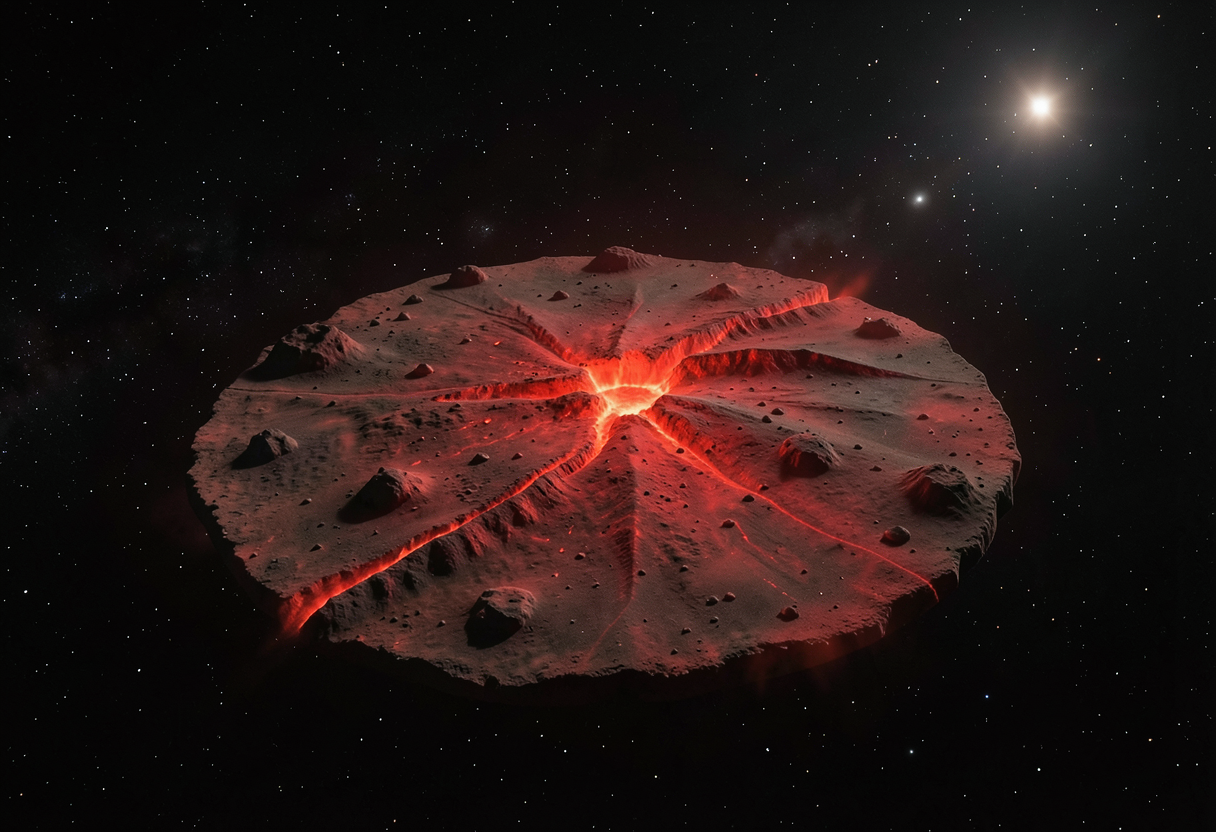
With a radius of 5,995 km (0.94 times Earth’s) and an estimated mass of 0.779 Earth masses, it sits in the sub-Earth category: rocky in character, and roasted to an equilibrium temperature of 1,114 K (840 °C) — well above the melting point of basalt. Validated in 2026 using data from NASA’s TESS spacecraft, it was one of roughly 70 planets whose confirmation pushed TESS past the 1,000-confirmed-planet mark, and it carries the highest Emission Spectroscopy Metric of any newly validated terrestrial planet in the study that announced it, placing it at the front of the line for observation by the James Webb Space Telescope.
Key facts
- Mass: 0.779 Earth masses (0.78× Earth)
- Body type: exoplanet
- Host star: TOI-6662
- Radius: 5,995 km (0.94× Earth)
- Density: 5,150 kg/m³ (0.93× Earth)
- Temperature: 1,114 K (840 °C)
- Orbital period: 7.1 h
- Orbital eccentricity: 0
- Distance: 69.09 light-years
- Insolation: 494,637 W/m²
- Discovered: 2026
- Discovery method: Transit
Physical characteristics
TOI-6662 b has a radius of 5,995 km, which is 0.94 times Earth’s radius. Its estimated mass of 0.779 Earth masses was derived not from a direct radial-velocity measurement but from the Chen and Kipping mass-radius relation, a statistical technique that maps radius onto probable mass for planets of similar bulk. That distinction matters: the mass figure is a model-based estimate, not a dynamically measured quantity, and future radial-velocity campaigns could refine or revise it.
The planet’s bulk density works out to approximately 5,150 kg/m³ — 0.93 times Earth’s mean density. That figure is consistent with a rocky, iron-bearing interior similar in composition to Earth or Venus, and rules out a large fraction of volatile ices or a substantial hydrogen envelope. A density that close to Earth’s, combined with a radius below 1.7 Earth radii, places TOI-6662 b firmly in the category of worlds expected to be primarily silicate and metal rather than water-rich or gas-dominated.
The equilibrium temperature of 1,114 K (840 °C) puts the dayside of TOI-6662 b into what researchers call the lava world regime — a temperature range at which silicate rock on the surface melts and, under some models, could form a magma ocean. Whether such a magma ocean actually exists depends on the planet’s rotation state, internal heat flow, and whether any atmospheric blanketing modifies the heat distribution; none of those quantities have been measured directly for this planet as of 2026.
Orbit and host star
TOI-6662 b orbits at a separation of 0.0058760760718937 AU from its host star. Mercury, the innermost planet of the Solar System, orbits much farther from the Sun, so TOI-6662 b sits dramatically closer to its star than Mercury does to ours. 2026 validation catalog, which ranges up to 47.0 days at its longest end.
The orbit is circular: the eccentricity is fixed at zero. At such a small orbital separation, tidal forces between the planet and its star are extreme, and theory predicts that any initial eccentricity would have been damped away on a timescale short compared with the system’s age. The circular orbit is therefore expected rather than surprising, and it is consistent with observations of other ultra-short-period planets.
The host star, TOI-6662, is an M dwarf with an effective surface temperature of 3,359 K. The Sun’s surface temperature is 5,778 K, so TOI-6662 is substantially cooler. M dwarfs emit most of their radiation in the near-infrared rather than in visible light, which has implications for the planet’s atmospheric chemistry and for the design of follow-up observations. Despite being a substantially cooler and smaller star than the Sun, TOI-6662 heats its planet to 1,114 K purely through proximity: the insolation received by TOI-6662 b reaches 494,637 W/m².
Discovery and validation
TOI-6662 b was identified through the transit method, in which the planet’s passage across the face of its host star produces a periodic dip in the recorded brightness of the star. NASA’s TESS spacecraft measured those brightness dips in its photometric light curve of TOI-6662, flagging the signal as a planet candidate. Producing a validated planet from a candidate requires ruling out false positives — scenarios in which eclipsing binary stars, background stars, or instrumental artefacts mimic a planetary transit signal.
The statistical validation was carried out in a 2026 study by Michael Collier, Steven Giacalone, and co-authors (arXiv:2608.21560). The team built an automated pipeline using TRICERATOPS, a Bayesian tool that computes the false-positive probability (FPP) for TESS planet candidates by weighing the likelihood of a genuine planet against a range of astrophysical imposters. The pipeline was applied to 443 TESS planet candidates; 80 passed the validation threshold, of which 64 were newly validated planets. Planet radii for the study were derived from Markov chain Monte Carlo fits to the TESS light curves, with stellar parameters drawn from version 8.2 of the TESS Input Catalog.
The validation threshold used in the Collier et al. 2026 study requires the FPP to fall below 0.015 — that is, a less than 1.5% chance that the signal is not a real planet. TOI-6662 b’s FPP when using all available data sits below that threshold, confirming it as a planet. Without high-resolution imaging from the Gemini South Zorro speckle instrument, however, the FPP for TOI-6662 b would rise to 0.026, exceeding the threshold and leaving the planet unvalidated. That single observing session at Gemini South — conducted on February 16, 2025 — supplied the contrast curve needed to exclude nearby contaminating stars and push the FPP into the valid range. 2026 study found that, across all planets below 1.7 Earth radii in the catalog, high-resolution imaging was required for validation 100% of the time, compared with 33% for planets larger than 4 Earth radii.
Significance for TESS and the exoplanet census
TOI-6662 b was part of a batch of approximately 70 planets added to the NASA Exoplanet Archive during the week of October 8, 2026 — the batch that carried TESS’s confirmed-planet total past the 1,000-planet milestone. The same batch brought the total confirmed planet count across all missions in the archive to 6,445. As of October 2026, approximately 4,823 TESS planet candidates remained in the ExoFOP database awaiting confirmation, indicating the pipeline of future TESS discoveries remains large.
2026 batch is notable for demonstrating how dependent small-planet validation has become on high-resolution imaging. Across the 64 newly validated planets in the study, 72% would have failed the validation threshold if speckle imaging data had not been available. Facilities such as the Gemini South Zorro instrument are therefore a structural requirement for translating TESS candidate lists into confirmed planets, particularly for sub-Earth-sized worlds.
Prospects for atmospheric characterisation
TOI-6662 b has an Emission Spectroscopy Metric (ESM) of 12.0, the highest among all newly validated terrestrial emission candidates in the Collier et al. 2026 study. The ESM quantifies how well a planet’s thermal emission can be detected in secondary eclipse — when the planet passes behind its star — relative to the noise in the measurement. The threshold for a rocky world to be considered a priority JWST target, as defined by Kempton et al. 2018, is an ESM of 7.5; TOI-6662 b exceeds that benchmark. The planet also has a Transmission Spectroscopy Metric (TSM) of 27.9, and on the combined strength of both metrics it was placed on the JWST follow-up candidate list in the Collier et al. 2026 study.
What a JWST observation might find remains an open question. For ultra-short-period rocky planets orbiting M dwarfs, the most developed theoretical scenario holds that any primordial hydrogen and helium envelope would have been stripped away by the intense stellar irradiation, leaving either a bare rock or a possible secondary atmosphere dominated by carbon dioxide and carbon monoxide. As of 2026, no definitive atmospheric detection had been confirmed for any planet of this class. TOI-6662 b’s high ESM makes it one of the more practical targets for testing whether such secondary atmospheres survive, but what the James Webb Space Telescope will measure — if it observes the planet — cannot be predicted from the validated data alone.
Did you know
- TOI-6662 b has the highest Emission Spectroscopy Metric (ESM = 12.0) of any newly validated terrestrial planet in the 2026 Collier et al. study, making it one of the best small rocky planets known for thermal emission characterization with JWST. (arxiv.org)
- The host star TOI-6662 is an M dwarf with an effective temperature of only 3,359 K, meaning it glows primarily in infrared light and is far cooler than the Sun’s 5,778 K surface temperature, yet its extreme proximity still heats TOI-6662 b to 1,114 K. (arxiv.org)
- Without a single night of telescope time at the Gemini South Zorro instrument on February 16, 2025, TOI-6662 b’s false-positive probability of 0.026 would have exceeded the 0.015 validation threshold, meaning the planet’s entire confirmed status rests on data collected in one observing session. (arxiv.org)
- The 72% of validated small planets in the Collier et al. 2026 study that would have failed validation without high-resolution imaging illustrates just how dependent the entire catalog — including TOI-6662 b — is on speckle imaging facilities like Gemini Zorro; without these telescopes, the majority of the 64 newly validated planets would not have been confirmed. (arxiv.org)
Data sources
- NASA Exoplanet Archive
- science.nasa.gov
- arxiv.org
- exoplanetarchive.ipac.caltech.edu
- astrobiology.com
Where it appears
- A Year on Exoplanet TOI-6662 b Lasts Just 7.1 Hours October 28, 2026
Data updated: 2026-10-26