
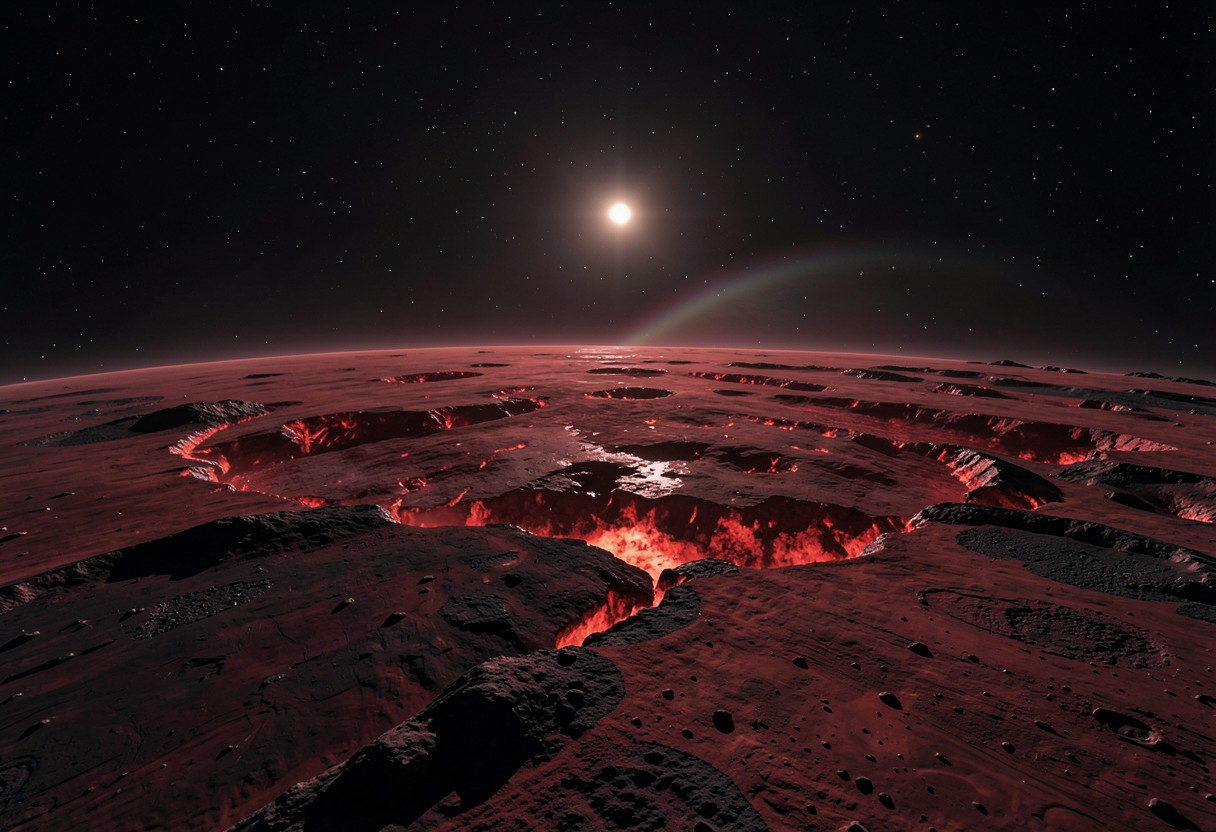
Its orbital period of just 6.7 hours places it so close to its host star that the measured dayside temperature reaches 2,049 K (+362/−359 K), sustaining a thin atmosphere made of rock vapor. Discovered in 2018 via the transit method and confirmed with radial-velocity follow-up, it sits in a class of worlds — sometimes called lava planets — that have no counterpart anywhere in the Solar System.
Key facts
- Mass: 4.97 Earth masses (4.97× Earth)
- Body type: exoplanet
- Host star: K2-141
- Radius: 9,631 km (1.51× Earth)
- Density: 7,930 kg/m³ (1.44× Earth)
- Temperature: 2,103 K (1,830 °C)
- Orbital period: 6.7 h
- Semi-major axis: 1,117,496 km
- Orbital eccentricity: 0
- Distance: 201.8 light-years
- Insolation: 4,436,860 W/m²
- Discovered: 2018
- Discovery method: Transit
Physical characteristics
K2-141 b has a radius of 9,631 km — about 1.51 times Earth’s radius — placing it firmly in the super-Earth category rather than among the gas-dominated mini-Neptunes. Its mass is 4.97 Earth masses and its mean density is 7,930 kg/m³, which is 1.44 times Earth’s mean density. That combination of size and density points toward a substantial iron interior: compositional models place the iron core at between 30 % and 50 % of the planet’s total mass, with a hard upper limit near 70 %. The 2026 Meier et al. interior model used a core radius of 5,359 km and a mantle depth of 4,450 km to simulate interior dynamics.
The equilibrium temperature listed in the NASA Exoplanet Archive is 2,103 K (1,830 °C), and a Spitzer phase-curve analysis by Zieba et al. (2022) measured a dayside brightness temperature of 2,049 K (+362/−359 K). The nightside brightness temperature in that same analysis was consistent with zero — below 1,712 K at 2-sigma — confirming that heat is not being redistributed around the planet by a thick atmosphere. Insolation at the planet’s orbital distance is measured at 4,436,860 W/m².
Orbit and tidal locking
K2-141 b orbits its host star K2-141 at a semi-major axis of only 1,117,496 km. The orbital eccentricity is measured at zero, meaning the orbit is circular to the precision of current data. At that distance, one orbit takes just 6.7 hours.
The planet is tidally locked to K2-141: one hemisphere faces the star permanently and experiences continuous daylight, while the opposite hemisphere sits in permanent night. Approximately two-thirds of the total surface area falls within the dayside. Interior models by Meier et al. (2026) applied a dayside surface temperature boundary condition of 3,000 K and a nightside boundary condition of 50 K, simulating the extreme thermal contrast that drives interior dynamics.
Surface and atmosphere
Computer simulations published on November 3, 2020 by a team from McGill University, York University, and the Indian Institute of Science Education predicted a magma ocean roughly 100 km deep on the dayside. At these temperatures, silicate material evaporates directly from the melt surface, producing a thin rock-vapor atmosphere composed primarily of sodium, silicon monoxide (SiO), and silicon dioxide (SiO₂). This makes K2-141 b unusual even among rocky planets: its surface, its ocean, and its atmosphere are all the same substance — rock — in three different phases.
Predicted supersonic winds exceed 5,000 km/h (about 3,100 mph) and carry rock vapor from the dayside to the frigid nightside, where it cools and falls as rock rain. On the nightside, if the atmosphere carries high sodium content, solid sodium is expected to flow back toward the dayside magma ocean in a process that models compare to the slow movement of glaciers on Earth. This planetary-scale rock cycle is structurally analogous to Earth’s water cycle, with evaporation, atmospheric transport, and precipitation — except that water plays no role at any step.
Partial crystallization near the edges of the magma ocean is predicted to produce compositional gradients in the melt. Near the boundary between the melt and the solid interior, the melt is expected to become saturated in water, which could lead to water exsolution at the day-night terminator. The SonicVapour modeling study found that for surface temperatures above 2,700 K the outgassed rock vapor becomes optically thick, which suppresses convection and makes the atmosphere difficult to detect via emission spectroscopy. Counterintuitively, the same study found that cooler lava planets with surfaces between 2,300 K and 2,700 K produce more distinct spectral features and are easier to characterize.
Interior dynamics and tectonics
The 2026 study by Meier et al. modeled mantle convection inside K2-141 b using the confirmed interior dimensions and extreme thermal boundary conditions. When the models include plastic yielding — a process in which the lithosphere weakens under stress — convection becomes markedly asymmetric: downwellings form preferentially on the nightside and upwellings rise on the dayside. Without plastic yielding, the models instead show a degree-2 convection pattern. In both cases, crustal material is recycled by downwellings concentrated near the day-night terminators, a geometry described as asymmetric, single-lid tectonics with no analog among Solar System bodies.
Three parameters were identified as key controls on interior behavior: radiogenic heating from the decay of uranium and thorium in the mantle, basal heating from heat transferred out of the iron core into the overlying mantle, and melt intrusion — the fraction of molten rock that erupts at the surface to form volcanoes rather than remaining underground. The interplay of these three factors determines whether nightside volcanism is sustained and at what rate.
Discovery and confirmation
K2-141 b was discovered in 2018 using the transit method: its host star dims slightly each time the planet passes in front of it as seen from Earth. The planet’s existence and mass were then confirmed through radial-velocity measurements with the HARPS-N spectrograph, supplemented by MuSCAT multi-band photometric imaging and high-resolution speckle observations from the NESSI instrument. The host star K2-141 sits at galactic coordinates of 80.19878° galactic longitude and −56.5953° galactic latitude, placing it well below the Milky Way’s disk plane.
Ongoing and planned observations
The James Webb Space Telescope (JWST) is well positioned to search for silicon monoxide (SiO) in the planet’s atmosphere, which would constitute strong observational evidence for an atmosphere composed of evaporated rock rather than conventional gases. As of 2026, JWST observations have placed K2-141 b within a group of highly irradiated rocky worlds — alongside HD 3167 b, 55 Cancri e, and TOI-561 b — where measured dayside temperatures fall below the maximum predicted for a bare, dark rock with no atmosphere. That deficit may indicate the presence of an atmosphere or elevated surface reflectivity, though neither explanation is yet confirmed.
A 2025 study by Boukaré et al., published in Nature Astronomy (Volume 9, pages 1511–1522, DOI: 10.1038/s41550-025-02617-4, online July 29, 2025), proposed two observable end-member stages for lava planets including K2-141 b: a hot, chemically homogeneous global magma ocean stage, and a cold, chemically differentiated solid-state stage. The study argued that JWST spectroscopic observations could in principle distinguish between these two states. On May 7, 2026, the SETI Institute hosted a public event titled ‘SETI Live: Lava Worlds and Nightside Volcanoes on K2-141 b,’ featuring planetary scientist Claire Marie Guimond of ETH Zurich, focused on mantle convection modeling, tidal locking, and nightside volcanism at K2-141 b.
Did you know
- Unlike Earth — where the surface is rock, the ocean is water, and the atmosphere is gas — on K2-141 b all three layers are the same substance: rock, in the specific form of sodium, silicon monoxide, and silicon dioxide at different temperatures and pressures. (earthsky.org)
- K2-141 b runs a rock cycle that mirrors Earth’s water cycle step for step: rock evaporates on the 3,000 °C dayside, supersonic winds blowing at more than 5,000 km/h carry the vapor to the nightside, and it falls as rock rain — with no water involved at any stage. (sci.news)
- Lava worlds like K2-141 b have no equivalent anywhere in the Solar System. Even Mercury, the closest planet to the Sun, does not orbit closely enough to have magma oceans covering its surface. (earthsky.org)
- On K2-141 b the distinction between surface, ocean, and atmosphere is purely a matter of temperature: all three consist of the same rocky material — sodium, silicon monoxide, and silicon dioxide — rather than the three entirely different substances that occupy those roles on Earth. (earthsky.org)
- The rock cycle on K2-141 b is a direct structural analog to Earth’s water cycle: evaporation on the 3,000 °C dayside, atmospheric transport by supersonic 5,000 km/h winds, and precipitation as rock rain on the nightside — none of it involving a molecule of water. (sci.news)
- The dayside of K2-141 b sits at roughly 3,000 degrees Celsius and is covered in a lava ocean, yet the nightside boundary condition used in the 2026 Meier et al. interior models is just 50 K — illustrating the most extreme day-night temperature contrast of any known rocky planet. (arxiv.org)
Data sources
- NASA Exoplanet Archive
- arxiv.org
- iopscience.iop.org
- sci.news
- earthsky.org
- space.com
- science.nasa.gov
- astrobiology.com
- nature.com
- seti.org
- ar5iv.labs.arxiv.org
- exoplanetarchive.ipac.caltech.edu
Where it appears
- K2-141 b finishes a full year in just 6.7 hours October 27, 2026
Data updated: 2026-10-26