
The Rock That Passed Five Moons Away
On October 16, 2026, at 07:16 UTC, a small asteroid called 2026 TB2 reached its closest point to Earth, 4.95 lunar distances out, almost five times farther than the Moon. “Miss distance” is the term that matters: it tells you how far the object got, not how close it came to actually hitting anything.
Measured in Moons, Not Kilometers
At closest approach, 2026 TB2 was about 1,183,000 miles (1,903,900 km) from Earth, or 0.01273 astronomical units. An astronomical unit (AU) is the average Earth-Sun distance, 149,597,870.7 km, useful for comparing planets, not much help for picturing a rock a few dozen meters wide. So reach for a smaller ruler: the Moon, orbiting an average of 238,855 miles (384,400 km) from Earth. Divide the asteroid’s distance by that figure and you land on 4.95. 2026 TB2 passed just shy of five times farther out than the Moon, close enough to count as a genuine close approach, far enough that no one tracking it ever called it dangerous.
Both the AU figure and the lunar-distance figure measure distance, not speed. The number 4.95 says only how far the rock got from Earth, nothing about how fast it was moving to get there, and how fast it actually was moving is a figure this piece can’t state with confidence, so it’s left out rather than guessed at.
How We Know, to the Minute
This number didn’t come from a camera catching 2026 TB2 mid-flight. It came from orbit determination: repeated position measurements run through the same orbital mechanics used to track any object in the solar system, refined until the time and distance of closest approach can be stated to the minute and to several decimal places of an AU. That result is logged in NASA’s Jet Propulsion Laboratory Center for Near-Earth Object Studies (CNEOS) close-approach data system, the standard public record for events like this one. The precision is real, and it describes the asteroid’s path with confidence. It says almost nothing about the asteroid itself.
How Big? Nobody Has Actually Measured It
No radar dish has pinged 2026 TB2, and no telescope has resolved it into more than a point of light. What has been recorded is its absolute magnitude, a measure of intrinsic brightness, at roughly H=25.2. Brightness alone can’t give you a size; you also need to guess how much sunlight the surface reflects, a property called albedo. Assume a bright, rocky surface, albedo 0.25, and the diameter works out to around 79 feet (24 m). Assume a dark, carbon-rich one, albedo 0.05, and it grows to about 177 feet (54 m), more than double, from identical brightness. That’s a diameter estimate, not a measurement, and it rests on an assumption about the surface, not a reading of it.
What’s Still Open
How fast 2026 TB2 was moving relative to Earth isn’t settled in the public record this piece could draw on, so it stays out of the story rather than get guessed at. Who first spotted the asteroid, and exactly when, also isn’t confirmed here. Its composition is unknown entirely, which is exactly why the size estimate above leans on an assumed albedo instead of a measured one. None of that is unusual. Most near-Earth asteroids this size exist, for the rest of us, only as a row of numbers in a catalog.
Not the First of Its Kind, and No Photograph Exists
2026 TB2 isn’t a rare case. A similarly sized object, 2022 TM2, with the same absolute magnitude and the same 24-to-53-meter diameter range, passed Earth in 2022, and it came inside a single lunar distance, closer than 2026 TB2 did. One data point doesn’t make a rule, but it’s a useful reminder that rocks this size turning up as close-approach events happens routinely. They’re just rarely bright enough to photograph.
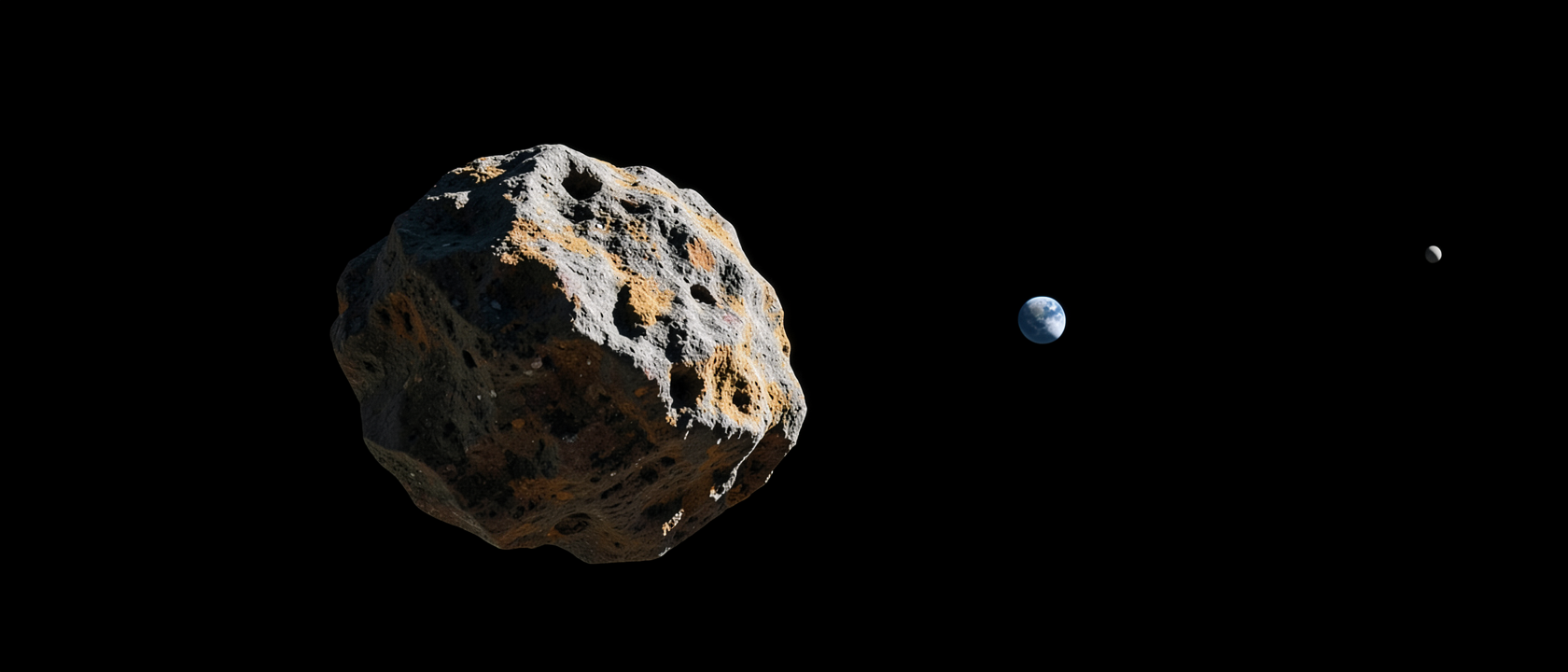
There is no picture of 2026 TB2, not a blurry one, not a pixel smear. It was never bright enough, or visible for long enough, for any telescope to resolve more than a point of light drifting against the stars. What exists instead are orbit-diagram renderings: computer visualizations plotting the calculated path past Earth and the Moon, built from the same tracking data behind every number above. If an image of 2026 TB2 turns up anywhere, that’s what it is, a diagram of the math, not a photograph of the rock. That distinction is the difference between an ordinary asteroid pass and clickbait.