
A House-Sized Rock Passed Five Moons From Earth
A rock roughly the size of a house, maybe closer to a small apartment block, slipped past Earth, and nobody saw it happen. No telescope flagged a naked-eye streak, no alarms, nothing. It was never going to hit anything. It just went by.
The rock has a catalog name now: 2026 TB94. It made its closest approach at 01:07 UTC on October 27, 2026, passing Earth at a measured distance of 0.01307 AU, about 1,215,000 miles (1,955,000 kilometers). An astronomical unit, or AU, is the average Earth-Sun distance, roughly 93 million miles (149.6 million kilometers), so 0.01307 of one is a thin slice of that. Written out in miles, “thin slice” still sounds like a long way. That’s where the Moon comes in.
The Moon as the Measuring Stick
NASA’s Jet Propulsion Laboratory Center for Near-Earth Object Studies, known as CNEOS, converts its raw distance into something more familiar: lunar distances, or LD, where one LD equals the Moon’s average distance from Earth, about 239,000 miles (384,400 kilometers). By that yardstick, 2026 TB94 passed 5.08 LD from Earth, a little over five Moons away, lined up end to end.
That conversion earns its keep because nobody carries an astronomical unit around in their head, but almost everyone has watched the Moon rise. “Five Moons away” is a distance you can feel without a calculator. The underlying number hasn’t moved; only the ruler has.
How We Know
CNEOS didn’t catch 2026 TB94 in one photograph and read off a number. Ground-based telescopes tracked its position across the sky over several nights, and that string of positions was fed into an orbit-fitting model, the same kind of calculation that pins down where a comet will be years out. The 01:07 UTC time and the 0.01307 AU distance are the result of that fit, not a single snapshot. One orbit-data aggregator citing CNEOS-style fields lists the object’s speed relative to Earth at 11.6 kilometers per second, or about 25,950 mph. Which survey first picked up 2026 TB94 isn’t part of the published record, so that detail stays open.
Far by Human Standards, Close by the Solar System’s
0.01307 AU looks enormous spelled out, over a million miles. But the planets of the solar system sit tens to hundreds of millions of miles apart, and against that spacing, 1,215,000 miles is barely a gap. Both readings are true at once: “a long way” in units we drive, “practically grazing” in units astronomers use for the furniture of the solar system.
For a sense of how much closer these passes can get: in 2024, an asteroid cataloged as 2024 XA, a fragment only about 3.9 to 9.2 feet (1.2 to 2.8 meters) across, came within 4,801 miles (7,726 kilometers) of Earth’s center, just 0.0201 LD. Next to that, 2026 TB94’s 5.08 LD looks roomy. Next to the Moon, it’s a close shave. Scale depends entirely on where you’re standing.
A Size That’s Estimated, Not Measured
2026 TB94 is listed at roughly 66 to 148 feet (20 to 45 meters) across. That range doesn’t come from a ruler or a radar echo, nobody has imaged the rock or bounced a signal off it. It comes from its absolute magnitude, a brightness value of around H 25.6, run through a standard size model under two assumed surface reflectivities, or albedo: 0.25 for a brighter surface, 0.05 for a darker, sootier one. A brighter rock can be smaller and still produce the same magnitude; a darker one has to be bigger to match it. Until someone points radar at 2026 TB94 or catches it in thermal infrared, its true diameter sits somewhere inside that range, an estimate, not a fact.
What’s Still Open
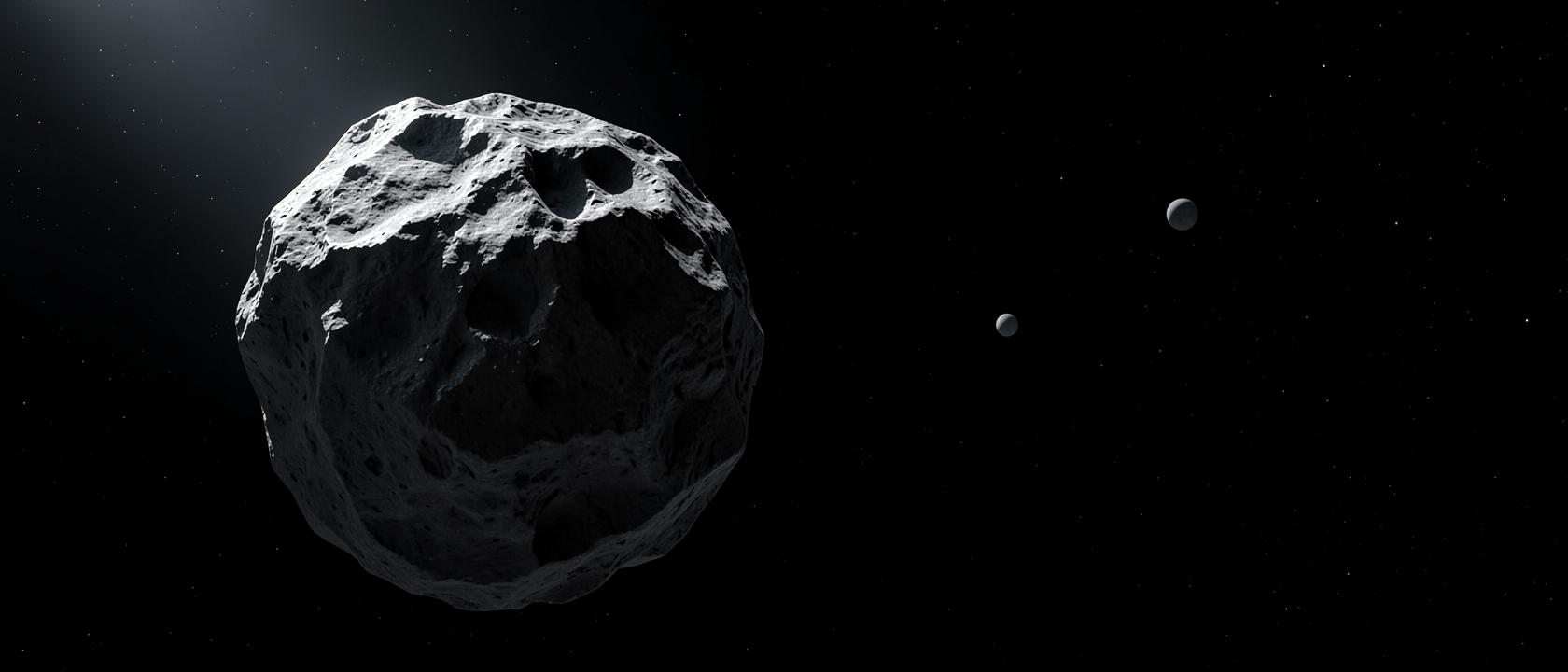
Several things about 2026 TB94 haven’t been settled. Which orbital family it belongs to, what it’s made of, which survey spotted it first, none of that is in the published record. There’s also no photograph of the rock itself; objects this small and this fast don’t hold still long enough for a portrait. The only image likely to exist is a CNEOS orbit diagram, an illustration of the path it followed, not a picture of the object. For now, that plotted line is as close as anyone gets to seeing 2026 TB94.