
2026 UE: A Rock the Size of a House, Five Moons Out
A house-sized asteroid slipped past Earth at just over five Moon-distances away, close enough to count, far enough to never make the news. The object, 2026 UE, made its closest approach on October 25, 2026, at 05:53 UTC, passing at 1,250,000 miles (about 2.01 million km). Converted into the unit astronomers actually use for the solar system, that’s 0.01345 astronomical units, an astronomical unit, or AU, is the average Earth-Sun distance, about 93 million miles (149.6 million km), and it stays abstract right up until you measure the pass against something smaller: 5.23 lunar distances. Five and a quarter Moons, laid end to end, is the gap. The Moon itself sits an average of 238,900 miles (384,400 km) from Earth, a number nobody carries around either, until they remember watching it clear a rooftop.
How We Know
Nobody saw 2026 UE through an eyepiece and gasped. Ground-based sky surveys picked it up across several nights, and those tracked positions went into NASA JPL’s Center for Near-Earth Object Studies, whose orbit-fitting software turned a string of dots into a trajectory: a date, a time, and a miss distance with real precision. That’s the pipeline behind the figure on NASA’s Asteroid Watch dashboard, 1,250,000 miles, cross-checked by an independent close-approach calendar listing the pass at 5.2 lunar distances and a relative velocity of about 15.9 km/s relative to Earth. This is ordinary bookkeeping. CNEOS logs passes like this routinely, and nothing about the process signals concern.
How Big, Really?
Nobody has measured 2026 UE’s actual size, no radar echo, no infrared read on its surface. What exists is a measured brightness value, an absolute magnitude of H = 25.78, plus two working assumptions about albedo, meaning how much sunlight a surface bounces back versus absorbs. NASA’s dashboard reports an estimated diameter of about 76 feet (23 m), based on a standard default albedo. Push the assumption toward a darker, carbon-rich surface and the object has to be larger to produce the same brightness; push it toward a paler, rockier one and it shrinks. Run both ends and the honest range is roughly 59 to 135 feet (18 to 41 m), a garden shed at one edge, a mid-rise apartment block at the other. That spread isn’t rounding error. It’s the size of what we don’t know.
Why “Five Moons” Still Counts as Close
Five lunar distances sounds roomy, until you set it next to the rest of the solar system, which is laid out in AU, fractions and multiples of 93 million miles. Against that ruler, 0.01345 AU is barely a step past the front door. Objects this size cross Earth’s neighborhood within a few lunar distances with real regularity; most never make the news, because a pass that was never aimed at anything isn’t a story. 2026 UE’s orbit carried it to that 1,250,000-mile point and carried it straight back out again, a measured closest approach, not a step toward a future one. In that same stretch of the calendar, NASA’s dashboard also logged three other small asteroids and one previously named object passing at their own safe distances, an ordinary week for a tool built to track exactly this.
The Picture That Doesn’t Exist
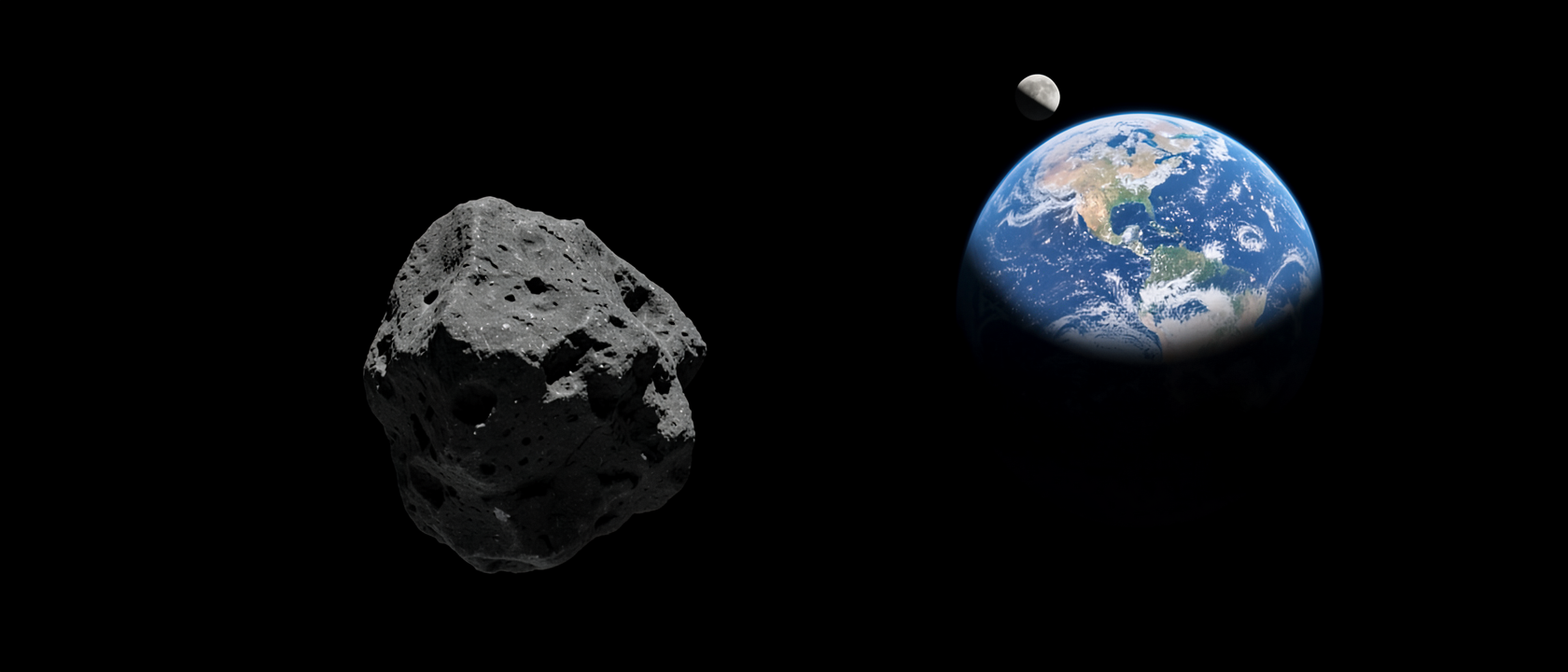
There’s no photograph of 2026 UE, not a blurry one, not a single resolved pixel. Something this small and this fast shows up on survey telescopes as a point of light and nothing more. What you’ll see labeled alongside this story is either a JPL orbit diagram plotting the flyby past Earth and the Moon, or a generic illustration of a near-Earth asteroid built from imagery of other, larger objects. Both are exactly that: a diagram and an illustration, not a picture of this particular rock. Its shape, its spin, what it’s actually made of, and its true diameter inside that 59-to-135-foot bracket are open questions, answerable only if some future pass brings it close enough for radar or infrared instruments to take an actual look. Nothing says that pass is coming.