The Planet Where a Year Ends Before Your Shift Does
Start a long shift at nine in the morning, and somewhere past the constellations you already recognize, a planet is about to finish an entire year before you clock out. TOI-4552 b, a small rocky world circling a faint red dwarf star, completes one full orbit in about 26,015 seconds. Divide that by 3,600 and you get roughly 7.23 hours. Earth’s year runs 365.25 days, 31,557,600 seconds, so lining the two up, this planet manages about 1,213 orbits in the time Earth needs for one.
The measuring stick
That 1,213 isn’t a new measurement. It’s one already-measured orbital period divided by another, TOI-4552 b’s 26,015 seconds against Earth’s 31,557,600. Flip the fraction and the planet’s year comes out to roughly 8.24 × 10⁻⁴ of an Earth year, or about one part in 1,213. Put plainly: 7.23 hours doesn’t leave room for a season. It barely leaves room for lunch.
How we know
Nobody clocked this with a stopwatch. The TESS space telescope found the regular dimming as the planet crossed in front of its star, repeating every 7.23 hours across three separate observing campaigns, cataloged as sectors 12, 39, and 66. Because that timing is both precise and repeatable, an orbital period like this one ranks among the sturdiest numbers you’ll find for any exoplanet, far more solid than its mass or radius, which take extra modeling to pull out of the same data.
Ground-based telescopes at LCO, ExTrA, and SPECULOOS caught their own transits to confirm the signal. Meanwhile the NIRPS and HARPS instruments tracked the host star’s spectrum for a Doppler shift: the faint back-and-forth wobble a planet’s gravity causes in its star, visible as a shift in the wavelengths of its light. That radial-velocity campaign ran 60 nights between 2023 and 2024. Avidaan Srivastava, René Doyon, François Bouchy, and their collaborators put the full picture together in a 2026 paper.
Why the orbit is so short
The short year comes down to simple proximity. TOI-4552 b’s semi-major axis, the average distance from a planet to the star it circles, measures 8.416 × 10⁸ meters: about 523,000 miles (841,600 kilometers). Earth, for comparison, orbits the Sun at 1 astronomical unit, roughly 93 million miles (149.6 million kilometers). TOI-4552 b’s orbit comes out to just 0.56% of that. Its star is also small and cool, measured at 3,258 Kelvin at the surface, far dimmer than the Sun, so the planet has to sit close just to stay warm.
Don’t mix that number up with how far the whole system sits from Earth. Gaia’s DR3 star-mapping data puts TOI-4552 at about 88.9 light-years away. That’s a separate figure, nine orders of magnitude larger, describing something else entirely, not a lap around a sun, but the gap between that solar system and ours.
What the numbers say about the planet
TOI-4552 b carries 1.83 times Earth’s mass, or 1.093 × 10²⁵ kilograms, mass, not weight; nobody has set a scale down on its surface. Its radius measures about 7,070 kilometers (4,393 miles), 1.11 times Earth’s own. Combine the two and the bulk density comes out to 7,740 kilograms per cubic meter, about 1.4 times Earth’s average of 5,514 kilograms per cubic meter. That’s a dense, iron-heavy mix for a planet this size. An interior model built with the exopie code estimates that around 54% of its mass sits in a metallic core, a figure called the core mass fraction, anywhere from 29% to 71% given its uncertainty, putting it somewhere between an Earth-like world and what the researchers call a “super-Mercury.” That’s a modeled estimate, not a direct reading.
The planet also absorbs roughly 263 times the energy per square meter that Earth receives from the Sun, give or take about 40. One modeled “equilibrium temperature”, a theoretical balance between sunlight absorbed and heat radiated away, assuming zero albedo, meaning the surface is assumed to reflect none of the light it gets, comes out around 1,122 Kelvin, or about 1,560°F. That’s a model output, not a thermometer reading, and the exact published figure is still being confirmed.
What’s still open
Whether TOI-4552 b is genuinely richer in iron than Earth isn’t settled. The mass carries enough uncertainty that confirming it will take sharper radial-velocity measurements than exist today. Nobody has determined whether the planet holds onto any atmosphere at all, that question sits outside the discovery data entirely. Its strong predicted emission signal and a quiet host star have researchers naming it a strong candidate for a future look with the James Webb Space Telescope, but that observation hasn’t happened.
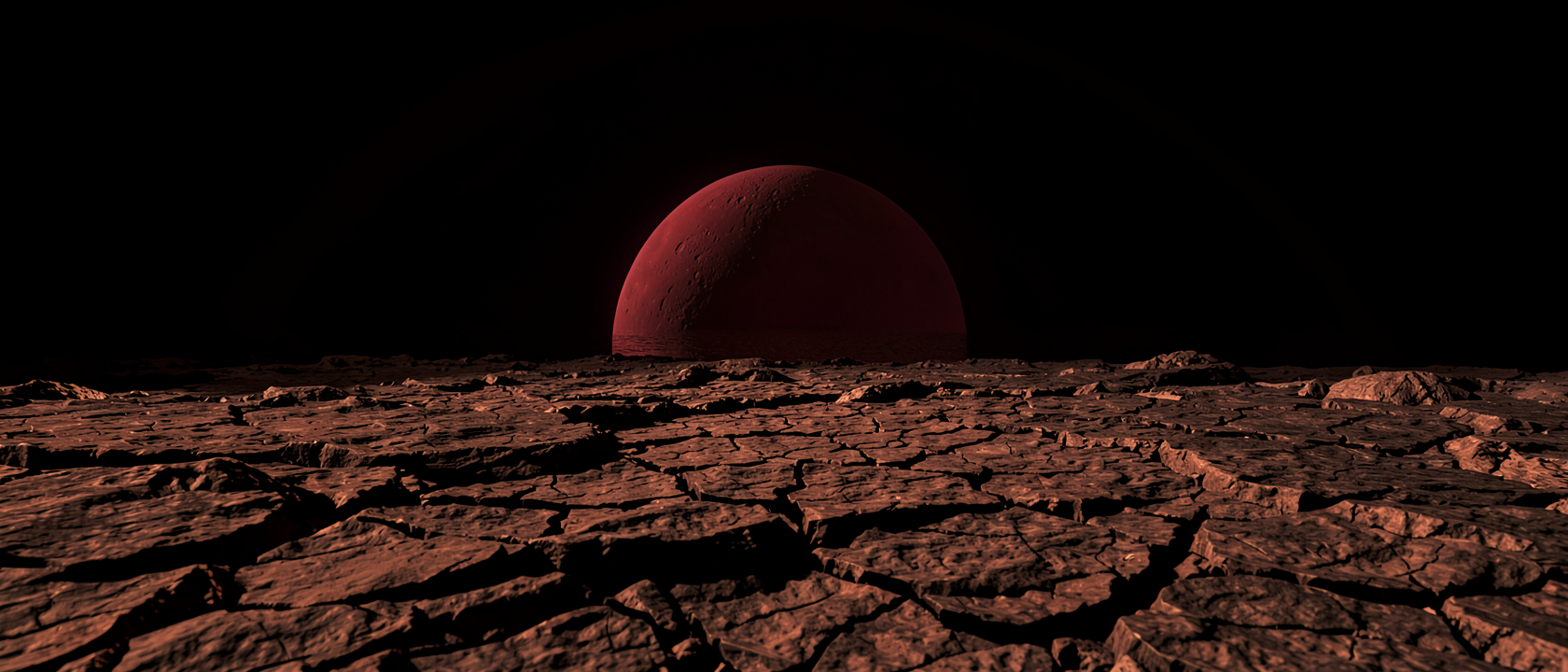
No camera has photographed TOI-4552 b, and none is likely to soon, it’s small, dim, and pressed close against its own star’s glare. Any image showing it as a glowing, scorched little world is an artist’s illustration built from the numbers above, not a photograph.