
A Year That Fits Inside a Work Shift
Picture clocking in for a full shift and watching an entire planet live out a complete year before you clock out. On PSR J2322-2650 b, one lap around its star, its whole year, takes 27,904.089 seconds. Divide that by 3,600 and you land on about 7.75 to 7.8 hours, start to finish.
The measuring stick
Set that against the year you and I actually live through: Earth’s orbit takes 31,558,149.5 seconds, or 365.25 days. Divide the planet’s year by ours and the ratio works out to about 8.84 × 10^-4. Flip it around, and Earth’s year is roughly 1,131 times longer than a year on PSR J2322-2650 b. By the time Earth finishes one trip around the Sun, this planet has already completed more than 1,100 of its own.
It helps to remember what “close and fast” usually means closer to home. Mercury, the speed champion of our eight planets, still needs 88 days to circle the Sun. PSR J2322-2650 b sits at a semi-major axis, the average planet-star distance, of about 948,200 miles (1.53 million km), or 0.0102 astronomical units, where one astronomical unit is the average Earth-Sun distance, roughly 149.6 million kilometers. That’s about a hundredth of the Earth-Sun gap. Next to this planet, Mercury’s orbit looks unhurried.
How we know
Nobody has photographed this planet, and nobody will with current instruments, it was never seen, only inferred. Its host, PSR J2322-2650, is a pulsar: a neutron star, the collapsed core left behind when a massive star exploded, spinning fast enough to sweep a beam of radio waves past Earth like a lighthouse. It turned up in the HTRU high-latitude pulsar survey, using the Parkes radio telescope, on May 4, 2011, in a 285-second observation, and was confirmed with follow-up observations starting in July 2012 at the Lovell Telescope, Jodrell Bank Observatory. The pulsar spins almost 300 times every second, with metronome regularity. A planet tugging on that spin shifts the arrival time of each pulse by fractions of a second, in a repeating pattern. Astronomers call this pulsar timing, and that pattern, not a picture, not a shadow crossing a star, is the measurement. Researcher R. Spiewak and colleagues worked out the full orbit from that timing data and published it in 2017 and 2018.
What’s measured, what’s estimated, and what’s still open
The orbital period and the semi-major axis come straight from that timing solution, measured, along with the orbit’s shape: an eccentricity under 0.0017, essentially circular, later refined to a vanishingly small 0.00012 as the data improved. The planet’s mass, though, is a minimum only: 0.7949 Jupiter masses, about 252.64 Earth masses, or 1.509 × 10^27 kilograms, mass, not weight, since there’s no ground to stand on and no gravity to feel. It’s a minimum because pulsar timing can’t reveal the orbit’s tilt relative to Earth, called its inclination; without that angle, the true mass, and the true density, stay open.
Radius and density are both estimates, and they disagree depending on the catalog. NASA’s exoplanet catalog lists a radius of about 55,090 miles (88,660 km), roughly 1.24 Jupiter radii, or 14 Earth radii, with a density near 1,840 kilograms per cubic meter, under twice the density of water. A separate catalog, ExoKyoto, derives a smaller radius of about 40,390 miles (65,000 km), and a 2026 paper puts the density closer to 1,590 kilograms per cubic meter. None of these numbers came from a ruler or a scale; all are worked backward from the mass and assumptions about structure, which is why they shift from paper to paper.
Temperature is modeled too: an estimated average near 1,900 K (about 1,630°C). The planet is tidally locked, meaning its rotation period matches its orbital period, the same arrangement that keeps the Moon always showing Earth one face. So one hemisphere permanently faces the pulsar. Models put that side near 2,040°C and the permanent night side around 649°C.
Even the distance to the whole system keeps moving. The original 2017 measurement placed it about 750 light-years away (230 parsecs; a parsec equals 3.26 light-years). A 2024 reanalysis using the MeerKAT radio telescope pushed that estimate to roughly 800 parsecs, around 2,600 light-years, nearly three times farther. That’s not a rounding error. It’s an open question, still being worked out.
In 2025, researchers reported a carbon-rich atmosphere around this planet, the first confirmed atmospheric spectrum on any pulsar companion. How a Jupiter-sized body carrying an atmosphere ended up orbiting the crushed core of a dead star this closely, this fast, is a question the original discovery paper raises without settling; several formation scenarios remain on the table.
The picture
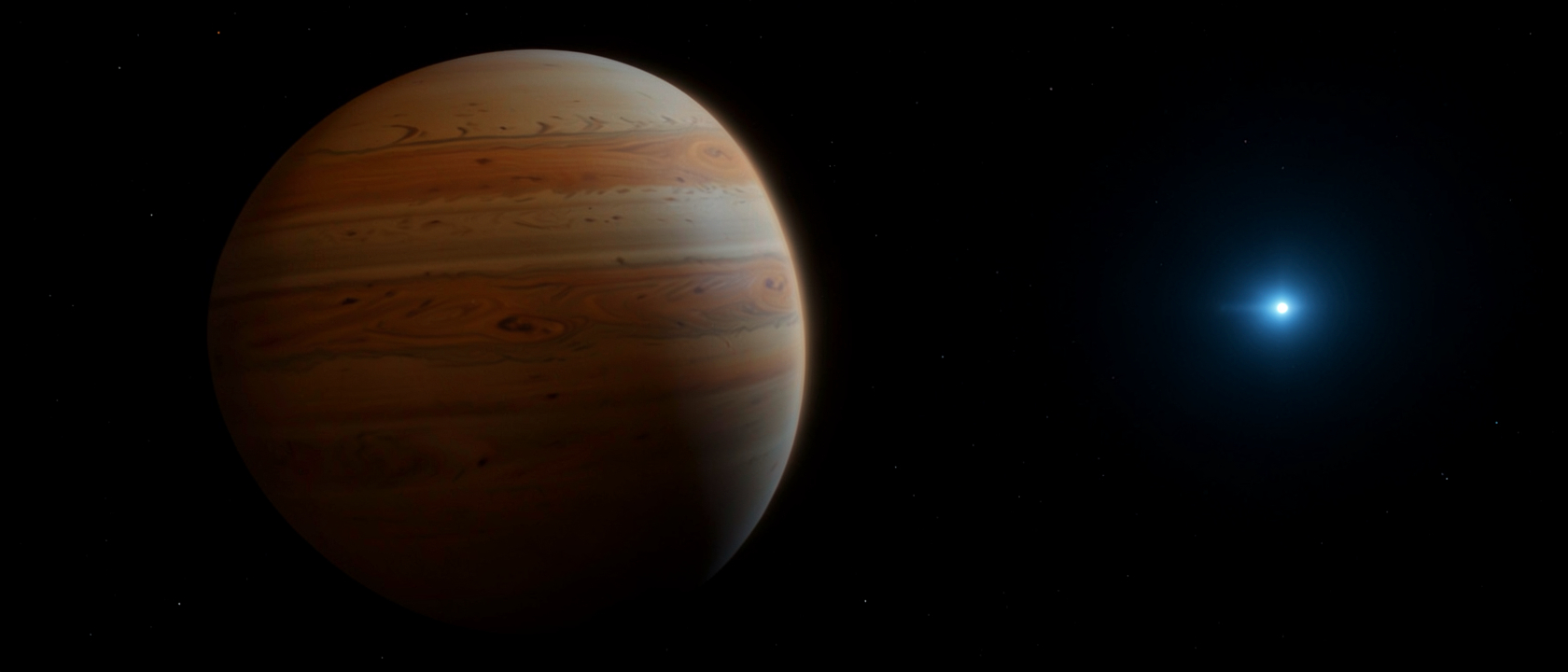
There’s no photograph of PSR J2322-2650 b, and there won’t be one from any telescope we have now, this whole planet was found in a radio rhythm, not in light. NASA’s exoplanet pages carry an artist’s concept of the system, credited to NASA with no individual illustrator named. It’s a guess at a scene no camera has ever captured, and it says so.