
The Rock That Passed Five Moons Away
An asteroid skimmed past Earth at a distance of almost five Moons, and nothing happened, which is exactly the point. On October 16, 2026, at 07:16 UTC, a near-Earth object designated 2026 TB2 reached its closest approach, passing roughly 1.18 million miles (1,904,108 kilometers) from Earth. That figure comes from NASA/JPL’s Center for Near-Earth Object Studies (CNEOS), the group that turns faint telescope detections into exact orbits and exact distances.
The Moon Is the Only Ruler That Fits
Nobody has a gut feeling for 1.18 million miles. Almost everybody has a gut feeling for the Moon. Earth’s only natural satellite sits an average of 238,855 miles (384,400 kilometers) away, the one distance in the solar system most of us have actually looked at. Divide the asteroid’s miss distance by that number and you get 4.95: 2026 TB2 passed just under five lunar distances away, or about 0.0127 astronomical units. An astronomical unit, or AU, is the average Earth-Sun distance, about 92.96 million miles (149,597,870 km), the scale planets are measured on, and a scale this asteroid barely registers on. Turning the miss distance straight into miles doesn’t make it easier to feel. Counting Moons does. Five of them sounds close. Against a solar system where planets sit hundreds of millions of miles apart, it’s a wide miss with plenty of room on either side.
How an Orbit Gets Pinned Down
Nobody watched 2026 TB2 through an eyepiece and called it in. The number above, 4.95 lunar distances, timed to the minute, is the output of an orbit-determination pipeline, not a single sighting. Ground-based survey telescopes record the object’s position against the star field on separate nights; CNEOS fits those positions into an orbit, then runs that orbit’s math forward and backward in time to find the exact moment and distance of closest approach. Which survey first caught 2026 TB2’s faint trail isn’t part of the published close-approach record checked for this piece, that detail stays open. What is published is the solution: one precise answer, built from a string of imprecise-looking dots collected over days.
Small, Faint, and Still Measured
Here’s the part that should feel wrong. 2026 TB2 is faint, faint enough that its size has to be worked out, not read off a ruler. Astronomers estimate an asteroid’s diameter from its absolute magnitude, a standard measure of how much sunlight an object reflects regardless of distance, combined with an assumed albedo, or surface reflectivity. For a different, similarly faint object, 2022 TM2, an absolute magnitude of 25.2 converts to an estimated diameter of 79 to 174 feet (24 to 53 meters), the low end assuming a brighter, stony surface, the high end a darker, carbon-rich one, since a darker surface needs more area to reflect the same amount of light. Reports around 2026 TB2’s flyby put its brightness in that same range, which would place it in a comparable size bracket, but that specific figure hasn’t been confirmed against JPL’s own records for this object, so it stays an estimate, not a measurement. Either way, an object too small to see clearly had its path tracked precisely enough to state, well in advance, exactly how far it would stay from Earth.
What Nobody Has Photographed
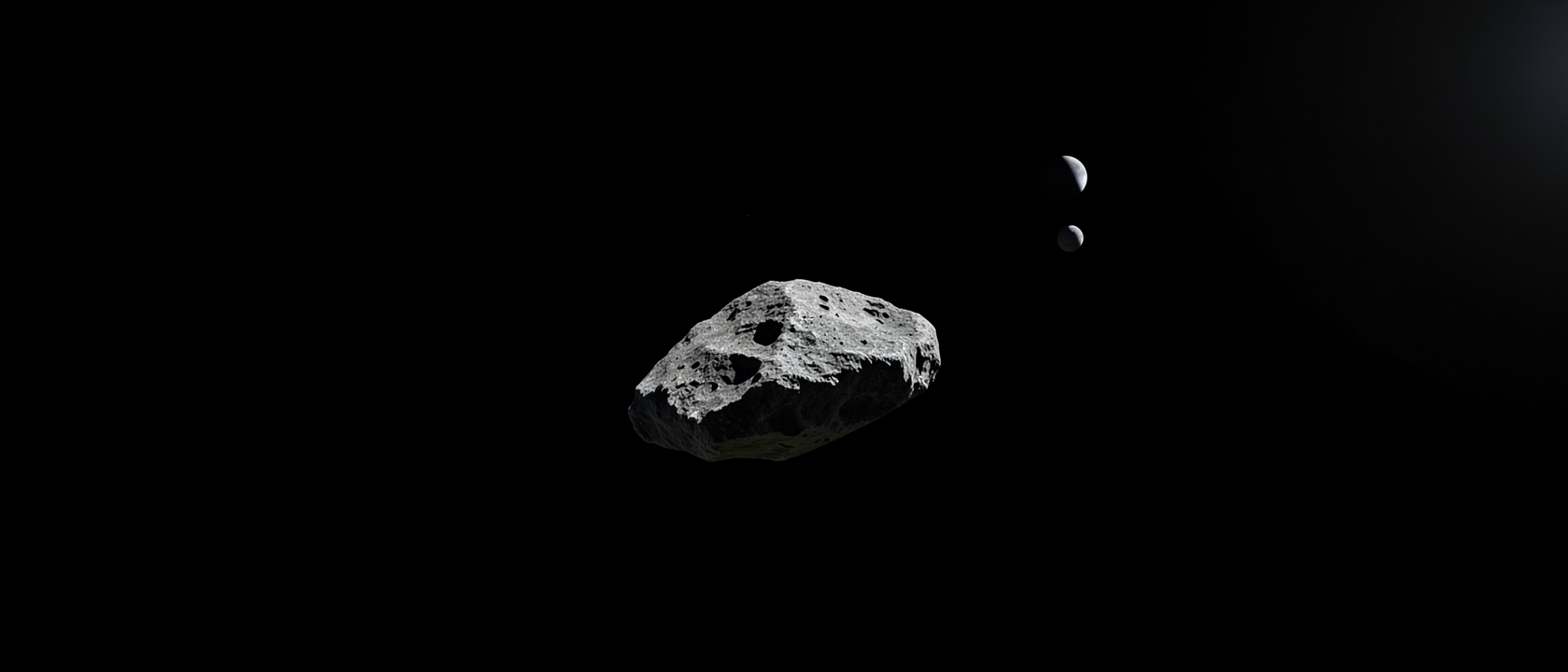
There’s no photograph of 2026 TB2. At that size, that distance, and that brightness, no telescope captures more than a point of light, if that, and no such image is part of the public record for this flyby. What JPL does publish is an orbit-diagram visualization, a plotted line showing Earth, the Moon, and the asteroid’s path through the neighborhood, not a picture of the rock itself. Any image showing a tumbling, cratered boulder up close is an artist’s illustration, not a photograph of this object.
Its true diameter, its composition, its exact speed at closest approach, and which observatory first flagged it are all unconfirmed as of this writing. That isn’t a hole in the story. A body somewhere in the range of a few dozen feet across had its path fixed precisely enough to rule out a collision, without anyone ever getting a clear picture of it. The measuring and the not-knowing happened at the same time, on the same object.