
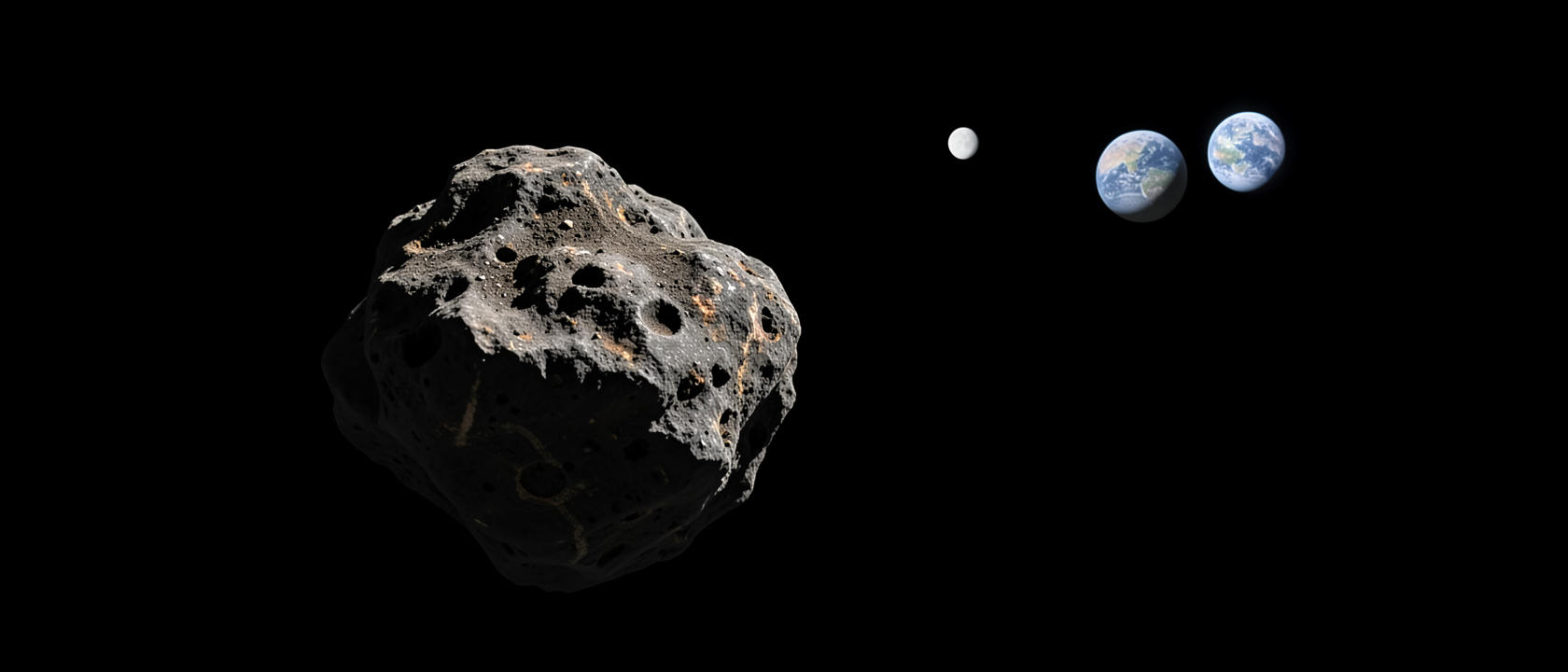
4.75 Moon-Distances: How Close an Asteroid Really Came on October 21
Four and three-quarter times farther than the Moon, that’s the whole story of asteroid 2026 TV8’s pass by Earth, in one ratio. The object made its closest approach on October 21, 2026, at 23:47 UTC, and it was never going to touch us.
The Measuring Stick
The number that matters is 4.75 lunar distances. A lunar distance is the average Earth-Moon gap, about 238,855 miles (384,400 km), the one cosmic ruler most people already carry in their head, since they’ve looked at the Moon and have some feel for how far off it sits. Multiply that by 4.75 and 2026 TV8 passed at roughly 1.13 million miles (1.826 million km). An independent close-approach listing cross-checks this at a slightly rounder 4.8 lunar distances, the same pass, measured and reported two different ways.
In astronomical units, the yardstick normally used for distances across the whole solar system, where one unit equals the average Earth-Sun distance of about 93 million miles (149.6 million km), that pass works out to 0.01221 AU. It’s a true figure, but a poor fit here: an AU is too large a ruler for something this close to home. The Moon is still the better stick.
2026 TV8 was moving at about 20,580 mph (9.2 km/s) relative to Earth, measured as part of the same orbit calculation. That speed is worth noting less as a number to do math with and more as a feel for the event: this was a fast, brief crossing, not a slow drift past a window.
How We Know
Nobody watched 2026 TV8 cross the sky like a plane. Objects this small and this fast show up as points of light that shift, night over night, against the background stars. Those positions get folded into an orbit-determination process, the same method NASA’s Jet Propulsion Laboratory applies to every object logged in its Center for Near-Earth Object Studies database. The close-approach time, the distance, and the relative speed all come out of that single calculation, which is why “4.75 lunar distances” counts as a measured result rather than a rough guess.
What isn’t in the public record is which survey telescope first picked up 2026 TV8, or exactly when. Several networks scan the sky for exactly this kind of object every night, but the discovery credit for this particular rock hasn’t turned up in the data reviewed here. That’s a gap, not a mystery.
Estimate: How Big
Nobody has measured 2026 TV8’s size directly, no spacecraft flew close enough, no radar dish pinged it. What exists is its brightness, converted into a size estimate using an assumed albedo: how much sunlight a surface reflects, with a dark, charcoal-colored rock reflecting far less than a pale, sandy one.
That math puts the asteroid somewhere between 59 and 131 feet (18 to 40 meters) across, a range two independent catalogs converge on. One working estimate lands near 82 feet (25 meters), call it a few stories tall. The real number sits somewhere inside that span; which end depends on a surface nobody has actually seen.
Why the Instinct Misleads
Nearly five lunar distances sounds like a comfortable margin, and it was, nothing here was ever on a collision path. But “comfortably far” on the solar system’s scale and “comfortably far” in daily life are different units. At 1.13 million miles out, 2026 TV8 would not have been visible without a telescope: a rock a few dozen meters wide, lit only by reflected sunlight at that range, is far too dim for the eye. It passed close enough to be worth tracking and dim enough to be invisible, at the same time. Every month, CNEOS and ESA’s Near-Earth Object Coordination Centre log dozens of small asteroids making passes like this one; none of the ones tracked so far has ever been found on a path that actually crosses Earth’s.
Open
Several things stay unsettled. Which telescope first spotted 2026 TV8, and exactly when, isn’t in the available record. Its composition, stone, metal, or a loose pile of rubble, is unknown, which matters because density, not just size, decides how much mass is really out there. The albedo used to estimate its diameter is an assumption, not an observation, which is why that estimate spans more than double from one end to the other. None of this puts the close-approach distance itself in doubt. It just means everything built on top of that number, the size, the makeup, still has soft edges.
The Picture
There is no photograph of 2026 TV8. At under 131 feet across and over a million miles away, moving at several kilometers a second, it was always too small, too dim, and too fast for any camera to resolve into more than a faint point of light, if that. What usually stands in for an image in a case like this is an orbit diagram, a plotted curve showing the asteroid’s calculated path sweeping past Earth’s, built from the same tracking data behind every number here. It’s an illustration of a calculation, not a photograph of a rock, and worth saying so plainly.