
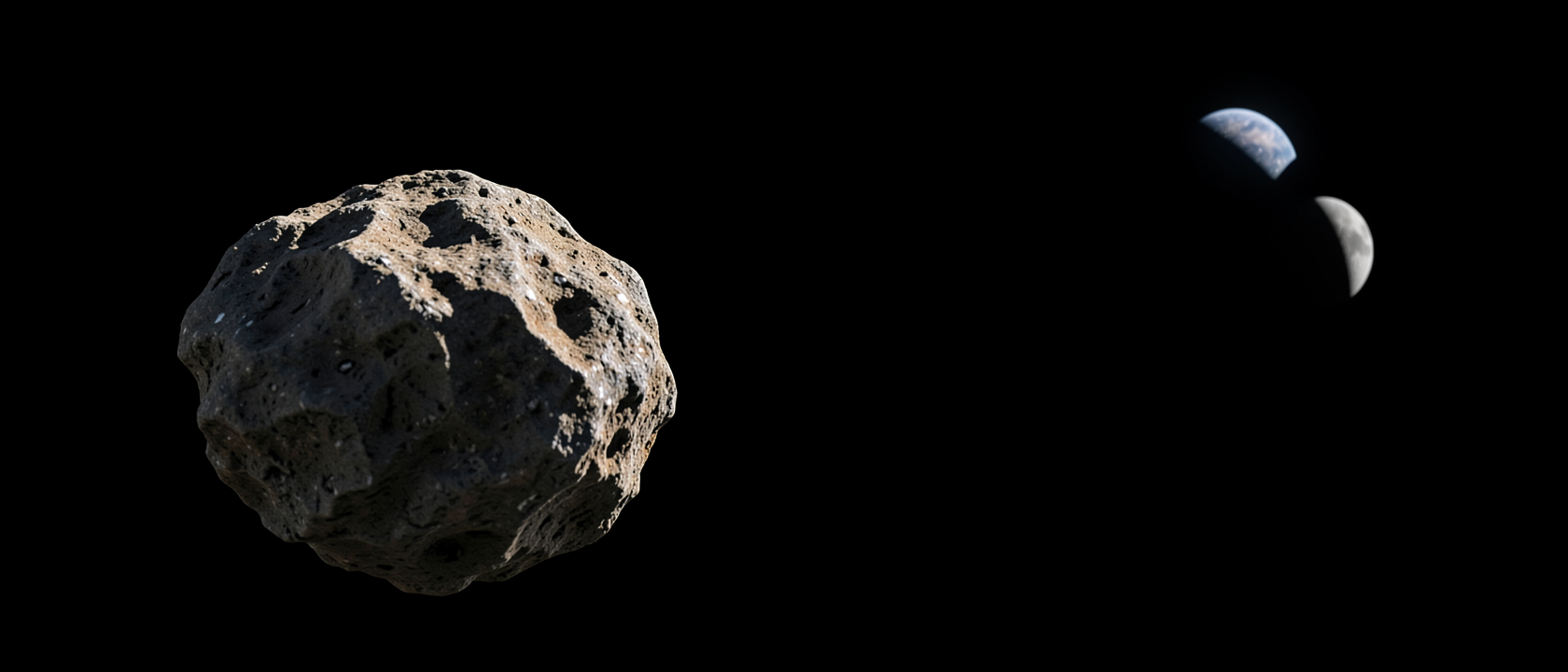
A Rock the Size of a Football Field, Passing at 2.4 Times the Moon’s Distance
You already carry a rough sense of how far the Moon sits from Earth: close enough to see every night, far enough that nothing gets there quickly. On October 18, 2026, a rock no wider than a football field passed by at about 2.4 times that distance, and two independent trackers pulling from NASA’s Jet Propulsion Laboratory data logged the pass almost identically.
That rock is asteroid 2026 TS. The tracking sites spaceweather.com and srpske.rs both list its closest approach at roughly 2.4 lunar distances, moving at 10.3 kilometers per second (about 23,000 miles per hour) relative to Earth. One version of the figures circulating gives a sharper number, 2.37 lunar distances and 0.00608 astronomical units, but that level of precision could not be confirmed against JPL’s own close-approach table in this research pass. Treat 2.4 lunar distances and 10.3 kilometers per second as the solid numbers; the extra decimal is plausible, not verified.
The Moon, Stretched to Almost Two and a Half Times Its Distance
One lunar distance is the Earth-Moon average gap, about 238,855 miles (384,401 kilometers). At 2.4 times that, 2026 TS passed roughly 575,000 miles (925,000 kilometers) from Earth. For comparison, one astronomical unit, the Earth-Sun distance, is about 93 million miles (149.6 million kilometers), a scale that makes this pass look small, since 2026 TS never came anywhere near a meaningful fraction of it.
How Anyone Knows This
Nobody photographed 2026 TS going by. What exists is a solved trajectory. Telescopes recorded the asteroid’s position against the background stars over several nights, and an orbit-determination model, the kind NASA’s Center for Near-Earth Object Studies (CNEOS) runs routinely, turned those positions into a path through space. That path is what gives trackers a distance and a speed worth quoting. “Measured” here means a tracked path, not a snapshot.
Which telescope spotted 2026 TS first, and when, isn’t part of the record pulled together for this piece. Close-approach listings often start with the orbit solution rather than the discovery image, a common gap for small, fast objects that only turn up on survey telescopes days or weeks before they pass by.
How Big Is It, Really? Nobody Has Measured That Part
The size of 2026 TS has never been measured directly, no radar echo, no resolved image, nothing a camera or dish actually caught. What exists instead is the asteroid’s absolute magnitude, a standardized brightness value that one version of the data puts at H=24.04, though that specific number also falls into the unverified category above. What’s solidly reported is a working diameter estimate of about 54 to 55 meters (roughly 177 feet), cited by both spaceweather.com and srpske.rs.
That single figure still hides an estimate, not a measurement. Turning brightness into size means guessing at a surface. Astronomers bracket the unknown with albedo, the fraction of sunlight a surface reflects: a dark, carbon-rich asteroid might reflect as little as 5 percent of incoming light, a brighter, rockier one as much as 25 percent. Depending on which albedo you assume, an object this bright could measure anywhere from about 135 feet (41 meters) to 302 feet (92 meters) across, the low end shorter than a football field, the high end close to its full length. The quoted 54-meter figure sits inside that range; it doesn’t replace it.
Why the Precision Feels Off, and Isn’t
Something under 300 feet across, passing hundreds of thousands of miles out, still got a distance figure solid to a tenth of a lunar distance and a speed solid to one decimal place. That gap, a tiny object paired with a confident answer for where it was, is the part worth noticing. Nothing here came close to grazing Earth. A distance of roughly 575,000 miles is more than twice the Earth-Moon gap, and 2026 TS was never on a path toward this planet. What happened is that a faint, moving point of light got pinned down with real precision, which is a better story than a near miss.
2026 TS wasn’t the only small asteroid passing through that stretch of October 2026. The same tracking list includes 2026 TO8, which went by at 3.5 lunar distances on October 11, an estimated 33 feet (10 meters) across, and 2022 UP6, at 2.6 lunar distances on October 15, an estimated 26 feet (8 meters) across. Both are Apollo-group asteroids, meaning their orbits cross Earth’s own path around the Sun. Neither was ever assessed as a collision risk, and neither passed any nearer than 2026 TS did.
What Is Still Open
2026 TS’s true diameter, its surface composition, its actual albedo, and which survey first spotted it all remain unanswered in the public record available here. No radar return, no resolved image, and no published light curve exist for this object. Any graphic showing the pass is necessarily a diagram, Earth, Moon, and a dot placed at roughly 2.4 lunar distances, rather than a photograph, since 2026 TS has never been anything more than a faint point in a telescope’s data.