A House-Sized Rock Passed Earth With Almost Five Moons’ Width to Spare
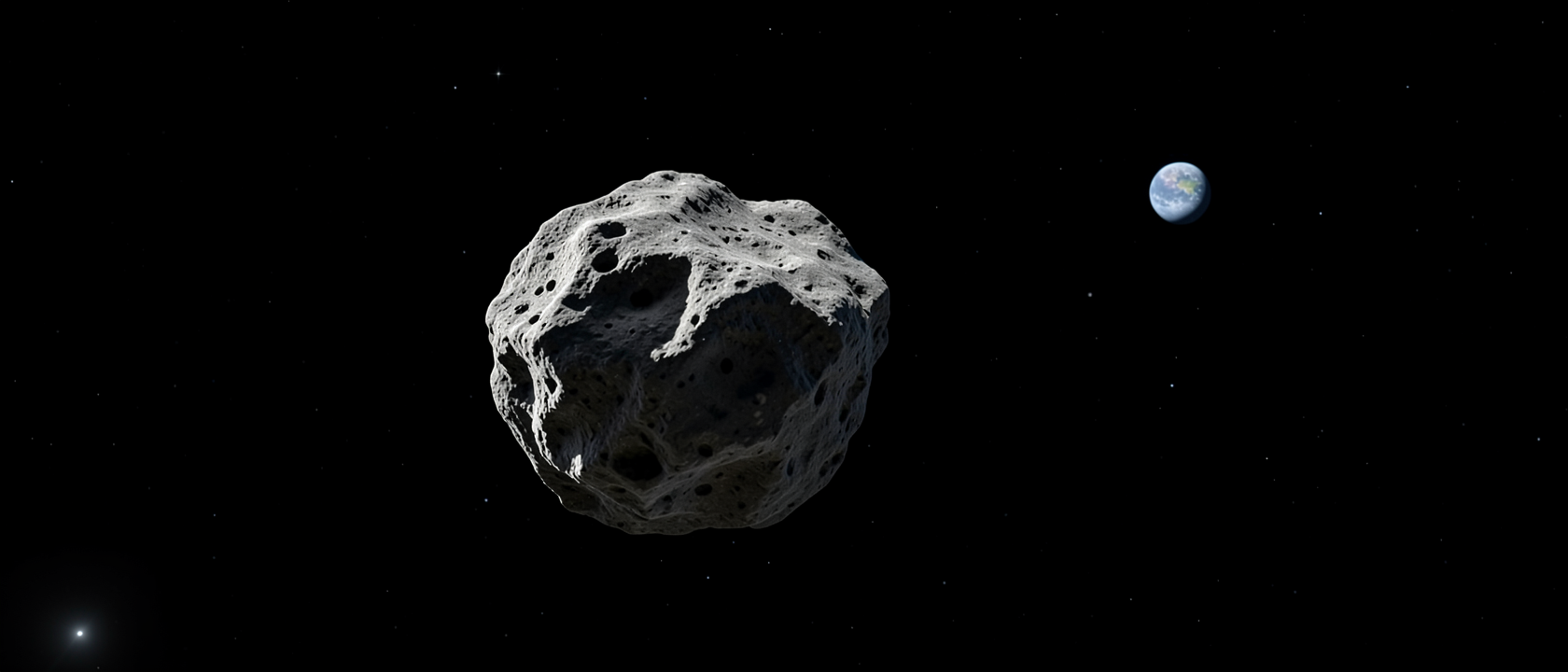
A rock no bigger than a house drifted past Earth, and the gap between it and us could have held almost five Moons’ orbits side by side. Nothing hit, nothing flared, nothing was visible without a telescope, the whole event lives in a tracking catalog, not a photograph. The object is called 2026 TV8, and it made its closest approach to Earth on October 21, 2026, at 23:46 UTC.
The Measuring Stick
MEASURED. At its closest, 2026 TV8 was about 1,135,300 miles (1,827,074 km) away, equal to 0.012213 astronomical units. An astronomical unit, or AU, is the standard yardstick for solar-system distances: roughly 93 million miles (149.6 million km), about the distance from Earth to the Sun. On its own, 0.012213 AU is a number with nothing to hold onto. Convert it the way ESA’s Near-Earth Object Coordination Centre (NEOCC) does, and it turns into something you can actually picture: 4.753 lunar distances, meaning the asteroid passed 4.753 times farther away than the Moon.
One lunar distance is fixed at about 238,860 miles (384,410 km), the average Earth-Moon gap and the one deep-space measurement most people already carry around in their heads. So 2026 TV8 cleared Earth with nearly five Earth-Moon gaps of open space to spare, comfortable by solar-system standards, and still precise enough to earn its own line in a close-approach catalog.
How We Know
The distance, the date, and the asteroid’s relative speed of about 20,580 mph (9.2 km/s) all come from NEOCC’s close-approach records, built using orbit-solution methods consistent with those NASA’s Jet Propulsion Laboratory applies at its own Center for Near-Earth Object Studies. None of these figures come from one lucky snapshot. They come from repeated telescope observations of 2026 TV8’s position, fed into an orbital model until the predicted path matches what was actually seen moving across the sky.
What the record doesn’t say is which survey first spotted the object. Several automated sky surveys hunt for near-Earth asteroids of exactly this size, but no specific one is credited here for the discovery, so that detail stays open rather than guessed at.
The Size Nobody Measured Directly
ESTIMATE. Nobody has a ruler on 2026 TV8. What NEOCC recorded is its absolute magnitude, H = 25.8, essentially how bright the object would appear from a fixed reference distance, a figure that only turns into a size once you assume how much sunlight the surface reflects. That reflectivity, called albedo, can run anywhere from close to black asphalt to pale concrete, and nobody knows which end applies here. Run the math across that whole range and the diameter comes out somewhere between about 62 and 131 feet (19 to 40 meters), more than double from one end to the other, not from sloppy work, but because a single point of light genuinely can’t tell you more than that.
During the approach, 2026 TV8 reached a peak apparent brightness of magnitude 19.1, far too faint for the naked eye or an ordinary pair of binoculars. Seeing it at all meant pointing a telescope built for exactly this kind of search.
What’s Still Open
OPEN. No camera has a picture of 2026 TV8, and none ever will at this size and distance, any diagram of this flyby shows a plotted orbit line, not a photograph of the rock itself. Its true diameter within that 62-to-131-foot range is unknown. So is its composition, its actual albedo, and which observatory first flagged it. Whether this was a one-time pass or part of an orbit that brings it back around isn’t settled here either. The date, the distance, and the speed are solid, measured numbers. Almost everything about the object itself is still a range, not an answer.
That gap between what’s nailed down and what isn’t is worth sitting with. “4.75 times the Moon’s distance” sounds like a short hop, the kind of multiple you’d use for a trip across town. At the scale this event actually happened on, it’s close enough that an agency tracks it, logs it, and keeps watching for the next one.