
A Rock the Size of a Tall Building Passed Earth, and We Clocked the Exact Minute
A rock roughly the size of a tall building passed Earth, and astronomers knew its path precisely enough to name the exact minute it would come closest. On October 25, 2026, at 09:27 UTC, asteroid 2026 TB8 reached that point, missing Earth by about 1,687,000 miles (2,714,984 kilometers). That figure is precise to the kilometer, which only happens when something has been tracked carefully, not glimpsed once and guessed at.
Seven Moons of Clearance
Astronomers measure close approaches against the lunar distance, the Moon‘s average distance from Earth, about 238,855 miles (384,400 kilometers). 2026 TB8 crossed at 7.06 of those lengths. In everyday terms, that sounds like plenty of room. In solar-system terms, it’s close enough to get logged to the kilometer rather than waved off as background noise. Astronomers also log the same pass in the astronomical unit, the average Earth-Sun distance of about 93 million miles (149,597,871 kilometers). 2026 TB8’s miss distance works out to 0.01815 AU, the number behind that lunar-distance figure.
How Fast Is 7.8 Kilometers a Second?
At closest approach, 2026 TB8 was moving at 17,448 mph (7.8 kilometers per second) relative to Earth. That word “relative” matters: this isn’t a fixed property of the rock, it’s its speed measured against Earth at that specific moment. Change the vantage point, watch it from the Sun instead, or from another asteroid, and the number changes with it. There’s no everyday vehicle that gets you close to this figure; it’s simply a different regime of motion, the kind only orbital mechanics produces.
How We Know
No spacecraft flew near 2026 TB8, and no camera got a close look. Every figure here, distance, speed, the minute of closest approach, comes from NASA’s Jet Propulsion Laboratory and its Center for Near-Earth Object Studies (CNEOS), which runs an orbit-determination model against repeated telescope sightings: a faint point of light, measured against background stars enough times to solve for its exact path.
Ground telescopes pinned the orbit down well enough that the model could say, in advance, exactly where 2026 TB8 would be on October 25 and how far it would pass Earth by. It wasn’t a singular event, either, the same day, it appeared on a running tally that spaceweather.com keeps with NASA’s Meteoroid Environment Office, alongside other small asteroids such as 2026 UE and 2026 SQ31, which passed Earth within the same stretch of hours. 2026 TB8 was one line in a log that gets new entries most days.
The Size Nobody Has Actually Measured
Here the register shifts from measured to estimated. Nobody has measured 2026 TB8’s size directly, no radar return, no resolved image, nothing to point to and call a diameter. What’s actually measured is brightness, expressed as absolute magnitude, a standard measure of how bright an object would look from a fixed distance. One listing puts that figure at 23.87, though it hasn’t been independently confirmed against NASA/JPL‘s own records, so treat it as provisional.
Turning brightness into size means assuming an albedo, how reflective the surface is, somewhere between 0.05, about as dark as asphalt, and 0.25, closer to pale concrete, because nobody has measured which one applies here. Working from that brightness, successive October 2026 listings put 2026 TB8 at somewhere between 184 and 197 feet (56 to 60 meters) across. Stretch the albedo assumption to its full range and the honest estimate widens to 148 to 328 feet (45 to 100 meters), more than double between the low end and the high end, not sloppy work, just an honest limit on what brightness alone can tell you.
What’s Still Open
Plenty is missing from the record. There’s no confirmed discovery date or survey name on file for 2026 TB8, no settled albedo, and nothing published yet on its composition, shape, or rotation. For an object cataloged this recently, that’s ordinary, detail fills in slowly, if it fills in at all, as more telescopes get more looks.
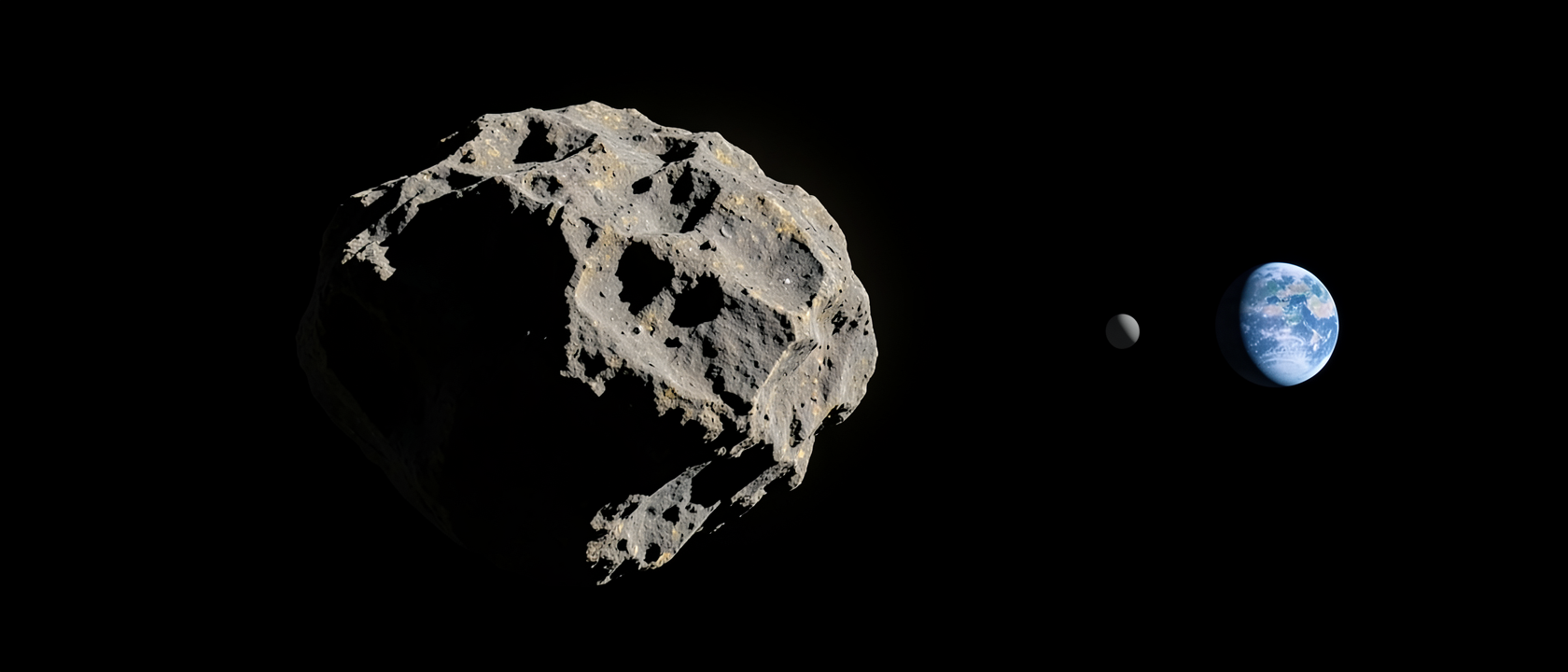
There’s also no photograph of the rock itself, and there won’t be one from this pass. Objects this small, at this distance, show up in survey telescope frames as a faint streak or a single point of light, not a shape a lens can resolve. The closest thing to an image is the orbit diagram CNEOS generates from the tracking data itself: a curved line showing 2026 TB8’s path bending past Earth. It isn’t a picture of an object. It’s a picture of a measurement, and for now, that’s the realest image anyone has of it.