
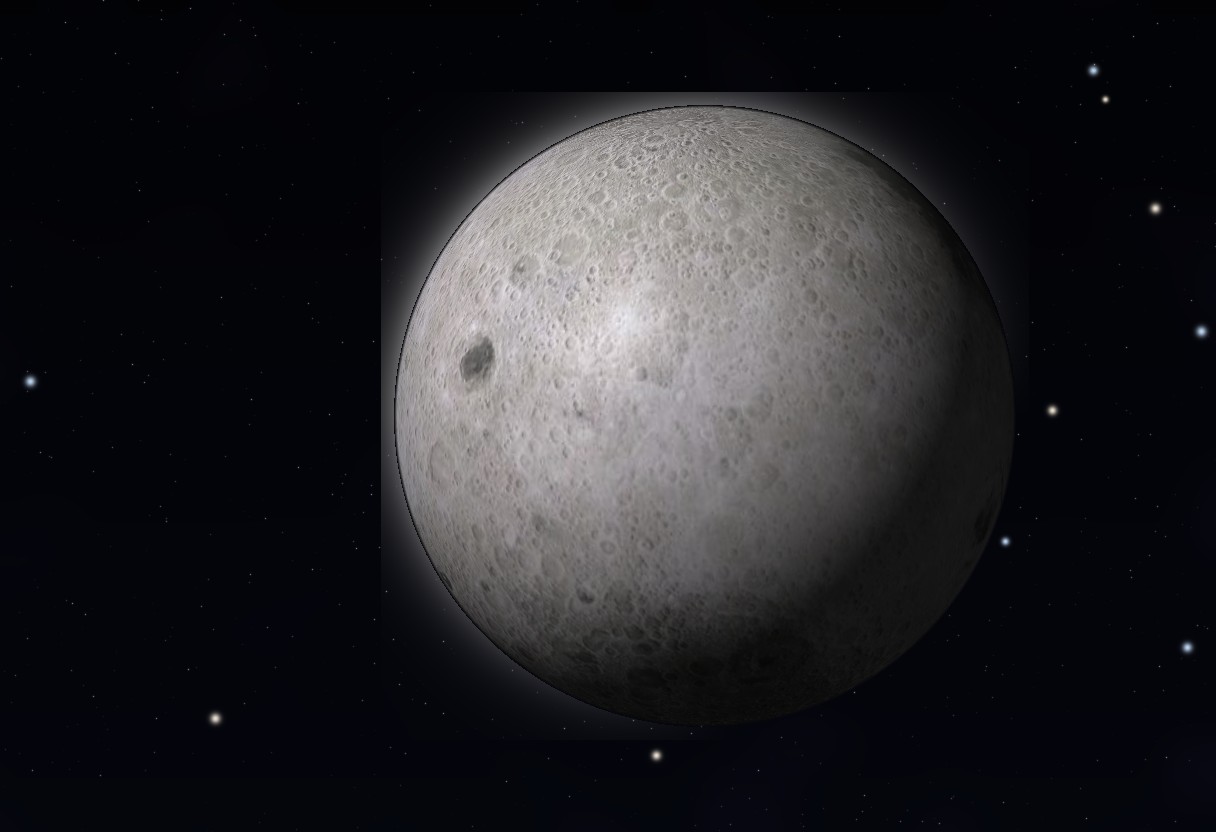
The Moon is a rocky body orbiting Earth at an average distance of 384,000 km — roughly the width of thirty Earths laid side by side — and at a radius of 1,737 km it is a little more than a quarter the size of the planet it circles. With a mass of 7.35 × 10¹⁹ metric tons (about one-hundredth of Earth’s mass), it is large enough to raise ocean tides, slow Earth’s rotation measurably over geological time, and serve as the reference clock for calendar systems stretching back to at least 3000 BCE. Twelve people have walked on its surface, and as of 2026 an international set of programs is preparing to send people back for the first time since 1972.
Key facts
- Mass: 7.35 × 10¹⁹ t (0.01× Earth)
- Body type: moon
- Orbits: Earth
- Radius: 1,737 km (0.27× Earth)
- Surface gravity: 1.62 m/s² (0.17× Earth)
- Density: 3,344 kg/m³ (0.61× Earth)
- Temperature: 253 K (-20 °C)
- Orbital period: 27.3 days
- Rotation period: 27.3 days
- Semi-major axis: 384,000 km
- Orbital eccentricity: 0.05
Physical characteristics
The Moon’s mean radius of 1,737 km gives it a total surface area of 37.9 million square kilometres — 7.4% of Earth’s surface. Despite that modest size, it is far from a uniform ball of rock. The crust varies substantially in thickness: on the near side, the hemisphere permanently facing Earth, it averages about 60 km; on the far side it reaches up to about 100 km. Beneath the crust lies the mantle, the thickest internal layer, built mainly of olivine and pyroxene — minerals composed of magnesium, iron, silicon, and oxygen. A 2023 study found that the Moon also has a solid inner core roughly 500 km in diameter, with a density close to that of iron, surrounded by a fluid molten outer core — an internal architecture that mirrors Earth’s own.
Surface gravity on the Moon is 1.62 m/s², or about one-sixth of Earth’s value, which means an astronaut on the lunar surface pushes down on the ground with only about one-sixth the force they would exert standing on Earth. Mean surface temperature, averaged over the full day-night cycle, is 253 K (−20 °C), but that average obscures extremes: the Diviner instrument aboard NASA’s Lunar Reconnaissance Orbiter measured −249 °C inside Hermite crater near the north pole — the coldest temperature ever directly measured anywhere in the solar system. The Moon’s bulk density is 3,344 kg/m³, which is 0.61 times Earth’s average density, consistent with a body that lacks a proportionally large iron-rich core.
The lunar crust is composed primarily of oxygen, silicon, magnesium, iron, calcium, and aluminium, with minor amounts of titanium, uranium, thorium, potassium, and hydrogen. The composition is not uniform across the surface: the bright highland regions are rich in calcium and aluminium and are built predominantly of anorthosite — a rock containing more than 90% plagioclase feldspar. This highland crust has been radiometrically dated to approximately 4.4 billion years old, representing the original shell that crystallised from a global lunar magma ocean. In contrast, the dark patches called maria — from the Latin word for seas — are impact basins subsequently flooded by lava between 4.2 and 1.2 billion years ago; they are richer in iron and titanium and sit mostly on the near side.
The Moon’s visual geometric albedo is about 0.12: it reflects only 12% of the sunlight that strikes it, a reflectivity roughly matching that of worn asphalt. Its apparent brilliance in Earth’s night sky is a product of contrast with the dark background, not of intrinsic brightness. The surface is blanketed by regolith — a layer of pulverised rock and dust produced by billions of years of meteoroid bombardment. In the older highland terrain, this regolith can be up to 20 metres deep; in the younger maria it may be only a few metres thick, with bedrock occasionally exposed. Below the regolith lies the megaregolith: cracked, shattered bedrock and massive ejecta thrown out by ancient large impacts.
Orbital mechanics and the lunar calendar
The Moon orbits Earth with a semi-major axis of 384,000 km and an orbital eccentricity of 0.05 — meaning its distance from Earth varies by about ±5% around that average, a nearly circular path. Its sidereal orbital period, the time to complete one full revolution relative to the background stars, is 27.3 days. Its rotation period is also 27.3 days; the two are identical because gravitational tidal forces have locked the Moon’s rotation to its orbit, a state called synchronous rotation. This is why the same hemisphere always faces Earth.
The synodic period — new moon to new moon — is 29.530589 days (29 days, 12 hours, 44 minutes, and 3 seconds), because Earth itself moves along its orbit around the Sun during those 27.3 days, so the Moon must travel roughly an extra 2.2 days’ worth of arc to re-align with the Sun as seen from Earth. That 29.5-day cycle is the basis of the earliest known formal lunar calendars, which emerged in Mesopotamia around 3000 BCE. The Sumerians and later the Babylonians built systems in which months alternated between 29 and 30 days to track the cycle; those Babylonian structures became the foundation for later Jewish, Islamic, and Christian calendar systems.
The exosphere
The Lunar Atmospheric Composition Experiment, deployed during the Apollo 17 mission, determined that the principal constituents are neon-20, helium, hydrogen, argon-40, and carbon dioxide.
A 2024 study published in Science Advances, by researchers from MIT and the University of Chicago, estimated that impact vaporisation from micrometeoroid bombardment has accounted for more than 65% of the sodium and potassium in the lunar exosphere over the Moon’s history, with the remainder attributed to other processes such as solar-wind sputtering. The exosphere is so tenuous that individual atoms travel on ballistic paths from one point on the surface to another, rarely colliding with one another — behaviour more typical of a vacuum than of what most people would recognise as an atmosphere.
Craters and surface geology
Scientists estimate there are approximately 1,850,000 craters with diameters exceeding 1 km on the lunar surface, and at least 125 with diameters greater than 100 km. The absence of plate tectonics and the extreme thinness of the exosphere mean that impact structures are preserved for billions of years without the erosion that rapidly degrades them on Earth.
Permanently shadowed craters near the poles are cold enough to trap volatile compounds deposited over billions of years. In October 2009, NASA’s LCROSS mission deliberately drove a 2,305-kilogram Centaur rocket stage into Cabeus crater at 2.5 km/s; instruments measured approximately 155 kilograms of water vapour and ice in the resulting ejecta plume, and analysis published in Science in 2010 estimated the regolith at the impact site to be about 5.6% water ice by mass.
Helium-3 and potential resources
Decades of solar wind bombardment have embedded helium-3 — an isotope that is extremely rare in Earth’s crust — into the top layer of lunar soil. Scientists estimate the Moon holds up to approximately one million metric tons of helium-3 in this surficial regolith, and this isotope is considered a potential future fuel for nuclear fusion reactors.
In September 2025, the Helsinki-based cryogenics company Bluefors signed a roughly $300 million agreement with the startup Interlune to purchase up to 1,000 litres of helium-3 annually, all of it intended to be mined from the Moon. The contract was described at the time as the first major commercial agreement for a lunar resource.
Tides and Earth’s rotation
The Moon’s gravitational pull is the dominant force driving Earth’s ocean tides. It creates two tidal bulges on opposite sides of Earth simultaneously — one facing the Moon and one on the opposite side — and as Earth rotates through these bulges, most coastlines experience two high tides and two low tides per day. When the Sun, Moon, and Earth align at new or full moon, solar and lunar tidal forces combine to produce especially high spring tides. When the Moon is at a right angle to the Sun during the quarter phases, the opposing forces produce weaker neap tides; solar tides are approximately half as large as lunar tides.
The same tidal interaction is gradually transferring angular momentum from Earth’s rotation to the Moon’s orbit, lengthening Earth’s day at a rate of roughly 1.7 milliseconds per century. Geological evidence from sedimentary structures called tidal rhythmites shows that Earth’s day was approximately 21 hours long about 600 million years ago, consistent with that long-term rate of slowing.
Exploration history
The first human-made object to reach the surface of another celestial body was the Soviet Union’s Luna 2 spacecraft, which impacted the Moon on September 13, 1959, after launching on September 12. Its instruments found no significant magnetic field or radiation belts around the Moon. A more cautious milestone followed on February 3, 1966, when the Soviet Luna 9 spacecraft made the first controlled soft landing on another world, touching down in the Moon’s Oceanus Procellarum region. Luna 9’s landing settled an open question: before it arrived, there was genuine uncertainty about whether the lunar surface was firm or whether a lander might sink into deep dust. The spacecraft demonstrated that the surface was solid enough to support a probe, and it transmitted surface photographs — in a format identical to wire-service newspaper photo transmission — that scientists at Jodrell Bank Observatory in England decoded using a facsimile receiver borrowed from the Daily Express newspaper, before Moscow had officially released the images.
NASA’s Apollo program landed humans on the Moon six times between 1969 and 1972: Apollo 11, 12, 14, 15, 16, and 17, with twelve astronauts walking on the surface in total. Apollo 17, launched in December 1972, was the last crewed mission and carried Harrison Schmitt, the only professionally trained geologist to walk on the lunar surface, who served as lunar module pilot. The Apollo 17 mission also deployed the Lunar Atmospheric Composition Experiment, which produced the first direct measurements of the exosphere’s composition.
On January 3, 2019, China’s Chang’e 4 mission achieved the first soft landing on the Moon’s far side, setting down in Von Kármán crater within the South Pole-Aitken Basin. Direct radio communication between the far side and Earth is impossible because the Moon’s bulk blocks line-of-sight contact, so China first launched a relay satellite named Queqiao to a halo orbit near the Earth-Moon L2 Lagrange point to bridge the link. In May 2024, China’s Chang’e 6 mission built on that success by collecting samples from the Moon’s far side — specifically from the Apollo Basin within the South Pole-Aitken Basin — and returning 1,935.3 grams of material to Earth on June 25, 2024, landing its return capsule in Inner Mongolia. Analysis of those samples dated the local basalt to approximately 2.83 billion years and the basin itself to approximately 4.25 billion years, providing the first direct age measurements of far-side geological material.
NASA’s Lunar Reconnaissance Orbiter, launched June 18, 2009, has produced the most detailed three-dimensional topographic map of the lunar surface and has imaged every Apollo landing site. Its ride-along spacecraft LCROSS confirmed water ice in the permanently shadowed Cabeus crater on October 9, 2009.
Current and planned missions
As of 2026, NASA’s Artemis program has completed two missions: Artemis I, an uncrewed test flight in November 2022, and Artemis II, a crewed lunar flyby conducted in April 2026. Artemis III, planned for 2027, is a crewed Earth-orbit mission designed to test docking procedures with commercial lunar landers. Artemis IV — the first crewed landing on the Moon since Apollo 17 in December 1972 — is planned for early 2028.
Did you know
- The Moon reflects only about 12% of the sunlight that hits it — roughly the same reflectivity as worn asphalt — yet it appears brilliantly bright because human eyes have adapted to the dark night sky, making relative brightness the perception, not absolute brightness. (lunarpedia.org)
- A common myth is that the far side of the Moon is always dark. In fact, the far side receives just as much sunlight as the near side — it is simply the side that never faces Earth, not one that is eternally shadowed. (cyclecalcs.com)
- In September 2025, the Helsinki-based cryogenics company Bluefors signed a roughly $300 million agreement with startup Interlune to purchase up to 1,000 litres of helium-3 annually — all to be mined from the Moon — marking the first major commercial contract for a lunar resource. (zmescience.com)
- China’s Chang’e 4 mission in January 2019 became the first ever to land on the Moon’s far side. Because the far side has no direct radio line-of-sight to Earth, China first had to launch a relay satellite named Queqiao to a halo orbit near the Earth-Moon L2 Lagrange point just to communicate with the lander. (nationalgeographic.com)
- When NASA’s LCROSS spacecraft deliberately crashed a 2,305-kilogram Centaur rocket stage into Cabeus crater at 2.5 km/s on October 9, 2009, scientists measured about 155 kilograms of water vapour and ice in the resulting plume — the first direct, measured confirmation of water ice at the Moon’s south pole. (azmth.space)
- The Soviet Luna 9 lander, which made the first soft landing on another world on February 3, 1966, transmitted its surface photographs in a format identical to wire-service newspaper photo transmission. Scientists at Jodrell Bank Observatory in England borrowed a facsimile receiver from the Daily Express newspaper and decoded the Moon’s surface images in time for the following morning’s front pages — before Moscow had officially released them. (spaceodysseyhub.com)
- China’s Chang’e 6 mission returned 1,935.3 grams of rock and soil from the Moon’s far side in June 2024 — the only far-side material on Earth — from the Apollo Basin within the South Pole-Aitken Basin, a site no mission had ever sampled in over six decades of lunar exploration. (azmth.space)
- The Moon completes one orbit around Earth relative to the stars every 27.3 days (the sidereal month), but the cycle of lunar phases — new moon to new moon — takes 29.530589 days (the synodic month), because Earth has moved along its own orbit in the meantime and the Moon must travel farther to realign with the Sun. (cyclecalcs.com)
Data sources
- NASA NSSDC
- science.nasa.gov
- earthsky.org
- newsweek.com
- arxiv.org
- scienceabc.com
- nasa.gov
- nssdc.gsfc.nasa.gov
- airandspace.si.edu
- nationalgeographic.com
- spacelaunchschedule.com
- nesdis.noaa.gov
- oceanservice.noaa.gov
- sci.news
- timeinmilitary.com
- lunarpedia.org
- zmescience.com
- universetoday.com
- cyclecalcs.com
- esa.int
- ebsco.com
- aaas.org
- azmth.space
Where it appears
- Asteroid 2026 TB8 Passed Earth at 7.06 Lunar Distances October 31, 2026
- House-sized asteroid passed Earth at 5.08 lunar distances, unseen October 30, 2026
- House-sized asteroid 2026 RF15 passed Earth at 5.53 lunar distances October 29, 2026
- Asteroid 2026 TB2 Passed Earth at 4.95 Moon-Distances October 27, 2026
- Asteroid 2026 TB2 passed Earth at just 4.95 lunar distances October 25, 2026
Data updated: 2026-10-26