
A Building-Sized Rock Passed By, Five Moons Away
A rock about the size of a mid-rise apartment building slipped past Earth with plenty of room to spare, nearly five Moons’ worth of room. It was never on a path toward us. It was just passing through, the way small asteroids do far more often than the headlines about them suggest.
The Measured Numbers
At 23:46 UTC on October 21, 2026, a near-Earth asteroid called 2026 TV8 made its closest pass by Earth. The European Space Agency’s Near-Earth Object Coordination Centre (ESA NEOCC) measured the distance at 1,827,074 km (1,135,576 miles), or 0.012213 astronomical units (AU, Earth’s average distance from the Sun, roughly 93 million miles). In lunar distances, the unit astronomers actually use for this kind of thing, that’s 4.753: the asteroid passed 4.753 times farther out than the Moon. At that moment it was moving relative to Earth at about 20,580 mph (9.2 km/s). This is a recorded closest-approach distance, nothing more. “Close approach” here is orbital bookkeeping, logged the way a flight path is logged, not a “near miss,” a phrase that implies a danger that was never there.
Why We Measure in Moons
Lunar distance is the stick that makes the number mean something. The Moon orbits Earth at an average of 238,855 miles (384,400 km), the one distance in the night sky most people have already memorized without trying. 2026 TV8 passed at 4.753 times that distance, roughly 1.135 million miles of open space. Picture the Moon as the near wall of a room; this asteroid went by a wall almost five rooms further back. An AU means little until you’ve driven it. “Farther than the Moon, five times over” needs no calculator. Some asteroids do pass closer than the Moon, a handful do most years, but this was not one of them, by a wide margin.
How We Know
The distance, timing, and speed all come from ESA NEOCC’s close-approach tracking, built the old-fashioned way: ground-based telescopes photograph the same patch of sky across several nights, and the one faint dot that crawls against the fixed stars gets picked out and followed. No radar pinged 2026 TV8 and no spacecraft flew anywhere near it, the entire orbit solution rests on optical tracking, the standard method for objects this size. That also explains why the numbers sharpen over time: NEOCC’s record for this object was last updated on October 22, 2026, at 17:31 UTC, tightening the solution even after the flyby itself. Position and timing, checked across repeat sightings, are solid measurements. Size is a different matter.
What We Don’t Actually Know: The Size
2026 TV8’s diameter is estimated at 62 to 131 feet (19 to 40 meters), somewhere between a six-story apartment building and a thirteen-story tower. That range comes from the asteroid’s absolute magnitude, a measure of how bright it would appear from a fixed, standard distance, put at H=25.8, run through an assumed surface reflectivity, or albedo, of roughly 5% to 25%. Brightness alone can’t tell a telescope whether it’s looking at a big dark rock or a small bright one, so the size stays a range until someone measures the albedo directly. Nobody has, for this object. No telescope has resolved its shape or surface; this is a modeled number, not a measured one.
Why “Close Approach” Feels Closer Than It Is
“Close approach” does something to your nerves that the numbers don’t back up. It’s a phrase built for headlines, and headlines are built to be opened. The real picture: about 1.135 million miles of clearance, a rock no bigger than an apartment block, and a flyby pattern that repeats constantly. Objects this size are often spotted only days, sometimes hours, before their closest pass, simply because something 62 feet across is too faint to see until it’s nearby. At its brightest, 2026 TV8 reached magnitude 19.1, far too dim for binoculars, let alone the naked eye. The unease that phrase produces says more about how these stories get told than about any real risk.
What’s Still Open
Several things about 2026 TV8 remain unknown. Its true diameter stays locked to an albedo nobody has measured, and its shape, composition, and rotation have no published values at all. Which survey first spotted it isn’t part of the public tracking record, and how many days of warning that first detection gave before the flyby is likewise not on record. These are ordinary gaps, not mysteries, this is an ordinarily sized asteroid, tracked by ordinary means, and not every object gets the full workup. NASA’s Sentry system, which monitors catalogued near-Earth objects for impact risk, lists no known significant threat from any tracked asteroid for the next century or more, 2026 TV8 included, one of several small rocks that passed Earth in October 2026 without incident.
The Picture
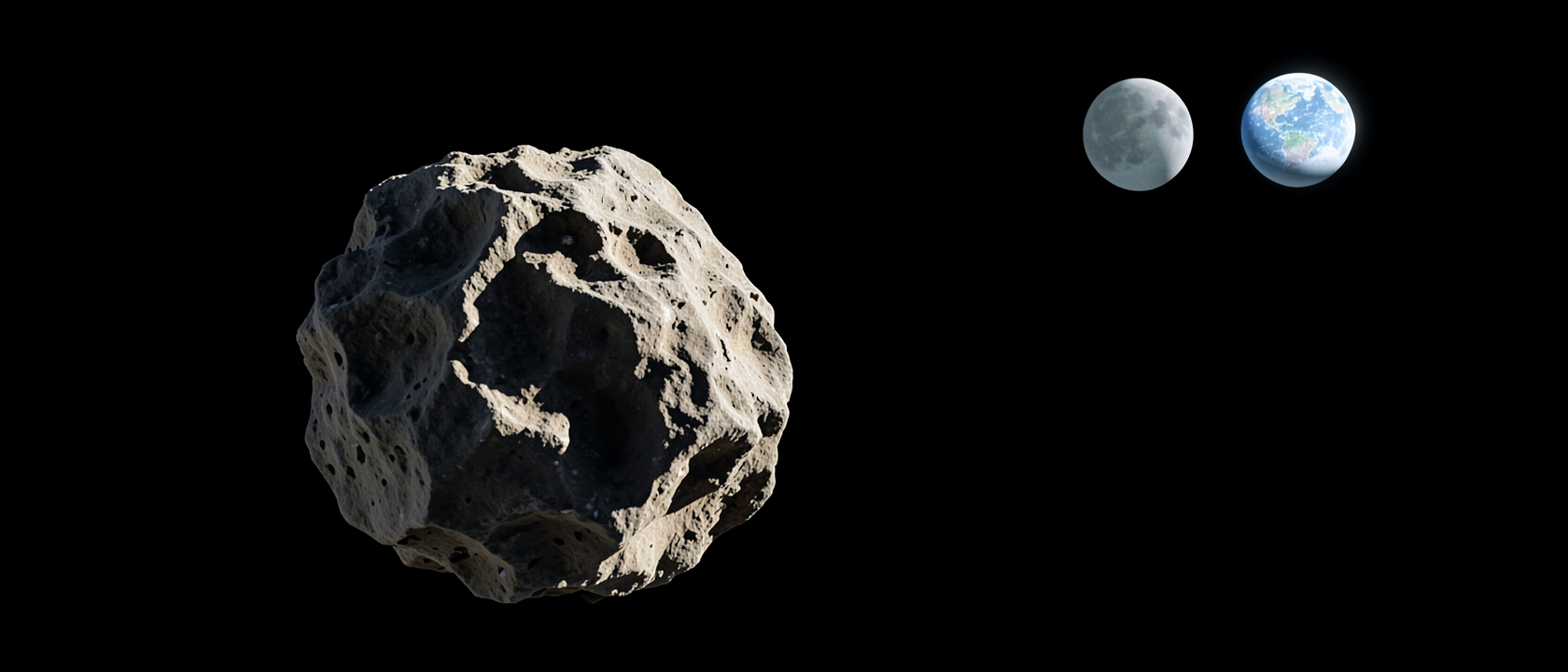
No photograph of 2026 TV8 exists, and none is likely to. At 62 to 131 feet across and more than a million miles out, it was far too small and far too distant for any camera to resolve as anything but a point of light, a dot crawling against the star field over a few nights of tracking. What NEOCC publishes instead is an orbit diagram: a computed line showing Earth, the Moon’s orbit, and 2026 TV8’s path threading through that region at the moment of closest approach. It’s a map of an orbit, not a picture of a rock, and no illustration of the asteroid itself appears here, because drawing one would invent a shape nobody has actually seen.