
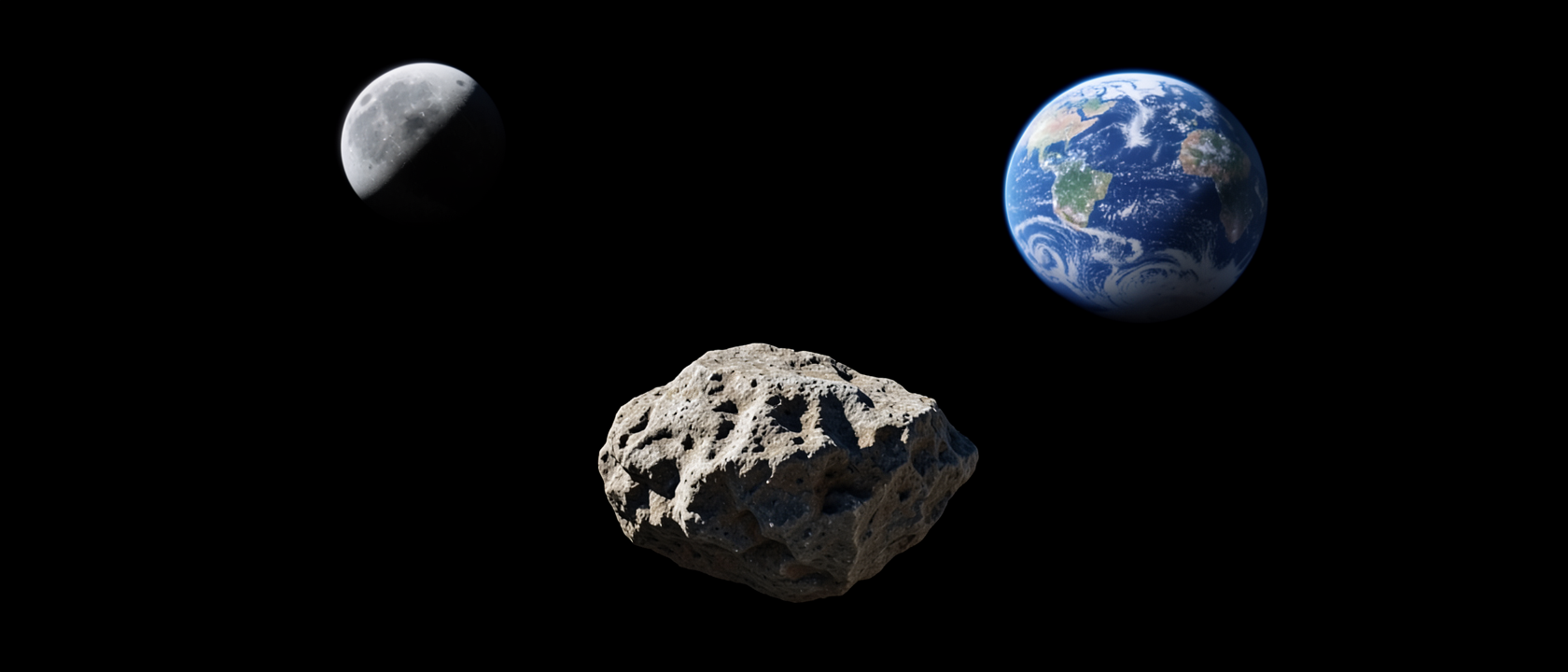
A Rock the Size of a Small Apartment Building Went By, and the Record Shows Exactly How Far
Something roughly 135 to 302 feet (41 to 92 meters) across passed by Earth without anyone needing to do a thing about it. The object is asteroid 2026 TS, and its closest approach happened on October 18, 2026, around 06:1x UTC, CNEOS-derived listings put the exact minute somewhere between 06:16 and 06:19 UTC, and that small gap is simply left open rather than guessed at. What matters more is the distance: about 564,200 miles (908,000 km) at closest approach. That is real, measured ground to cover. It just happens to be small change out where this rock lives.
Same Distance, Three Rulers
That 908,000 km figure is also written as 0.00607 astronomical units (an AU is the Earth-Sun distance, about 93 million miles, and it is the unit astronomers reach for once numbers get large), and as 2.36 lunar distances. These are not three separate facts. They are one measured gap, read on three different rulers.
The Moon ruler is the useful one, because it’s a distance people already carry a feel for: the average Earth-Moon gap is 238,854 miles (384,399 km). Multiply that by 2.36 and you get the asteroid’s miss distance. Which sounds tidy right up until you remember what the multiplier is doing: 2.36 times the Moon’s distance means this object cleared Earth by a gap wider than the entire Earth-Moon system, stacked more than twice over. That is not a near miss. It was never going to be one.
How We Know
The distance and the date, along with the speed, all come from NASA JPL’s Center for Near-Earth Object Studies, which runs the Close Approach Data system, the standing catalog that logs telescopic tracking of every flyby like this one. CNEOS turns repeated astrometric measurements (positions against background stars, taken over time) into an orbit, and the orbit into a predicted, then confirmed, closest-approach distance and time. That’s also why the minute itself wobbles a little between listings: the underlying solution is solid, but different database pulls round the same result slightly differently.
What the record doesn’t say is which survey telescope first spotted 2026 TS. That detail isn’t in the close-approach listing, and it’s left here as open rather than filled in.
How Big, Actually
Nobody has measured the size of 2026 TS directly, no radar echo, no resolved image. What’s recorded is its absolute magnitude, a brightness value: H = 24.06. To turn brightness into size, CNEOS assumes a surface reflectivity, or albedo, since a darker rock needs to be bigger to shine as bright as a paler, smaller one. Running the numbers at the two standard albedo bounds (0.25 and 0.05) gives a size range of 135 to 302 feet (41 to 92 meters), not sloppiness, just the honest shape of not knowing the surface. A separate report converges closer to 177–180 feet (54–55 meters), but that single-point figure rests on an H-magnitude listing that disagrees with the primary one by more than a full magnitude, so it’s noted here as unresolved rather than adopted as the answer.
Close in Space, Not Close on the Ground
2026 TS crossed Earth’s neighborhood at a relative speed of about 23,000 mph (10.3 km/s), relative to Earth, not some absolute number in a fixed frame. Call the flyby “close”: you’re right, measured against the roughly 93-million-mile gap to the Sun, 908,000 km is nothing. Call it close at human scale and you’re off, it’s more than twice the Earth-Moon distance, in one direction. And at no stage was 2026 TS “heading for” Earth. The tracked trajectory was a measured miss from the start. Nothing swerved, dodged, or narrowly avoided anything, because nothing was ever lined up to hit.
One of a Crowd
2026 TS wasn’t flying solo that week. A close-approach listing for October 16–21, 2026, also tracked 2026 TB2, 2026 TD2, and 2026 TV8 passing Earth at distances between roughly 0.006 and 0.018 AU during the same stretch. Small near-Earth asteroids a few tens of meters across go by at a handful of lunar distances more often than headlines suggest, this was simply a week with several logged at once.
What’s Still Open
The composition of 2026 TS, rock, metal, something more fragile, isn’t in the CNEOS record. Neither is which telescope first caught it, nor whether its orbit will bring it back for another pass. And there’s no photograph of it, nor is one likely: at this size and speed, survey telescopes register it as a single point of light, not a shape. If an image labeled “2026 TS” is circulating, it’s almost certainly an orbit diagram, lines and dates, not a picture of the rock. That’s a different kind of knowing, not a lesser one: we know exactly where it was and how fast it moved, without ever seeing its face.