
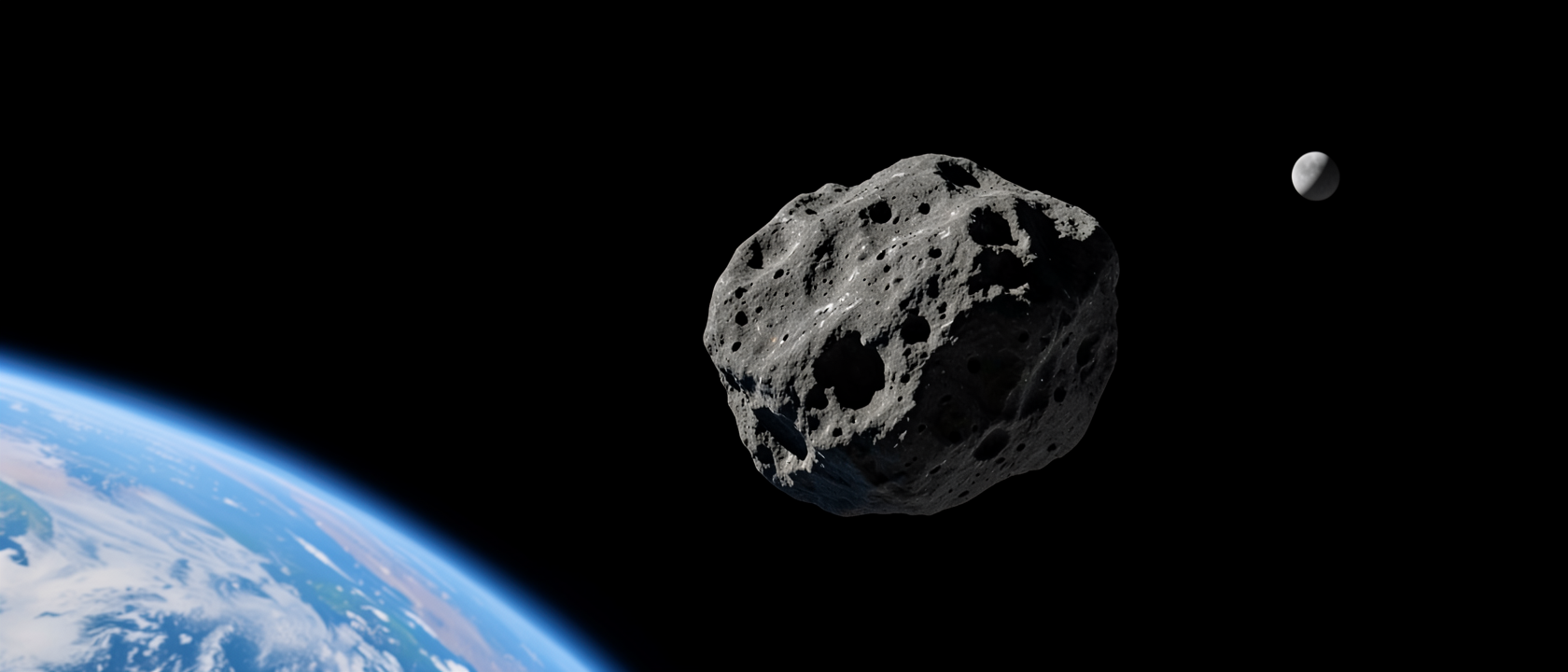
2026 TS: A Rock, a Ruler, and Two Moon-Widths of Clear Sky
An asteroid swept past Earth with more than two Moon-widths of open sky on either side, and the story still ran as a “close approach.” On October 18, 2026, the near-Earth asteroid cataloged as 2026 TS reached its nearest point to Earth, passing at roughly 0.006 astronomical units. An astronomical unit, or AU, is the average Earth-Sun distance: about 93 million miles (149.6 million kilometers). Even a small slice of that is a long way, and this slice worked out to about 2.4 times the distance to the Moon. That’s the whole event, before anyone reaches for the word “near-miss.”
The ruler nobody has to be taught
Astronomers measure close approaches in lunar distances for a simple reason: almost everyone already has a feel for how far away the Moon is, even without knowing the number. That number is 238,854 miles (384,399 kilometers), the span every full Moon has quietly stood behind for as long as anyone has looked up at it. 2026 TS’s closest point measured out to 2.4 times that distance, about 573,000 miles (roughly 920,000 kilometers) of open space. Put plainly: it stayed more than twice as far out as the Moon itself ever gets.
How we know it, and how well
These figures trace back to NASA JPL’s Center for Near-Earth Object Studies (CNEOS), which keeps a running table of every close approach by a tracked object. Two independent trackers of that data, Spaceweather.com and the Space Calendar project, both logged the same pass at 2.4 lunar distances, with a relative speed of about 23,000 miles per hour (10.3 kilometers per second). None of that came off a single instrument reading. It came out of an orbit model: a path fitted to a string of position measurements, tightened until it matches what was actually observed, then published as a close-approach solution. That is what “measured” means for an object like this, not one snapshot, but an orbit solved from many.
A size borrowed from brightness, not a tape measure
Spaceweather.com lists 2026 TS at about 180 feet (55 meters) across. That number is an estimate, not a measurement, nobody has bounced radar off this rock or resolved it in an image. It comes from converting the asteroid’s absolute magnitude, essentially how bright it would look from a standard distance, into a size, using an assumed surface reflectivity, or albedo, of 0.154, a middling value between a dark, carbon-rich surface and a pale, stony one. Shift that assumption and the size shifts with it. A separate listing, built on different albedo guesses, puts the same object anywhere from about 135 to 300 feet (41 to 92 meters) across; that range could not be independently confirmed against JPL’s own database here, so treat it as a rough bracket, not a settled figure. The rule behind it is simple, though: a darker surface has to be bigger to shine as bright as a paler one does. The size is a brightness calculation wearing a diameter’s clothes.
“Close approach” is not “near miss”
The phrase makes it sound like something swerved. Nothing did. 2026 TS was never on a path toward Earth. Its orbit always sent it through that particular patch of sky at that particular distance, a path set long before anyone pointed a telescope at it. A calculated 573,000 miles of clearance isn’t a close call avoided. It’s the answer to a question that was never actually open.
What the record doesn’t say
No discovery image or light curve for 2026 TS turned up in the sources behind this piece, and no survey or telescope is credited with spotting it first, a point of light, tracked night after night, is as close as anyone got. The catalogs don’t fully agree with each other, either: one feed, tagging an object also labeled 2026 TS, lists a noticeably larger miss distance than the 0.006 AU used here, and the exact time of closest approach shifts by close to an hour depending on which table is consulted. Whether October 18, 2026 was a single pass or one stop on a repeating orbit that will bring 2026 TS back this way again isn’t stated anywhere in the record. Those gaps aren’t hidden. They just haven’t been filled in yet.
What’s left, in the meantime, is a number most people can actually hold onto. Not an abstract fraction of an astronomical unit, but the Moon’s own distance, doubled, with plenty of sky left over. Most asteroid stories ask you to imagine something unfamiliar. This one only asks you to remember the Moon.