
A Flyby You Can Measure With the Moon
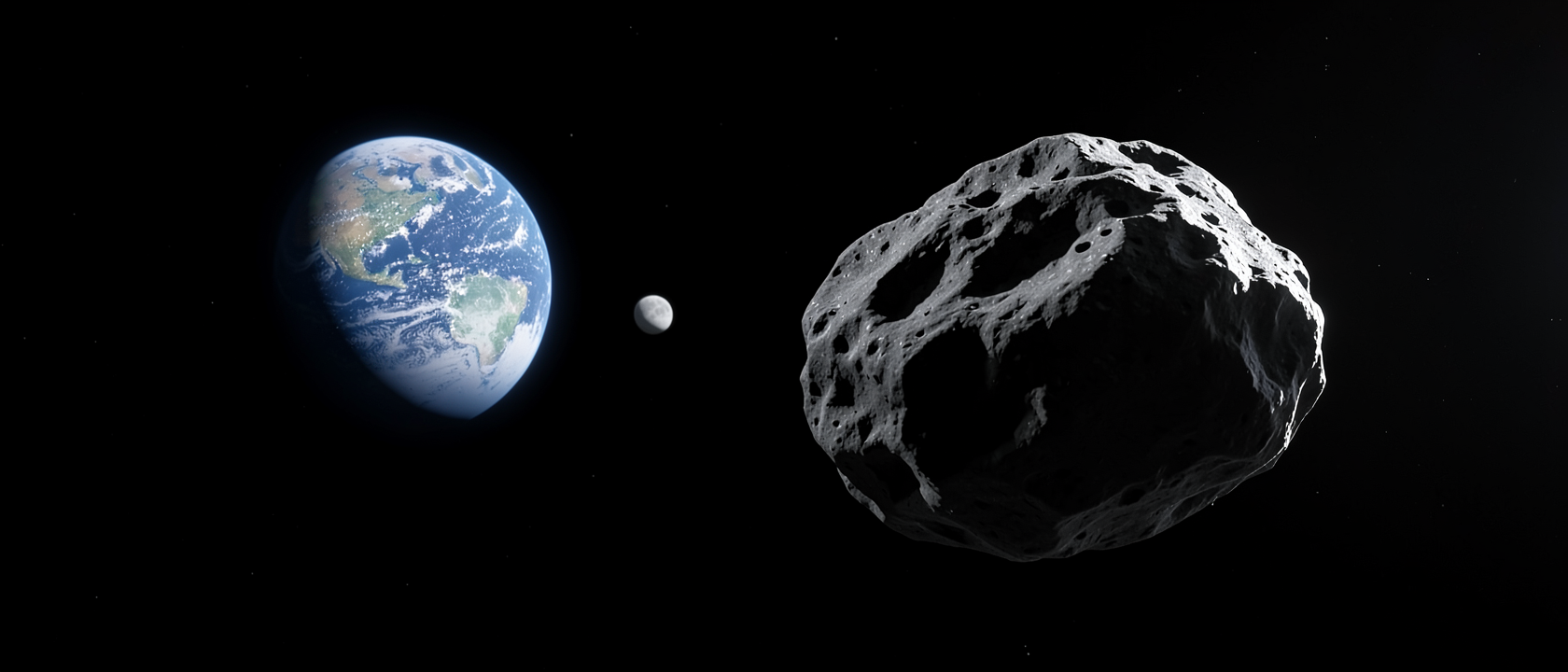
Picture the distance between Earth and the Moon, then stretch that gap out two and a third times wider. That’s almost exactly where a small near-Earth asteroid, cataloged as 2026 TS, passed Earth on October 18, 2026, at 06:16 UTC. Its measured miss distance: roughly 564,000 miles (907,900 km), or 2.36 times the average Earth-Moon distance of about 238,900 miles (384,400 km). This was a flyby, calculated well ahead of time from ordinary telescope data, not a warning sign, and nothing that needed watching.
The Moon as a Ruler
Kilometers and astronomical units (an astronomical unit is the average Earth-Sun distance, roughly 93 million miles, or 149.6 million km) are the native units for this kind of measurement, but they don’t mean much until you’ve got something to hold them against. Almost everyone has looked at the Moon and has some rough feel for how far it hangs. Stretch that gap two and a third times, and you’ve got where 2026 TS passed. Put the same number in astronomical units and it shrinks to 0.00607 AU, a sliver of the distance separating Earth from the Sun. Same 564,000 miles, two different feelings: roomy next to the Moon, practically nothing next to the Sun.
How We Know
The timing and the distance both come from NASA’s Center for Near-Earth Object Studies (CNEOS), run out of the Jet Propulsion Laboratory. Sky-survey telescopes catch a faint point of light shifting against the stars over days or weeks. CNEOS’s orbit-determination software fits a path to that handful of observations and runs it forward and backward through time. The 06:16 UTC close-approach time and the 564,000-mile distance are outputs of that fit. They are a calculation anchored to real telescope positions, not a guess.
Still Open: How Big Is It?
Asteroid size is usually worked out from absolute magnitude (a measure of how much sunlight an object reflects, taken from a standard distance) combined with an assumed albedo (the fraction of that light the surface actually bounces back). CNEOS’s own close-approach tables commonly assume an albedo around 0.154, a stand-in for an average rocky surface, and use it to estimate rough diameters across the board. For 2026 TS specifically, no clean, independently confirmed magnitude reading turned up in the data reviewed here. A size figure did circulate in some early reporting, but it couldn’t be matched against a verified CNEOS or JPL record, so it isn’t repeated in this piece. How big the rock actually is stays an open question until that gets sorted out.
A Mix-Up Worth Flagging
One number attached to 2026 TS in some reporting, a relative speed of 10.3 km/s, turns out to belong to a different object entirely. Independently verified reporting traces that figure to asteroid 2026 TP6, which passed Earth between October 14 and 15, 2026, at a much tighter distance of about 136,000 miles (219,000 km). The two designations were logged days apart with similar-looking names, and somewhere downstream the numbers got crossed. It’s a small story, but a useful one: a measured number is only as good as the label stuck to it, and checking that match is as much the job as the orbit fit itself.
The Picture: A Line, Not a Photograph
What CNEOS makes public is an orbit diagram, a plotted line showing Earth, the Moon’s orbit, and 2026 TS’s path sweeping past between them. It isn’t a photograph. An object this faint is a single point of light even through large sky-survey telescopes; there’s no surface to render, no texture, no color. The diagram is geometry: the same orbit fit from CNEOS, turned into a picture of where the rock went, not what it looks like.
What’s Still Open
The survey that first caught 2026 TS and logged its earliest observations hasn’t been confirmed. Its composition, whether it’s rock, metal, or loose rubble, is unknown. Its diameter waits on a verified magnitude reading. And whether its orbit brings it back for another pass near Earth is a question for more observations, not this one. None of that is a hole in the math. It’s just where the data runs out, for now.