
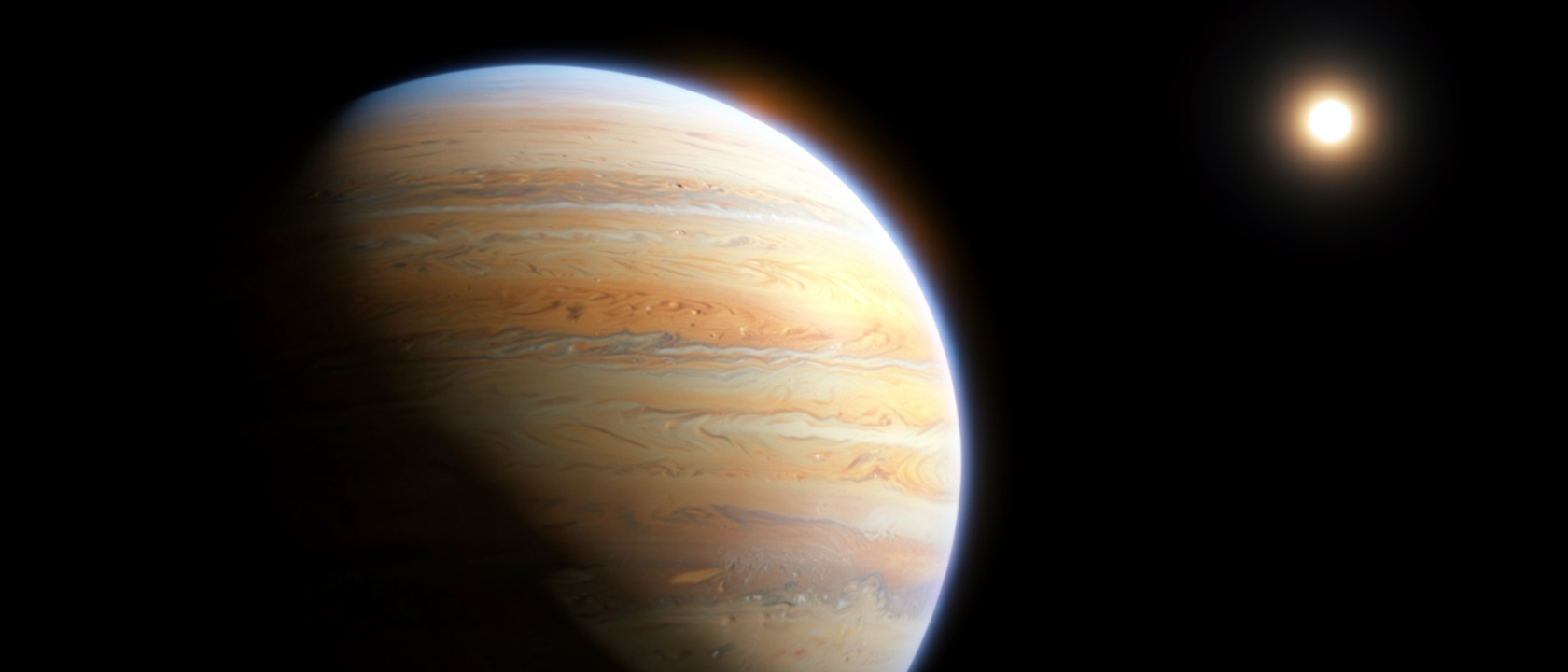
XO-6 b: A Gas Giant That Would Float
Picture a planet with roughly 1,398 times Earth’s mass that would still float if you dropped it into an ocean big enough to hold it. That’s XO-6 b, a gas giant found by the transit method in December 2016. The mass behind that claim isn’t a clean weighing, it’s an estimated ceiling, a modeled upper limit rather than a precise measurement, but even on the low end, the numbers work out lighter than water.
Two figures make the case: a mass of about 8.35 × 10^27 kg, the upper limit set by a 2016 radial-velocity study, which measures the tiny wobble a planet’s gravity induces in its star, and a radius of 1.480 × 10^8 m, 91,963 miles (148,000 km), 23.2 times Earth’s. Combine them and the estimated density comes out around 620 kg per cubic meter. Water is 1,000 kg per cubic meter. Over a thousand Earths’ worth of material, packed into a ball that size, and it still wouldn’t sink.
Twenty-Three Earths, Stacked
That radius, drawn from NASA’s Exoplanet Archive and matching the 2016 discovery paper, puts XO-6 b at 91,963 miles (148,000 km) across, radius, not diameter. Next to Jupiter, at 44,423 miles (71,492 km), it comes out 2.07 times as wide. Next to Earth, at 3,959 miles (6,371 km), the ratio is 23.2 to 1.
For a gut-check, not a catalog figure: shrink Earth to a marble about 0.6 inches (1.5 cm) across, and XO-6 b at the same scale would beat a basketball, closer to 14 inches (35 cm). That’s illustration; the real sticks are Earth and Jupiter, the two sizes most of us already carry around in our heads.
The units matter here. A planet 23.2 times Earth’s radius isn’t 23 times Earth’s volume, cube that ratio and you get roughly 12,500 times Earth’s volume. But the mass is only an estimated 1,400 times Earth’s. Volume ran far ahead of mass, and that gap is the whole story behind the low density.
How We Know
XO-6 b was found on December 8, 2016, by the XO planet search team, working from Haleakalā Observatory on Maui, Hawaii. The method, transit photometry, watches a star’s brightness dip by a tiny fraction every time a planet crosses in front of it. Time the dips and you get the orbital period, 3.76 Earth days here. Measure how deep each dip runs, against the star’s own radius, and you can work out the planet’s size.
That last step is the catch: a transit doesn’t hand you a ruler reading. The planet’s radius is calculated from the dip depth and the assumed radius of its star, XO-6, an F5 star hotter than the Sun at roughly 6,720 K. Get the star’s size wrong and the planet’s size shifts with it, which has happened here. The discovery paper and later catalog work list XO-6 b at 2.07 to 2.17 Jupiter radii; a newer analysis using the Gaia satellite’s revised distance to the system brings that closer to 1.52 Jupiter radii. This piece uses the larger, current Exoplanet Archive figure, but the planet’s true size is still being argued over.
The survey has its own history: started in 2005, it found five close-in gas giants, XO-1b through XO-5b, before a rebuilt instrument ran from 2012 to 2014. XO-6 b, pulled from that later run, was announced in 2016.
Why It’s Puffed Up
XO-6 b orbits just 7.58 million miles (12.19 million km) from its star, 0.0815 astronomical units, where one astronomical unit (AU) is the Earth-Sun distance, 149.6 million km. Close enough to bake the planet. Its equilibrium temperature, a modeled figure rather than a thermometer reading, works out to about 2,379°F (1,577 K) in one estimate, or 1,670 K (2,546°F) in another, two models roughly 6% apart. Either way, by one estimate, XO-6 b receives something like 580 times Earth’s insolation, the amount of starlight hitting a given patch of surface.
Heavy irradiation like that is a known way to inflate a gas giant’s atmosphere until the whole planet measures bigger than its mass alone would predict. That fits what’s seen here. Whether it’s the specific cause at XO-6 b, rather than one of several plausible ones, is still an open call.
There’s a story behind the mass number, too. XO-6 spins fast, its rotation period is shorter than its planet’s orbit, under 2.12 days against 3.77 days, and that speed smears the radial-velocity signal astronomers need to weigh a planet precisely. The 2016 paper could only set an upper limit: less than 4.4 Jupiter masses, which is where the widely quoted 8.35 × 10^27 kg comes from. Treat it as a ceiling, not a scale reading.
What’s Still Open
No photograph of XO-6 b exists, and none is likely to. At roughly 760 light-years away, it’s too faint and sits too close to its star for direct imaging, everything here comes from the dimming of starlight, not a picture of the planet itself. Any artwork of XO-6 b is an illustration, not a photograph.
Two more questions stay open. Ground-based observations once suggested XO-6 b’s transits run early or late by about 14 minutes, on a roughly 450-day cycle, hinting at a second, unseen planet tugging on its orbit. A later study using NASA’s TESS mission found no evidence for that variation at all. And nobody has published a structural model explaining how something with an estimated 1,400 Earths’ worth of mass ends up less dense than water. For now, that’s simply unanswered.