
A Planet Built Like Packing Foam, Or Maybe Not
Pull a block of packing foam out of a shipping box, the kind that crumbles a little before you toss it in the recycling bin. That foam runs about 30 to 50 kilograms per cubic meter (kg/m³), light enough that a block the size of a bathtub would weigh less than a bag of flour. Now set a planet next to it. One fitted solution in NASA’s Exoplanet Archive gives Kepler-176 e, a world orbiting a star of the same name, a bulk density of 41 kg/m³. If that number is right, this planet sits inside foam’s own range. Earth, for comparison, comes in at 5,514 kg/m³, so on that reading, Kepler-176 e would be somewhere between 0.007 and 0.01 times as dense as the ground under your boots, call it one part in 135. But that’s only one of the answers the archive gives, and the article below explains why the other answer looks nothing like it.
The Measuring Stick
Foam earns its place here because it’s something almost everyone has thrown away but nobody has ever weighed: 41 kg/m³ sits comfortably inside the 30-to-50 kg/m³ band of packing-grade polystyrene, no mental conversion required. A useful second stick is Kepler-7b, a different exoplanet with a measured density of about 166 kg/m³, also squarely in household-foam territory, so even a modestly puffy world can land there. Against plain water, at 1,000 kg/m³, the low-density reading for Kepler-176 e would put it about 24 times less dense, a planet that would float, given an ocean large enough to hold it.
How We Know
Nobody has set Kepler-176 e on a scale, and nobody ever will. It was confirmed in 2016, found by the transit method: the regular, shallow dip in its star’s light every time the planet passes in front of it, the same technique NASA’s Kepler space telescope used across its entire mission. That dip gives you a radius, 1.45 times Earth’s, or roughly 5,747 miles (9,248,245 m; a radius, not a diameter). Mass comes from a separate kind of signal entirely, a faint wobble or timing shift in the star’s own behavior, and NASA’s catalog lists 0.52 times Earth’s mass for this planet, about 3.11 × 10^24 kg. Density itself isn’t a reading from either instrument. It’s mass divided by the volume the radius implies, worked out afterward, and it’s only as solid as the numbers that feed it.
A Planet That Shouldn’t Add Up
Here’s the catch. Take NASA’s own headline numbers for Kepler-176 e, 1.45 times Earth’s radius, 0.52 times Earth’s mass, and do the division yourself, and you land near 940 kg/m³. Lower than Earth, but nowhere near foam. The 41 kg/m³ figure doesn’t come from that pairing at all. It’s one of 36 separate fitted solutions in the Exoplanet Archive’s composite table for this system, each built on a different assumption about the host star’s own mass and radius. Shift that assumption, and the planet’s calculated density shifts with it, by more than twenty times. Even on its own terms, the archive lists the low figure with an error range stretching from about 23 to 82 kg/m³, wide enough that “41” is really a midpoint standing in for a much blurrier answer.
The Orbit We Do Know
Some things about Kepler-176 e sit on steadier ground. It circles its star every 51.2 Earth days, about 0.14 times Earth’s own trip around the Sun, at a distance of 0.25654 astronomical units (an AU is the average Earth-Sun distance, about 93 million miles), roughly 23.85 million miles (3.838 × 10^10 m) out. Its orbit is logged as perfectly circular, with an eccentricity of 0.0, though in a composite catalog like this one a flat zero sometimes just means nobody has pinned down anything better yet, a placeholder rather than a confirmed measurement. Figures for its temperature and the sunlight it receives turn up in some listings but couldn’t be confirmed against a primary source here, so they’re left out rather than guessed at.
The Open Question
So which planet is it: one barely denser than packing foam, or one sitting at roughly a sixth of Earth’s density, comfortably rocky by comparison? Nobody knows yet. The Exoplanet Archive carries both answers at once, depending on which model of the host star you trust, and that gap is the real story here. Exoplanet masses this small often rest on faint, marginal signals, and a small error in reading the star can swing the planet’s calculated density by a factor of twenty or more. What Kepler-176 e is actually built from, a hydrogen-and-helium shell wrapped around a small core, or something else entirely, isn’t something the current numbers settle either way.
The Picture That Doesn’t Exist
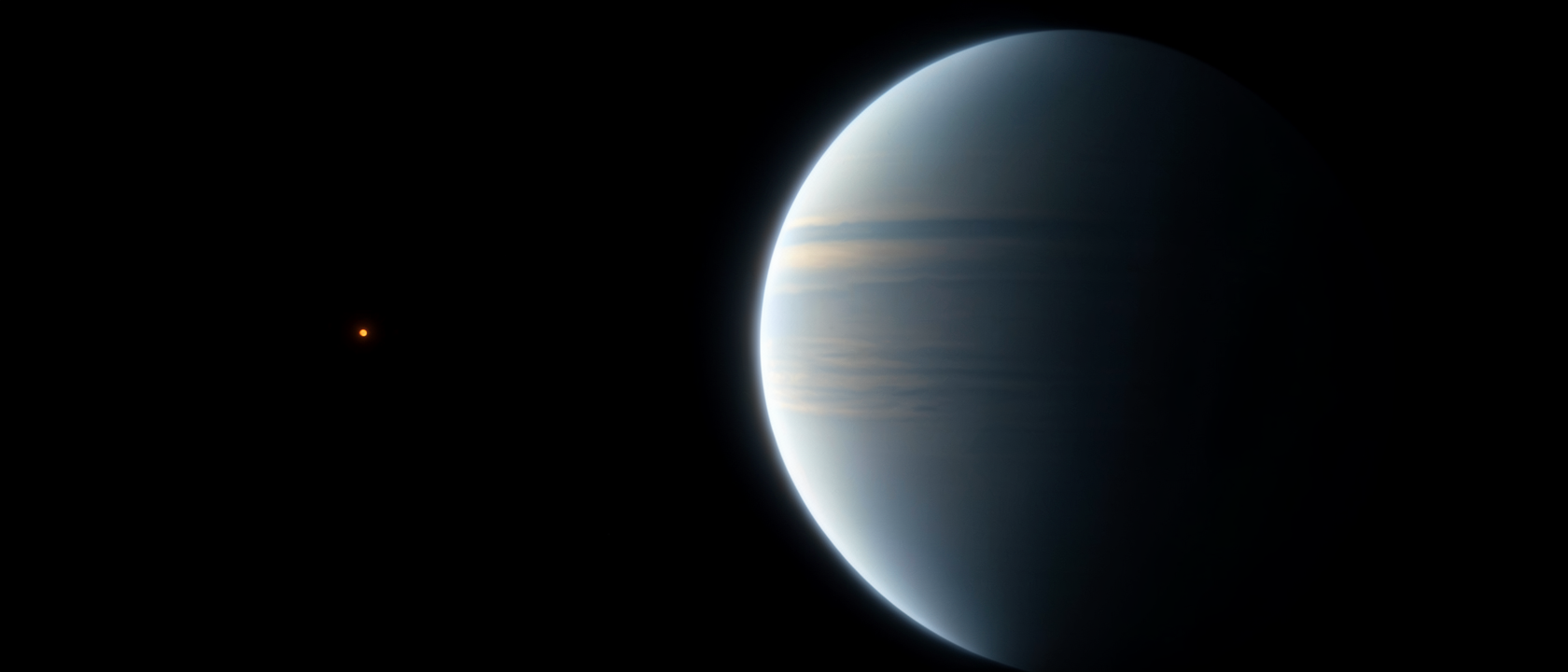
There’s no photograph of Kepler-176 e, and no telescope currently in operation could take one. At this distance it is a flicker in a light curve, not a disk anyone could resolve. Any image of it you come across, however convincing, is an artist’s illustration built from the numbers above, not a frame any camera has captured.