
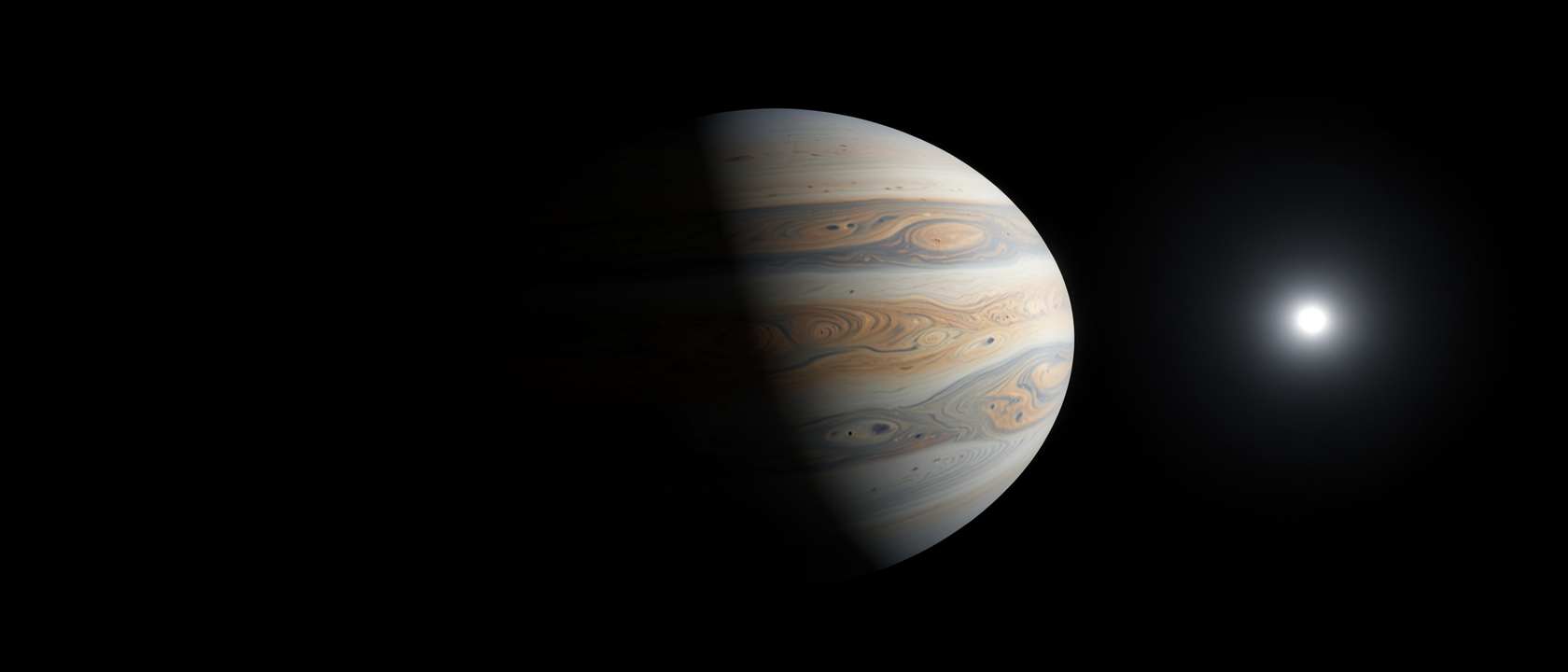
A Planet on a Stretched-Out Loop
An orbital eccentricity of 0.92, more than triple the most stretched planet our own solar system has to offer, belongs to a world called HD 26161 b. Eccentricity is a shape number, not a distance or a speed: zero means a perfect circle, and numbers creeping toward one describe an ellipse squashed almost flat. Every planet in our solar system sits at the tame end of that scale, with eccentricities running from about 0.0068 up to roughly 0.248. HD 26161 b blows past all of them.
The planet itself carries roughly 9,045 times Earth’s mass, orbiting a star about 133 light-years away, a light-year being a distance, not a time, around 5.88 trillion miles (9.46 trillion kilometers). No camera has ever photographed it. It turned up the way most long-period giants do: astronomers watched its star wobble, the back-and-forth tug of an unseen companion’s gravity stretching and squeezing the star’s light.
How we know
The discovery traces back to the California Legacy Survey, a long-running radial-velocity hunt that used the Keck Observatory’s HIRES spectrograph in Hawaii to track hundreds of nearby stars. HD 26161 b showed up in that data and was added to NASA’s Exoplanet Archive in a June 17, 2021, update, alongside twenty other newly confirmed worlds. The star’s wobble timing gives the orbital period, about 30 years, or roughly 9.45 × 10^8 seconds. The sharpness of that wobble gives the eccentricity.
A number still moving
That eccentricity hasn’t settled. The original 2021 discovery paper fit it at 0.82, with an uncertainty of about plus 0.06 or minus 0.05, built from only a partial stretch of the planet’s 30-year lap. The archive’s current figure of 0.92 comes from a later refit of that same kind of data. Which number better describes the real orbit is still an open question; nobody has tracked HD 26161 b through a full closest approach yet.
The planet’s mass estimate has shifted even more across reanalyses. A 2021 fit gave a minimum of 13.5 Jupiter masses, radial velocity alone can only set a lower limit, since it can’t reveal the orbit’s tilt. A 2022 study that folded in astrometric data raised that to about 28.5 Jupiter masses, essentially the number behind the archive’s current mass figure of 9,045 Earth masses. A 2025 reanalysis pushed it further still, to roughly 58.65 Jupiter masses. Same star, same wobble, three different answers, because the orbit is still only partly sampled.
What’s still unresolved
Even the host star’s basic type is disputed. One NASA-linked catalog calls it a G0 dwarf, sun-like; another calls it an F-type star, hotter and larger. The planet’s modeled temperature, about -260°F (111 K), and its modeled sunlight, about 33 watts per square meter against Earth’s 1,361, are both averages pulled from stellar brightness and orbital distance, not a thermometer reading. On an orbit this stretched, an average hides a lot: the close pass each lap should run far hotter and brighter than the distant one, and that swing hasn’t been modeled anywhere in the available record.
The picture
There isn’t a photograph of HD 26161 b, and the radial-velocity method could never produce one, it reads a star’s spectrum, not a planet’s surface. Any illustration of the planet is an artist’s impression, not an observation. The honest picture here is a diagram: Earth’s orbit drawn as a near-perfect circle, and HD 26161 b’s drawn beside it as a long, flattened loop. That shape is the whole story, a reminder that the tidy, circular paths we grew up picturing are not the rule out there. They’re the exception.