
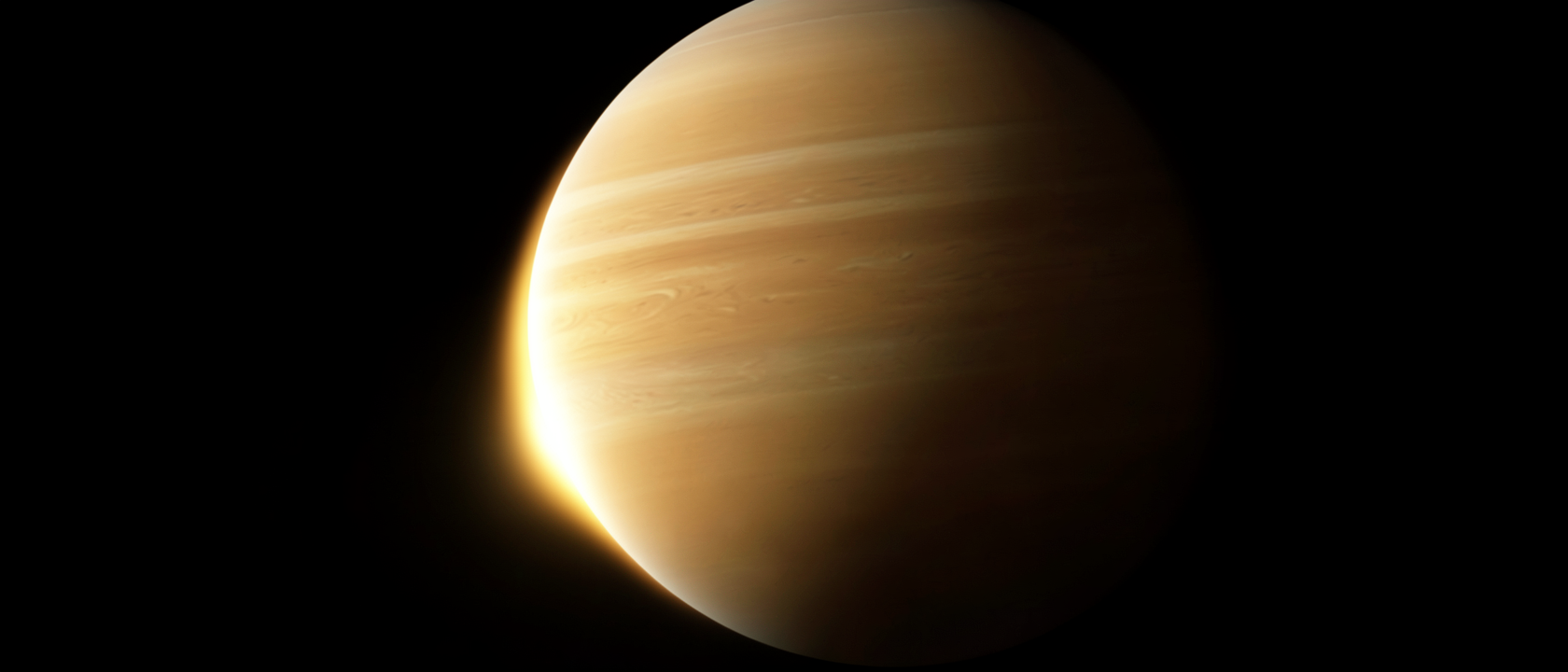
Kepler-435 b: Twice Jupiter’s Width, Thinner Than Scuba Tank Air
Picture Jupiter, the planet big enough to swallow a thousand Earths, then double its width. That doubled giant is Kepler-435 b: a planet with a radius of roughly 88,400 miles (142,300 km), about 22.3 times Earth’s own radius of 3,959 miles (6,371 km). Here’s where the picture breaks. Something that size should feel crushingly heavy. This one doesn’t. Its estimated average density loses out to the compressed air a diver carries on their back.
The Jupiter Yardstick
Earth is the wrong ruler for a planet like this; comparing a ball of gas to a ball of rock doesn’t scale well. Jupiter does the job better. By that measure, Kepler-435 b works out to 1.99 Jupiter radii, call it two Jupiters standing shoulder to shoulder, not a tower of 22 Earths. The reframing changes the feel of the number. “Twenty-two Earths” sounds impossible; “about two Jupiters” sounds like a planet that could plausibly exist. It does: it’s listed in the NASA Exoplanet Archive under its own name and under its discovery tag, KOI-680 b.
How We Know: Two Instruments, Two Methods
No camera has photographed Kepler-435 b, and none can; it’s too small, too dim, too close to its star’s glare. What exists is a dip in starlight. NASA’s Kepler Space Telescope watched the host star for years and caught a tiny, repeating dimming every 8.6 days, a planet transiting, or crossing, in front of the star’s disk. A team led by Almenara confirmed the detection in 2015, reading the planet’s size out of how deep that dip ran and how long it lasted, scaled against the star’s own radius.
Size from a shadow is only half the case. The mass came from an entirely separate method: ground-based follow-up with the SOPHIE spectrograph picked up the faint back-and-forth wobble the planet’s gravity imposes on its star, visible as a shift in the star’s light spectrum called radial velocity. That measurement gave a mass of 0.84 Jupiter masses, about 267 Earth masses, or 1.594 × 10^27 kg. Two independent techniques landing on the same planet is about as solid as this kind of evidence gets.
A World Too Light for Its Size
Divide that mass into that volume and the planet’s estimated average density comes out to around 131 kg per cubic meter. Earth averages 5,514 kg per cubic meter, so Kepler-435 b packs in roughly two percent of that. Plain water runs 1,000 kg per cubic meter; this planet is thinner still, and it loses out even to compressed air squeezed into a scuba tank. This isn’t a rocky world wearing a thin layer of gas. It behaves like gas that never quite got around to forming a core.
Baked by Its Star
Part of the answer sits in the orbit. Kepler-435 b circles its star at just 0.0948 astronomical units, an astronomical unit being the average Earth-Sun distance of about 93 million miles (149.6 million km), so roughly a tenth of that gap. One full orbit takes only 8.6 days. That close in, the planet soaks up a flux estimated at several hundred times Earth’s solar constant of 1,361 watts per square meter; one catalog figure puts the planet’s insolation near 923,000 watts per square meter, though that exact multiplier hasn’t been independently rechecked against the original paper.
Modeled temperatures for the planet’s outer atmosphere run from about 2,363°F to 2,653°F (1,568 K to 1,729 K), depending on assumptions about clouds and how heat circulates. These are modeled values, not thermometer readings, no instrument has ever touched this planet’s atmosphere directly. A planet baking at that temperature puffs up its outer gas much the way heated air swells a balloon. The extreme width and the extreme thinness look like two symptoms of the same heat.
What’s Still Unknown
The host star sits an estimated 4,627 light-years away, each light-year equal to roughly 5.88 trillion miles (9.46 trillion km), a distance worked out from its parallax, the tiny shift in its position as Earth swings around the Sun over the year, measured by the Gaia mission. But the star’s own size is still unsettled: published solutions put its radius anywhere from 1.38 to 3.21 times the Sun’s, and that uncertainty carries straight through to the planet’s own numbers. Whether the orbit is perfectly circular or slightly stretched is also open; a non-zero eccentricity has been proposed but not independently confirmed. And the planet’s actual makeup, how much hydrogen and helium, whether anything like a core sits buried inside, remains unknown. Every figure here comes from a shadow crossing a distant star. Nobody has ever seen the planet itself.