
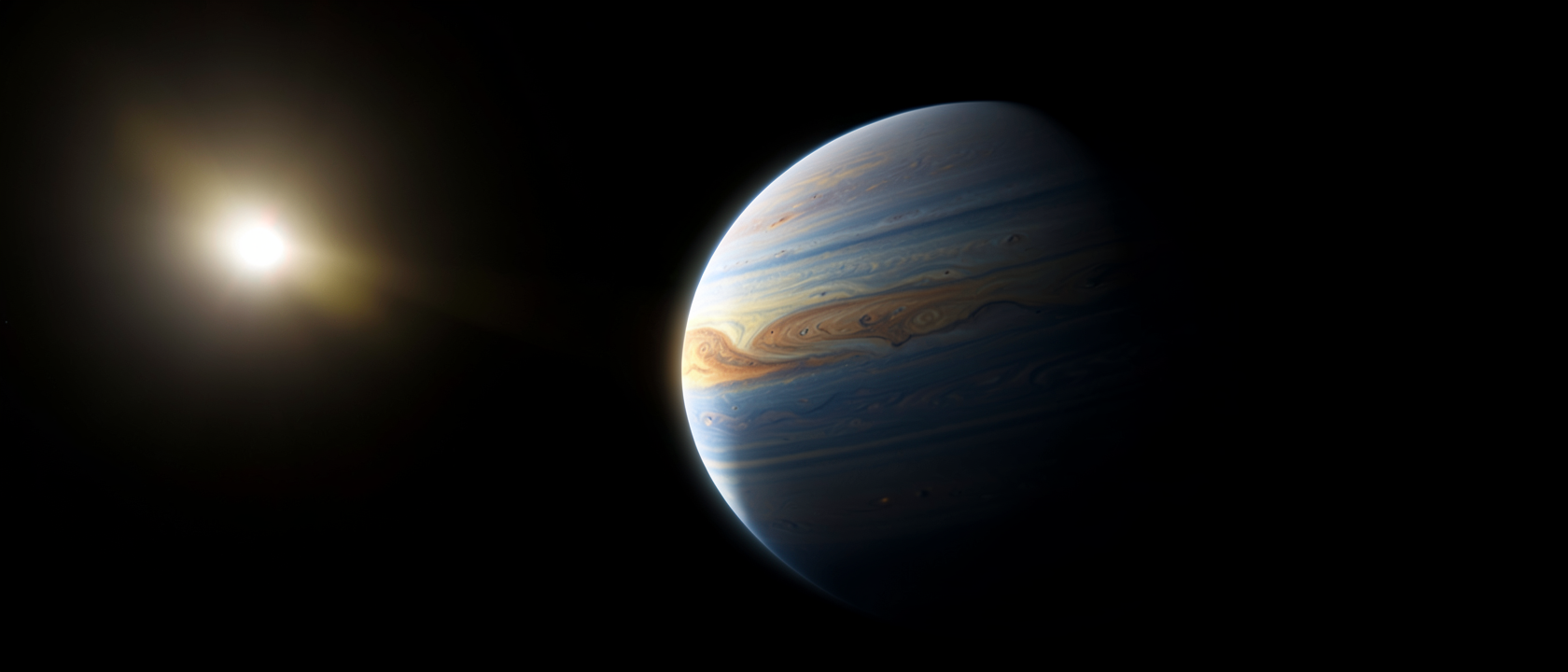
The Planet That Swings Like a Comet
Most planets keep close to a circle. This one dives toward its star, swings back out almost to where it started, then repeats the loop, a shape that looks far more like a comet’s path than a planet’s lane. The object is TIC 241249530 b, and its orbital eccentricity is 0.941–4.6 times more lopsided than Mercury, the solar system’s most eccentric planet, which manages only 0.2056. Eccentricity carries no unit; it’s a ratio that grades how far an orbit strays from a perfect circle, which sits at 0, toward a needle-thin ellipse, which sits close to 1.
Outclassing Every Transiting Planet Known
Among every planet ever caught crossing in front of its star by the transit method, the technique that watches starlight dim as a planet passes across it, none on record has a more stretched-out orbit than this one. Its closest known relative is HD 80606 b, a planet 4.1 times Jupiter’s mass with an eccentricity of 0.93 and a 111-day orbit; the two form a small, odd club of gas giants behaving like comets.
Caught in the Act of Dimming
On January 12, 2020, during a 28-day stretch in which NASA’s TESS spacecraft was staring at that patch of sky in the second year of its primary mission, the star’s brightness dropped by about 0.8% and then recovered, the signature of a planet crossing its face. That single dip wasn’t enough on its own to map the orbit’s shape. A team led by Arvind Gupta followed up with the NEID and HARPS-N spectrographs, tracking the tiny back-and-forth wobble the planet’s gravity imposes on the star’s light, and with the NESSI speckle-imaging camera, to rule out a background star faking the signal. The eccentricity came out of combining all of it: how long the dimming lasted, how that lines up with the planet’s 165.8-day orbital period, and the shape of the star’s wobble. The result was published in Nature in 2024.
A Year That Isn’t Steady
One full orbit takes 165.7719 days, about 1.4323 × 10⁷ seconds, just under half of Earth’s trip around the Sun. The planet riding that orbit is no stray chunk of ice: it carries 4.98 times Jupiter’s mass, or 9.453 × 1027 kilograms, in a body with a radius 1.186 times Jupiter’s, roughly 52,700 miles (84,790 kilometers) from its center to its outer edge. The archive’s catalog currently lists a modeled equilibrium temperature, a calculation of how warm a planet would run if it evenly absorbed and re-radiated its star’s light, not a thermometer reading, of about 439 K, roughly 331 °F (166 °C). Treat that figure carefully: it’s a single average spread across an orbit that, at this eccentricity, spends almost no time anywhere near average. A planet swinging this hard between close and far doesn’t have one temperature any more than a pendulum has one height.
What’s Still Open
The catalog gives a semi-major axis of 0.641 astronomical units (an AU being the Earth–Sun distance, about 149.6 million kilometers), 9.589 × 10¹⁰ meters, but not the periastron and apoastron, the actual closest and farthest points of that ellipse, which is where the real violence of the swing would show up. One 2026 follow-up study puts the current closest approach near 0.037 AU, but that figure sits inside an active dispute over which process, steady equilibrium tides or more chaotic dynamical ones, is driving the orbit’s slow circularization. The leading explanation for how the orbit got this stretched in the first place points to a wide companion star, cataloged separately about 1,664 AU away, whose distant gravity may have triggered cyclical tugging known as von Zeipel-Lidov-Kozai oscillations. That’s a favored hypothesis, not a settled one. Models suggest the orbit will keep rounding out into an ordinary hot Jupiter over a timescale of hundreds of millions to roughly a billion years. And no camera has ever photographed this planet, it was found purely from the dip it cut into its star’s light, so any image you see of it is an artist’s concept, not an observation.