
A Beach Ball That Would Float
Drop a beach ball into a backyard pool and it doesn’t sink. It rides high, mostly out of the water, because there’s almost nothing inside it. Now imagine a planet built the same way: a radius about 2.1 times Jupiter’s, wide enough to count among the giants, yet so light for its size that an ocean large enough to hold it would simply let it float.
That planet exists. It’s called TOI-3540 A b, and its radius works out to about 93,200 miles (150,000 kilometers), 23.5 times Earth’s radius of 3,959 miles (6,371 kilometers). It’s wider across than Jupiter itself. And it carries so little mass for all that bulk that, by the numbers, it would bob on water with room to spare.
The Measuring Stick
Twenty-three and a half Earths, lined up side by side, would just about span this planet’s width. But Earth is a small stick for something this size. The better one is Jupiter, the planet most people already picture when they hear “gas giant.” TOI-3540 A b comes out to roughly 2.1 times Jupiter’s radius, unusually large even by gas-giant standards, not just by Earth’s.
Shrink Earth down to a marble about six-tenths of an inch across (1.5 centimeters), and TOI-3540 A b becomes a ball roughly the size of a beach ball, about 14 inches across (35 centimeters). Same ratio, just small enough to hold in two hands.
How We Know
Nobody has photographed TOI-3540 A b, and nobody will for a long while; it sits too close to its star for any camera to resolve a disk that small at that distance. What exists instead is a dip. NASA’s Transiting Exoplanet Survey Satellite, TESS, watched the star TOI-3540 A and caught its light fading by a measurable fraction, then recovering, over and over. That repeating dimming, the transit method, is how the planet’s radius was worked out: the deeper and longer the dip, the bigger the object blocking the light.
The mass came from a separate technique, radial velocity, which tracks the tiny wobble a planet’s gravity induces in its star. Together, the two methods gave a team led by astronomer Yee enough data to publish the discovery in The Astronomical Journal on May 20, 2022. The host star, TOI-3540 A, is itself one half of a binary system, with a cooler companion star, TOI-3540 B, orbiting nearby, though that companion plays no measured role in the planet’s own numbers.
Why Intuition Fails
Radial velocity follow-up puts TOI-3540 A b’s mass at 375 Earth masses, give or take 44, about 1.18 times Jupiter’s mass. Pair that mass with a radius 2.1 times Jupiter’s, and the bulk density comes out to roughly 65 kilograms per cubic meter, or about 4 pounds per cubic foot.
For comparison: Earth averages about 344 pounds per cubic foot (5,513 kilograms per cubic meter). Plain water runs about 62 pounds per cubic foot (1,000 kilograms per cubic meter). TOI-3540 A b is lighter than water, by a wide margin. Size usually means mass, and mass usually means something sinks. This planet is mostly puffed-up gas, held together so loosely that most of its volume is close to empty by planetary standards.
Numbers That Need a Label
TOI-3540 A b orbits at just 0.043 astronomical units from its star, an astronomical unit being the Earth-Sun distance, or roughly 4.0 million miles (6.4 million kilometers). One full lap takes 269,568 seconds, a little over 3.12 days: about a hundredth of the time Earth takes to circle the Sun.
Its equilibrium temperature is modeled at about 2,237°F (1,498 K, plus or minus 22 K). That’s not a thermometer reading; it’s a figure derived from how much starlight the planet is assumed to absorb and radiate back out. By the same modeling, it receives roughly 841 times the sunlight Earth gets, give or take about 50 times either way. Its orbit is logged with an eccentricity of zero, but that value was fixed in the model fit, not independently measured to that precision.
What’s Still Open
A few things here are genuinely unsettled. Whether the 2022 radius and mass figures hold up as more transit data comes in is one question; catalog values like these do get revised. What the planet actually looks like on the inside, the structure that produces such extreme puffiness, is another; no atmospheric study has been published yet. Whether the orbit is truly circular, or just modeled that way because the data isn’t precise enough to say otherwise, is a third. And its distance from Earth, in light-years, hasn’t even been pinned down in the catalog.
The Picture
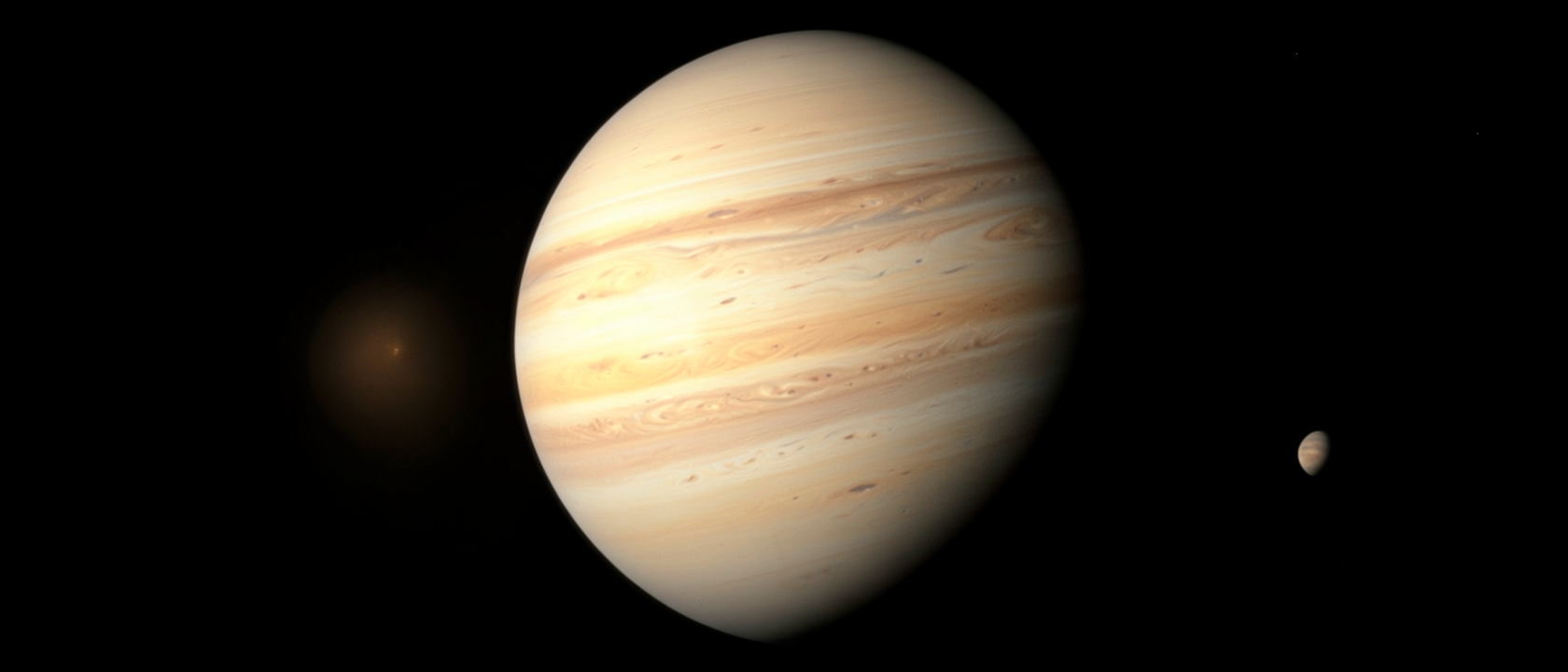
Any image you see of TOI-3540 A b, glowing cloud bands, a crescent against a dim star, is an artist’s illustration built from these numbers, not a photograph from any telescope. None exists. The only real data point is a light curve: a line on a graph that dips every 3.12 days and, indirectly, tells you everything above.