A Gas Giant Bigger Than Jupiter, Built Almost Hollow
Put Jupiter next to its closest known rival for sheer size, and Jupiter loses. The rival, a planet called HAT-P-67 b, has puffed its atmosphere out past Jupiter’s edge and kept going, while carrying less than half of Jupiter’s mass. A planet built big and left nearly hollow.
The Measuring Stick
A 2025 reassessment of the planet’s data puts HAT-P-67 b’s radius at 95,070 miles (153,000 km), about 24 times Earth’s own radius of 3,959 miles (6,371 km), the standard yardstick for exoplanets because Earth is the one rock everyone has actually stood on. Jupiter’s radius is 43,441 miles (69,911 km); set the two side by side and HAT-P-67 b comes out at 2.14 Jupiter radii, a bit more than double.
Mass runs the other way. The same 2025 study puts HAT-P-67 b’s mass at 8.54 × 10^26 kilograms, about 143 Earth masses, or only 0.45 times Jupiter’s mass, give or take 0.15. A planet wider than Jupiter, carrying less than half its mass.
How We Know
Nobody has flown a probe past HAT-P-67 b, and no camera has caught it directly. It turned up the way most exoplanets do: by dimming its star’s light on a schedule. Astronomers watched the star HAT-P-67 lose a measured sliver of brightness every 4.81 days (415,593 seconds, if you want it exact) as the planet crossed in front of it. The size of that dip, combined with the host star’s own radius, about 2.65 times the Sun’s, is what gives you the planet’s size. The orbit itself is perfectly circular, with an eccentricity of zero, and tight: a semi-major axis of just 6.05 million miles (9.73 million km), or 0.065 astronomical units. One astronomical unit is the average Earth-Sun distance, so HAT-P-67 b circles its star roughly 15 times closer than Earth circles the Sun.
Zhou and colleagues published the discovery in the Astronomical Journal in April 2017. A year earlier, in 2016, the same team used a technique called Doppler tomography. It works by tracking how starlight shifts across the face of a rapidly spinning star as something crosses it, and it let them rule out the chance that the dimming came from a disguised pair of eclipsing stars rather than a real planet. The mass figure came from a separate method, measuring the small wobble a planet’s gravity gives its star, and that measurement is harder to pin down here: HAT-P-67’s own fast spin makes the wobble tricky to isolate.
Why Bigger Doesn’t Mean Heavier
Divide that mass by that volume and the 2025 study lands on a bulk density of about 3.8 pounds per cubic foot (61 kilograms per cubic meter), under a sixteenth of water’s roughly 62 pounds per cubic foot (1,000 kilograms per cubic meter). That makes HAT-P-67 b the second-lowest-density transiting hot giant on record, behind only a planet called WASP-193 b.
The likely driver is heat, though this part is a model, not a thermometer reading: an equilibrium temperature near 2,966°F (1,903 K), worked out from how close the planet sits to its star. Sitting that near a star for a long stretch of time can swell a gas giant’s outer atmosphere, the way a marshmallow puffs up before it ever catches fire.
The Picture That Actually Exists
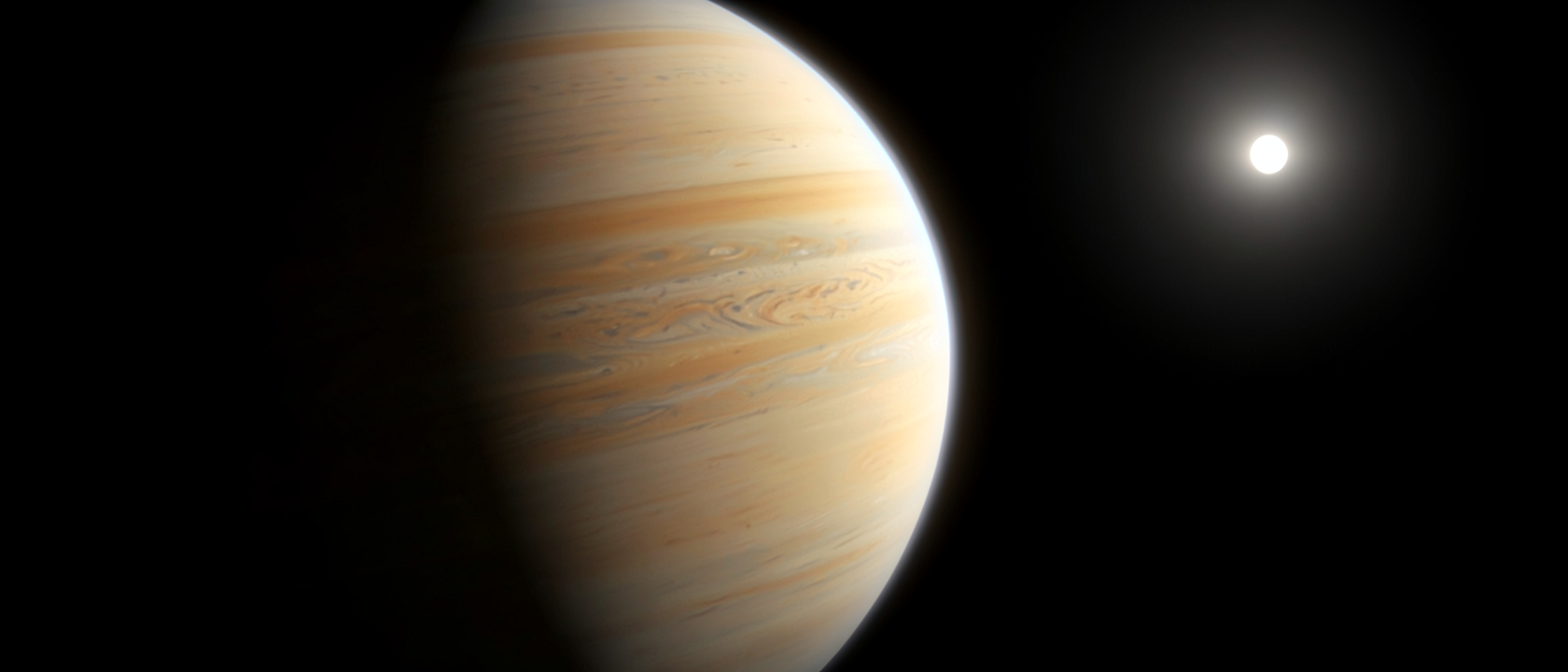
There’s no photograph of HAT-P-67 b, and no camera on the horizon changes that. At this distance, a transiting exoplanet is a shadow on a graph, not a disk in a lens. Any image showing swirling clouds or a glowing crescent is an illustration, assembled from the measured numbers, not a camera’s record.
The real evidence is plainer: a light curve, starlight dipping by a measured fraction, holding for a few hours, then climbing back as the planet clears the star’s face. That dip is the actual data behind every number in this piece, less dramatic than a photograph, and more honest about what was actually seen.
What’s Still Open
The 153,000-kilometer figure above is a 2025 revision of the numbers from the planet’s 2017 discovery, a reminder that exoplanet catalogs get updated as better data arrives, not a flaw in the method. What’s still unresolved is HAT-P-67 b’s longer-term fate: models suggest that gas giants this inflated, orbiting this close to a star, sit on an unstable path that eventually ends with the planet spilling its own atmosphere onto the star. Nobody has watched that happen here. It’s a prediction, not an observation, and for now it stays that way.