
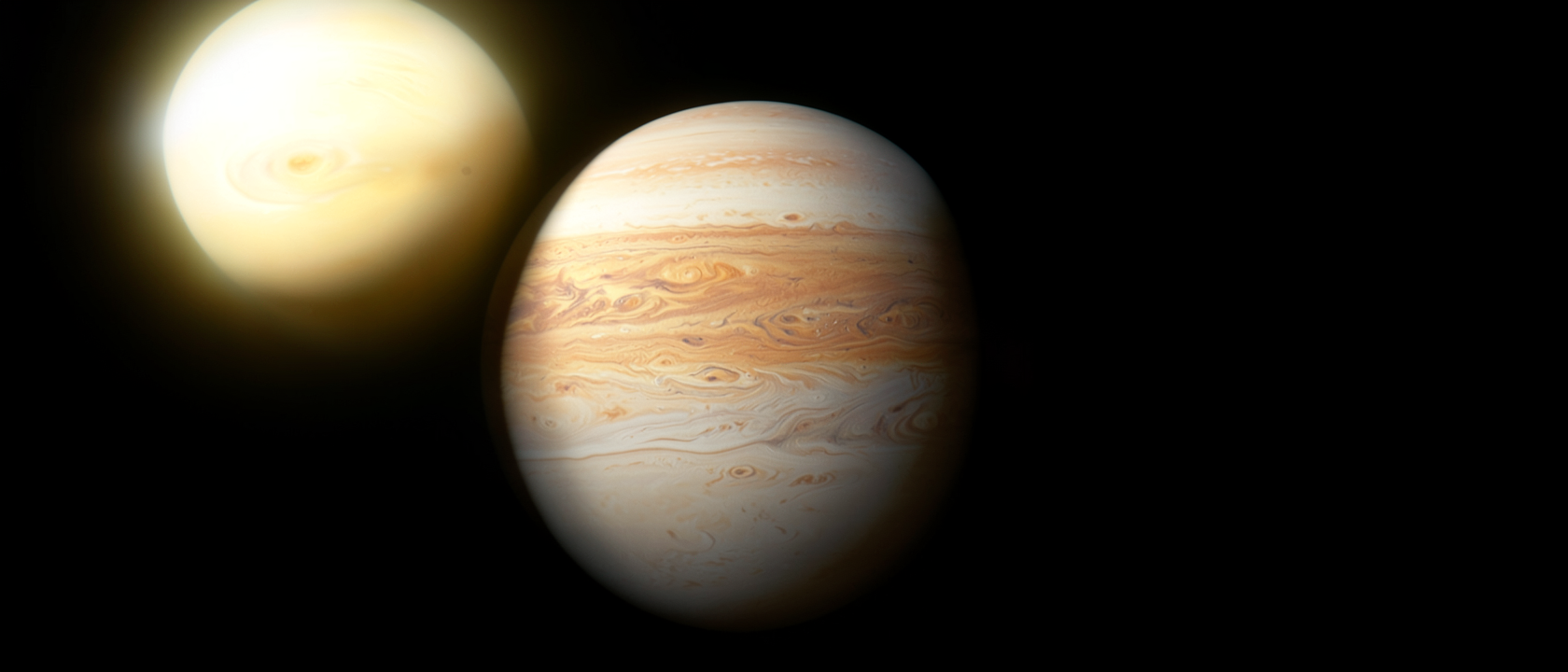
HD 80606 b: An Orbit Stretched Almost to Breaking
Here’s the number first: 0.932. That’s orbital eccentricity, a scale from 0 (a perfect circle) to 1 (an ellipse squashed almost flat), and it’s the figure NASA’s Exoplanet Archive currently lists for HD 80606 b. Mercury, the most elongated orbit in our own solar system, sits at 0.206. Divide one by the other and HD 80606 b’s path is about 4.5 times more stretched than Mercury’s, and Mercury is already the oddball among the planets we’ve watched up close.
Put that shape into motion and you get a planet the size of Jupiter swinging from about 2.92 million miles (4.69 million km) from its star at closest approach out to roughly 82.65 million miles (133.02 million km) at its farthest, within one 111-day year. The far point is about 28 times the near point. No planet in our solar system does anything close to that in a single orbit.
How We Know
Nobody has photographed HD 80606 b. It was found in April 2001 by a team led by Michel Mayor and Didier Queloz, using the ELODIE spectrograph at the Haute-Provence Observatory. As the planet orbits, its gravity tugs the star back and forth by a tiny amount, and that tug shows up as a rhythmic shift in the star’s light spectrum, the same Doppler effect that bends the pitch of a passing siren. The planet’s mass, its period, and the shape of its orbit are all worked out mathematically from that wobble. Nobody has seen the planet. They’ve seen its star flinch.
The eccentricity figure has been sharpened more than once since discovery. A 2009 study combining radial-velocity measurements with timing from the Spitzer Space Telescope put it at 0.9336. A later refit using a global network of telescopes tightened that to the 0.93183 now carried in the archive. The host star itself sits about 216.8 light-years away, a distance pinned down by Gaia’s parallax measurements, a light-year being a distance, roughly 5.88 trillion miles, never a stretch of time.
A Jupiter-Class Planet on a Short Leash
HD 80606 b carries 4.16 times Jupiter’s mass, about 7.90 × 10^27 kilograms, mass, not weight; there’s no scale anywhere to set it on. Its radius runs about 45,845 miles (73,780 km), roughly 1.03 times Jupiter’s own. A body that size, on an orbit this eccentric, spends most of its 111.4-day year far from its star, then falls inward fast and finishes the close pass in a matter of hours.
The Heat Spike Spitzer Caught
In 2009, Laughlin and colleagues pointed NASA’s Spitzer Space Telescope at HD 80606 during one of those close passes. Over a few tens of hours, the sunlight striking the planet rose roughly a thousandfold, and its measured temperature climbed from about 400 K to 1,400 K (260 °F to 2,060 °F) before easing back down as the planet swung outward again. It’s one of the rare cases where astronomers watched a planet’s weather change in something close to real time, instead of inferring it from a single snapshot.
What’s Still Open
Whether HD 80606 b truly holds the record for the most eccentric confirmed orbit is disputed. A 2010 study flagged HD 20782 b as a possible rival, though that figure rests on a single measurement and hasn’t been confirmed. What bent this orbit into such an extreme shape is also unsettled: one proposed mechanism, laid out by Wu and Murray in 2003, suggests a distant stellar companion, HD 80607, about 1,200 astronomical units away, dragged the orbit through repeated gravitational cycles that tidal friction then locked in place. That’s a plausible story, not a settled one. And there’s no single “resting” temperature for this planet. Published estimates for its equilibrium temperature range from under 500 K to 1,400 K, because the number depends entirely on where in that lopsided orbit you happen to catch it.