
A Planet on a Rubber Band, Not a Wedding Ring
Picture a planet swinging on a stretched-out ellipse instead of a tidy loop, flinging itself far from its star and then whipping back in, lap after lap. HIP 66074 b does exactly that, and the shape of that path has a number attached to it: eccentricity, a dimensionless ratio running from 0 (a perfect circle) to just under 1 (a sliver thin enough to almost pinch shut). HIP 66074 b’s orbit measures 0.948 ± 0.004, published in 2023 by Sozzetti and colleagues in the journal Astronomy & Astrophysics and still the value listed on the NASA Exoplanet Archive’s overview page.
The measuring stick
Earth’s own orbit sits at 0.0167, close enough to a perfect circle that no eye, only instruments, could tell the difference. HIP 66074 b’s orbit is about 57 times more eccentric than that. Among confirmed exoplanets known at the time this result was published, only one had a more stretched orbit: HD 20782 b, measured at 0.97. Eccentricity carries no mass and no size inside it, it’s a pure shape ratio, which is exactly why a giant planet here and a far smaller body elsewhere in the catalog can sit on the same number line and be compared fairly.
How we know
The story behind that number has a twist. In 2022, the Gaia mission, which measures the precise position of stars across the sky, a technique called astrometry, flagged a candidate super-Jupiter tugging HIP 66074 through what looked like a nearly edge-on orbit, completing a lap roughly every 300 days with only modest eccentricity. Astronomers checked the signal with the HARPS-N spectrograph, part of the TNG/GAPS programme, using a different method: radial velocity, which watches a star’s light shift color as gravity pulls it back and forth. The signal they measured was fifteen times weaker than Gaia’s solution had predicted. That gap was the puzzle.
The GAPS team resolved it in 2023 by simulating how Gaia actually scans the sky. The true orbit, it turned out, was being viewed almost face-on, tilted less than about 13 degrees from our line of sight, a geometry in which Gaia’s astrometry systematically underestimates eccentricity. Once that correction went in, HIP 66074 b became the first exoplanet candidate flagged by Gaia’s astrometry to be confirmed through follow-up radial-velocity measurements, in a paper published that September.
Numbers that don’t behave
HIP 66074 b orbits at a semi-major axis, roughly the orbit’s average radius, of 0.8 astronomical units, or about 1.195 × 10^11 meters. An astronomical unit, or AU, is the average Earth-Sun distance, about 1.496 × 10^11 meters, so this planet’s average lap sits a bit tighter than Earth’s. It completes one orbit in 310.9 days, close to an Earth year in length. But because the path is so stretched, that single year carries the planet from a distant arc down to an estimated periastron, its closest approach, of just 0.04 AU, about 3.7 million miles (5.98 × 10^9 meters) from the star. At that range, the discovery paper’s modeling suggests any smaller planet orbiting closer in would be unlikely to survive the gravitational pull.
The planet’s mass carries its own asterisk. Radial-velocity data alone pin down a minimum mass of about 0.79 Jupiter masses. The full mass is listed as 5 ± 2 Jupiter masses, around 1,589 Earth masses, or 9.49 × 10^27 kilograms, but that figure rides on the same hard-to-pin orbital tilt, found to be nearly face-on, which is why the uncertainty is wide enough to swing the true mass by several Jupiters in either direction.
What’s still open
Numbers for this planet’s radius, density, sunlight received, and surface temperature circulate in places, but none of them trace back to a confirmed primary measurement. HIP 66074 b has never been seen passing in front of its star, so there’s no transit data and no direct way to measure its radius at all. Until further observations close that gap, those figures stay unconfirmed. What has held up since 2023 is the orbit’s shape, the eccentricity measurement itself.
The picture that doesn’t exist
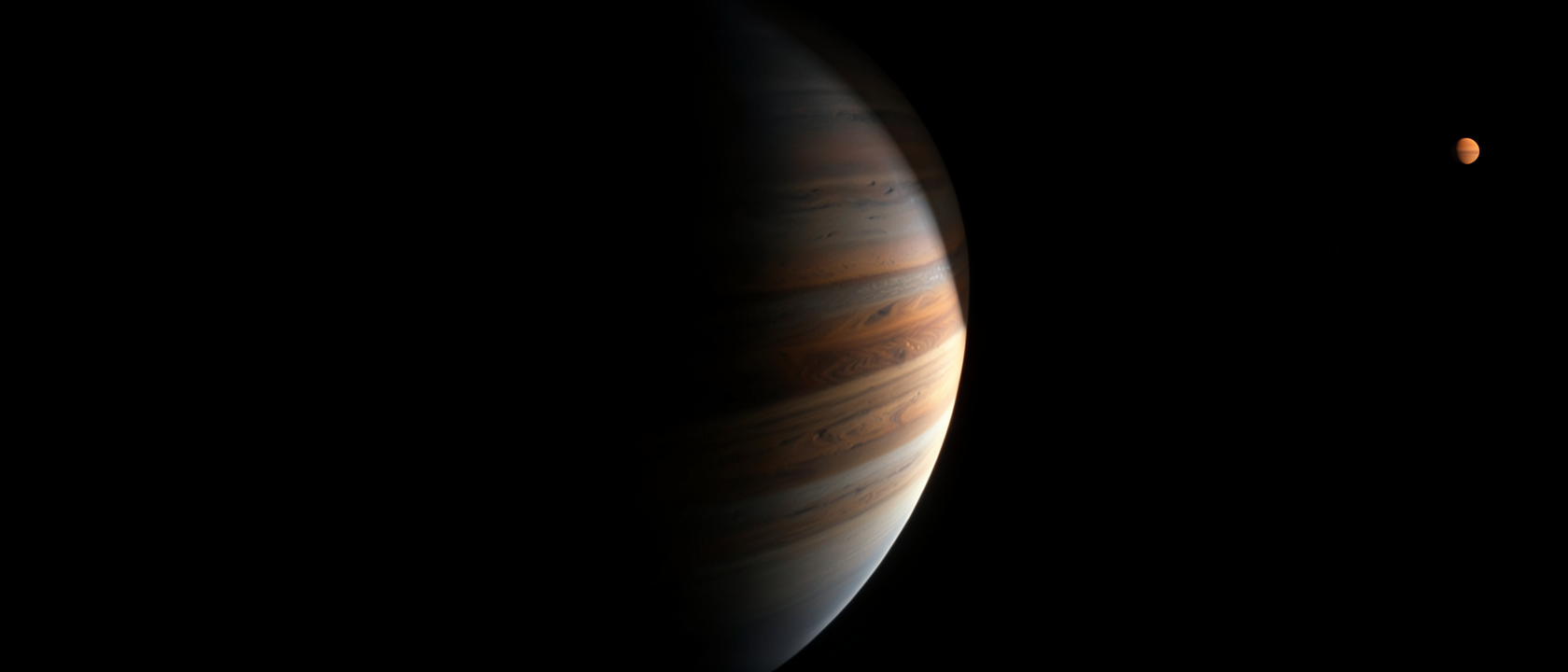
The HIP 66074 system sits about 114 light-years away (1.08 × 10^18 meters), a light-year being a distance, the span light covers in a year, not a stretch of time. No telescope has photographed this planet, and none is likely to soon: it was found by watching its star move, not by catching the planet’s own light. Anything shown alongside this story is either an artist’s illustration or a plot of that stellar wobble, never a photograph.