
A Planet Wider Than Jupiter, Lighter Than Water
Shrink Earth to the size of a regulation golf ball, about 1.7 inches across (4.3 cm), and the planet in this story balloons out to a sphere roughly 3.5 feet wide (1.07 m), tall enough that you’d duck to walk under it in a kitchen. That planet is TOI-1408 b, a gas giant that circles its star every 4.4 days, found via the transit method with NASA’s Transiting Exoplanet Survey Satellite (TESS) and announced in 2023.
The stick: Jupiter, and then some
Most people’s mental yardstick for “big planet” is Jupiter, about 44,424 miles (71,492 km) in equatorial radius, the largest thing a backyard telescope regularly shows off. TOI-1408 b measures about 99,100 miles (159,500 km) in radius: 2.23 times Jupiter’s radius, and roughly 25 times Earth’s mean radius of about 3,959 miles (6,371 km). It doesn’t just edge past the Jupiter comparison. It blows straight through it.
How we know: a shadow, not a snapshot
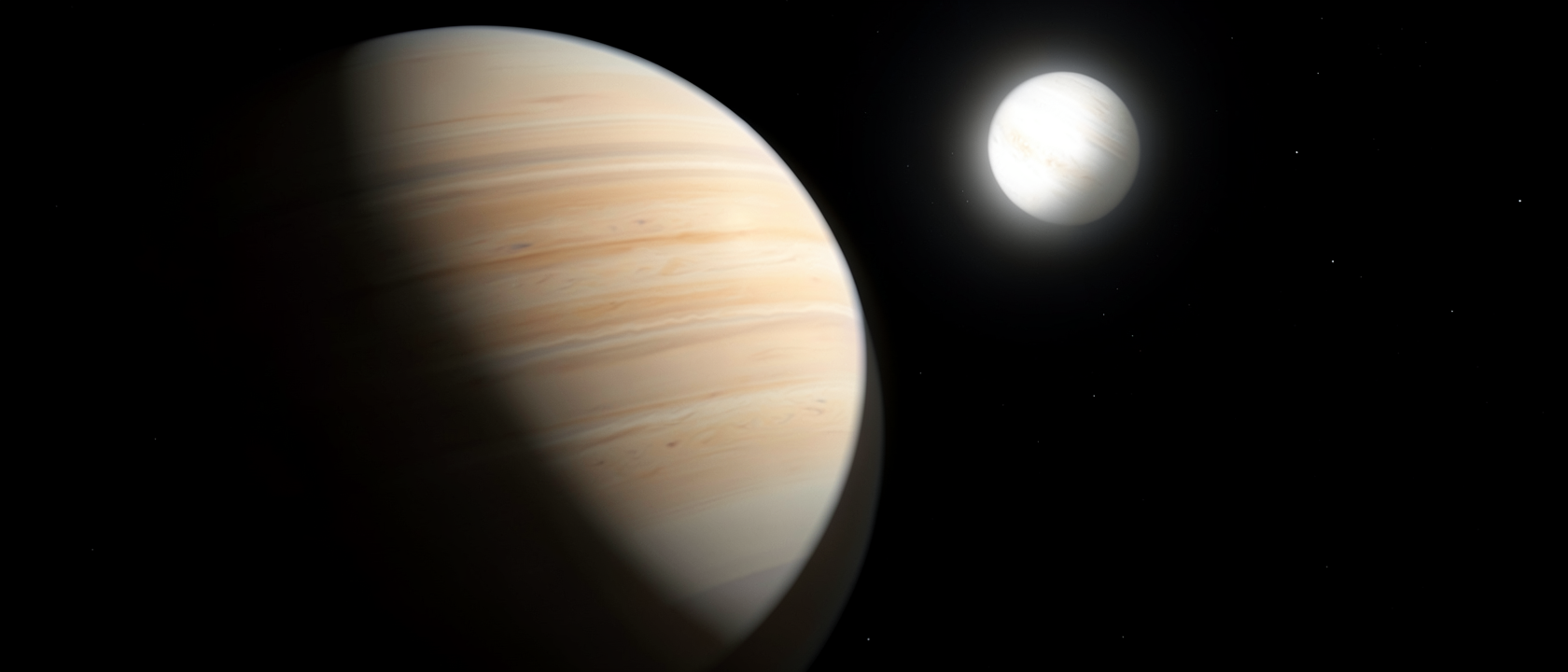
No telescope has photographed TOI-1408 b. Any glowing, swirled-orange sphere attached to a story about it is an illustration, not a photograph, there’s no Hubble frame or Webb composite of this planet, because none exists. What TESS actually recorded was a light curve: the star’s brightness dipping every 4.4 days as something passed in front of it. From the depth of that dip, combined with the star’s own known radius, astronomers calculate how large the object blocking the light has to be. That’s where 159,500 km comes from, a figure built from shadows, later checked against radial-velocity data (the Doppler wobble a planet’s gravity induces in its star) the same year.
One complication: TOI-1408 b’s transit is a grazing one. It clips only the edge of the star’s disk as seen from Earth instead of crossing the middle, which makes the radius harder to pin down precisely, part of why the number shifts slightly between papers.
Why the math feels wrong
A planet more than twice as wide as Jupiter ought to feel heavier than Jupiter. This one doesn’t, not by nearly enough. NASA’s exoplanet archive lists its mass at 1.69 Jupiter masses, about 537 Earth masses. A 2024 discovery paper on a companion planet in the same system put the figure a little higher, at 1.86 Jupiter masses. Neither number is wrong so much as unsettled; they come from different modeling runs, and the gap between them hasn’t closed.
Either way, divide mass by volume and the result is strange: a density of roughly 180 kilograms per cubic meter, an estimate calculated from those catalog numbers rather than measured directly. Water comes in at about 1,000 kg/m³. Earth is 5,514 kg/m³. TOI-1408 b is a ball of gas thin enough that, dropped into a large enough tub, it wouldn’t sink, it would sit on top of the water.
The estimate behind the heat
Nobody has measured TOI-1408 b’s temperature directly; there’s no surface to hold a thermometer against. Its equilibrium temperature is modeled from how much starlight it absorbs at a distance of 0.058 astronomical units from its star, an astronomical unit being the average Earth-Sun distance, about 93 million miles, combined with an assumed reflectivity. The model gives roughly 1,868°F (1,293 K). That heat, from sitting so close to a bright star, is the leading proposed explanation for why the atmosphere has puffed out this thin. It’s a hypothesis, not a settled finding.
What’s still open
Three things remain unanswered. Whether stellar heating alone explains a density this low, or whether something else is involved, is open. What the atmosphere is actually made of hasn’t been measured at all. And the mass and radius figures themselves are still catalog values, not fully reconciled between the discovery-era papers and later ones, the same kind of loose thread a team from Lund University, led by Judith Korth, pulled on in a paper published July 25, 2024, when tiny timing wobbles in TOI-1408 b’s transits, the largest such wobble measured relative to orbital period at the time, led them to a second, smaller planet, TOI-1408 c, tucked in even closer to the star. The same radial-velocity data hinted at a possible third, longer-period object, still unconfirmed. TOI-1408 b, in other words, is still being measured, one shadow at a time.