
The Scale You Can Picture
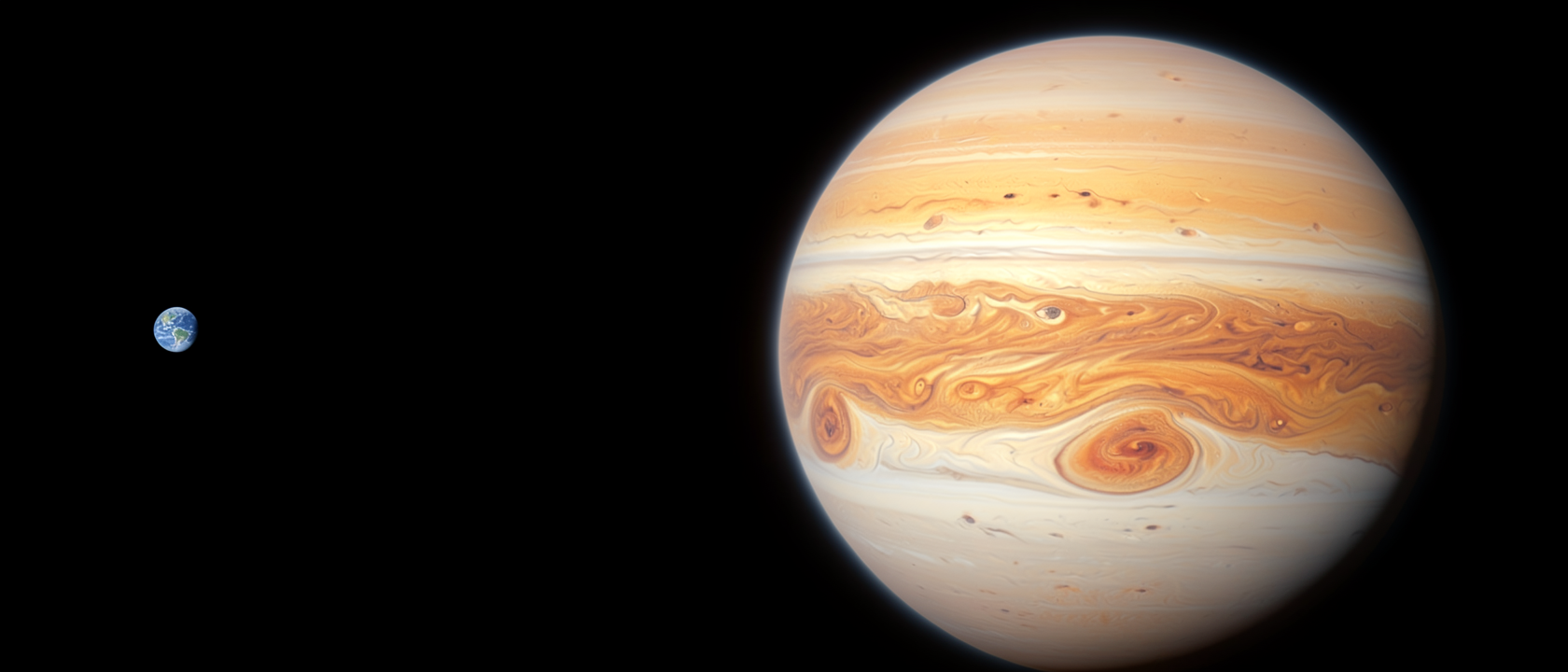
Imagine a giant balance scale with Jupiter sitting on one pan. On the other pan, you start loading Earths, one at a time. The beam won’t level out until you’ve stacked 317.83 of them there. Not “hundreds.” That exact ratio is what NASA’s own planetary fact sheet gives for the two worlds. It’s the single largest gap between Jupiter and Earth on that entire sheet, bigger than the difference in size, spin, or anything else you could line the two planets up against.
The Measuring Stick
Jupiter’s mass is 1,898.13 × 10^24 kilograms, write out the zeros and it’s 1.89813 × 10^27 kg. Earth’s mass, tabulated on the same NASA reference sheet, is 5.9722 × 10^24 kg. Divide one into the other and you land on 317.83.
The comparison works because Earth is the one mass everybody already trusts. Nobody carries a gut feeling for a “lunar mass” or a “solar mass.” Everybody has stood on Earth their whole life. So the real fact here isn’t “Jupiter is 1.898 × 10^27 kg.” It’s “Jupiter has the mass of 317.83 Earths”, the one planet you already know, scaled up past anything you can hold in your head, and then handed a number anyway.
How We Know
Nobody has ever put Jupiter on a scale. Mass at this size is worked out from motion: watch how hard a planet pulls on something nearby, time that pull precisely, and Newton’s and Kepler’s laws hand you a value called GM, the planet’s gravitational parameter, its pull expressed as a single number. Jupiter’s is 126.687 million cubic kilometers per second squared, against 0.39860 million for Earth. Divide either one by the gravitational constant, and the mass falls out the other side.
Spacecraft have sharpened that measurement well beyond what watching moons alone can do. Track how a probe’s flight path and radio signal bend as it swings past Jupiter, and you’re reading gravity straight off the trajectory, a technique used across Pioneer’s flyby in 1973, Voyager’s passes in 1979, Galileo’s tour of the system starting in 1995, and Juno’s radio tracking running since 2016. NASA’s fact sheet gives 317.83 as a settled reference ratio, the sum of decades of that tracking work, though it doesn’t say which mission’s data anchors today’s best-fit number most tightly. Different labs round the underlying figure slightly differently, one common value is 1.89813 × 10^27 kg with an uncertainty of ±0.00019 × 10^27 kg, but that’s a rounding difference between catalogs, not a real dispute about the planet itself.
Why Size and Mass Don’t Match
Here’s where intuition trips. If Jupiter has 317.83 times Earth’s mass, shouldn’t it be roughly 317.83 times bigger, too?
Not close. Jupiter’s volumetric mean radius, the radius you get once you average out its slight equatorial bulge, is 43,441 miles (69,911 km), against Earth’s 3,959 miles (6,371.0 km). That’s a linear ratio of 10.973, nearly 29 times smaller than the mass ratio.
The gap closes once you remember mass tracks volume, and volume tracks radius cubed. 10.973 cubed comes out close to 1,320, suddenly the mass ratio looks almost expected. What’s left over is density. Jupiter’s mean density is about 82.8 pounds per cubic foot (1,326 kg/m³), only 0.241 times Earth’s 344.2 pounds per cubic foot (5,513 kg/m³). Earth is rock and iron, packed tight. Jupiter is mostly hydrogen and helium under enormous pressure, but nowhere near as dense, it’s huge because it’s big, not because it’s heavy for its size.
The Picture
The image most people picture when they hear “Jupiter”, churning tan and cream bands, storms folding into one another, is a real photograph, not a render. NASA’s Juno spacecraft has been photographing Jupiter’s cloud tops with its JunoCam instrument on close passes since 2016, and NASA has released processed, color-enhanced composites built from that raw data: true storm structures, with contrast and color adjusted to pull out detail the raw sensor data would otherwise bury. It isn’t an illustration. It’s the actual, moving surface of the planet that outweighs Earth 317.83 times over, photographed a few thousand kilometers above its clouds.
What’s Still Open
The total mass is settled. What’s still being worked out is how that mass is arranged inside the planet, how much sits in a possible dense core versus how much is spread through the layers of metallic hydrogen further out. That question is being chipped away at through ongoing analysis of Juno’s gravity measurements, not answered by this fact sheet’s single number.