
A Year That Ends Before Your Shift Does
Clock in for a full workday, and somewhere out past the galaxy’s crowded core, an entire planet could finish its year, go home, and beat you to the parking lot. That planet is M62H b, and its “year”, one full lap around its host star, takes 11,485.586 seconds. Divide that by 3,600 and you get about 3.19 hours. An 8-hour shift swallows that orbit whole, with almost five hours left over.
The Measuring Stick, Checked Both Ways
Earth’s year, defined the way astronomers define it, runs 365.25 days, or 31,557,600 seconds. Put M62H b’s 11,485.586 seconds over that and you get roughly 3.640×10⁻⁴, the planet’s year is that sliver of ours. Multiply it back the other way, 31,557,600 seconds times 3.640×10⁻⁴, and you land close to 11,485.586 again. The two directions agree, which is what makes a comparison trustworthy instead of just convenient. One caution: this is a clock-to-clock stick. It says nothing about how far M62H b sits from its star or how big the planet is, those are separate questions, and, as it happens, open ones.
How We Know, Without Ever Seeing It
Nobody watched this planet cross its star’s face, and nobody will, at this speed and distance, no telescope catches that kind of shadow. In 2024, the MeerKAT radio telescope in South Africa turned up three new millisecond pulsars in the crowded core of the globular cluster Messier 62, a dense, ancient ball of stars orbiting near the Milky Way’s center. One of them, M62H, is a pulsar: the fast-spinning collapsed core of a dead star, sweeping a beam of radio waves past Earth with metronome regularity. A companion tugging on that pulsar shifts its pulses forward and back by fractions of a second, and that pattern, reported by Vleeschower and coauthors in MNRAS, is how M62H b’s orbit was measured, not photographed. The 11,485.586-second period comes straight out of that timing signal. It is a measured value, not a modeled guess.
Why the Number Doesn’t Look Like a Typo
In the time Earth manages one trip around the Sun, M62H b completes roughly 2,748 of its own. That’s the direct flip side of the 3.640×10⁻⁴ ratio above, nothing extra assumed. It strongly suggests a tight, fast orbit. What it can’t tell us is how tight in actual distance: the semi-major axis, the measurement of how far the planet sits from its star, isn’t listed in the archive data behind this catalog entry. That’s a real gap, not a rounding error, and it stays open until better data closes it.
Mass Is Not Weight, and a Catalog Value Is Not Gospel
M62H b’s mass is listed at about 4.688×10²⁷ kilograms, roughly 785 times Earth’s mass, or 2.47 Jupiter masses. That figure comes from modeling the pulsar’s own mass at 1.4 times the Sun’s, then working out what pull would produce the observed timing wobble. Nobody weighed this planet; nobody could. And with no measured radius, there’s no way to calculate surface gravity or say how heavy anything would feel standing on it, the planet’s radius is simply unknown. A companion figure, an average density near 11 grams per cubic centimeter, is likewise derived, not directly measured, and worth treating as a current best estimate rather than a fixed number.
What Isn’t Settled Yet
The list is short but genuine. The distance between M62H b and its star is unlisted. The planet’s radius is unknown, which blocks any real talk of density checks or surface conditions. Because the system shows no eclipses, only a median mass estimate exists, the true mass and the tilt of the orbit relative to Earth remain undetermined. And the distance from Earth to the M62 cluster itself isn’t given in this data set either. These aren’t small print; they’re the difference between clocking a planet’s year and actually knowing the planet.
The Picture That Isn’t There
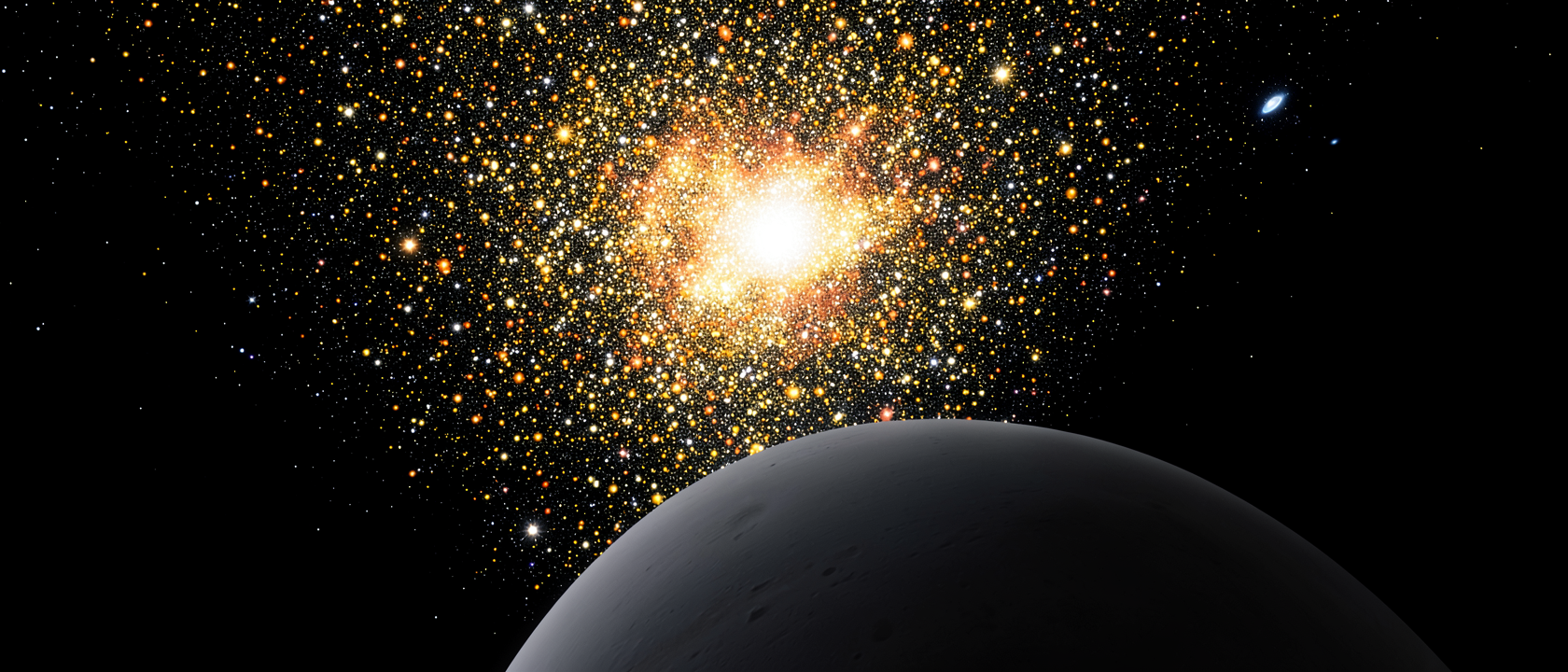
There is no photograph of M62H b, and pulsar timing will never produce one, it reads a signal, not a scene, the way a heart monitor reads a rhythm rather than a face. What exists instead are artist’s illustrations and diagrams of the timing residuals, the tiny early-late pulses that gave the planet away. Both have their use. Neither is a photograph, and any image claiming otherwise is telling you something that isn’t true.