
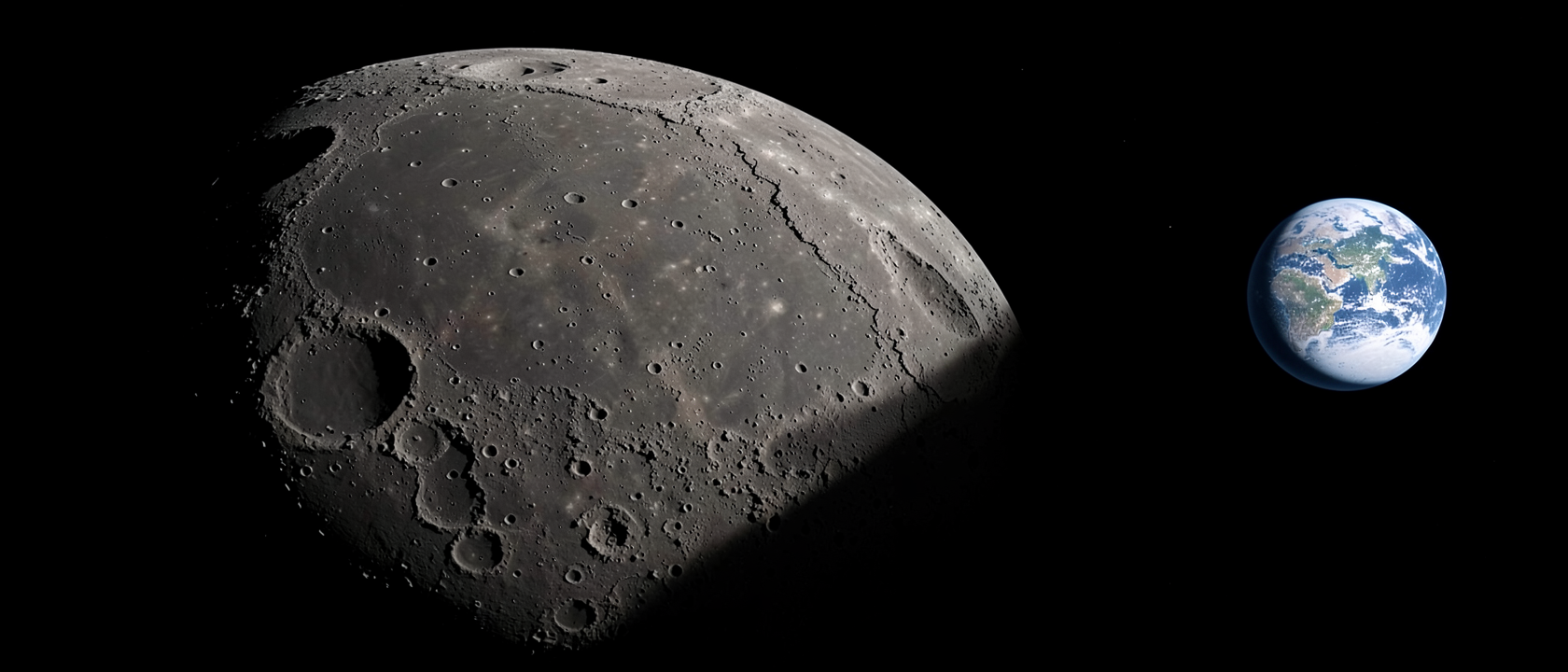
Thirty Earths, End to End
Stand thirty Earths side by side, each one touching the next, and you would just about span the gap to the Moon. Earth’s diameter, the full width across, not the radius, is 7,918 miles (12,742 km). Line up thirty of those and you land close to 238,900 miles (384,400 km), which is the Moon’s average distance from Earth. It’s a number you could sketch on a strip of paper: thirty circles, done.
An Eighteen-Day Flight
Here’s a stick most people have actually held: a boarding pass. A commercial jet cruising at about 559 mph (900 km/h) would need roughly 18 days of continuous flying, no landing, no refueling, the seatbelt sign never switching off, to cover that same 238,900 miles (384,400 km). Nobody has flown that route; this is simple division, distance over speed, not a logged flight. But eighteen days is something your own patience can measure, and that’s what turns a quarter-million-mile figure into something felt.
How We Actually Know
The 384,400 km figure isn’t a guess dressed up as a fact. Since the Apollo missions and the Soviet Lunokhod rovers left mirrored reflectors on the lunar surface, observatories on Earth have been firing laser pulses at those mirrors and timing how long the light takes to bounce back. That round-trip timing, combined with radar tracking and decades of orbital modeling, is what feeds into a semi-major axis, the long-term average radius of an elliptical orbit. It’s a measured, compiled value, not something calculated from gravity alone, and NASA’s own planetary fact sheets carry it to a small fraction of that quarter-million-mile span.
A Ratio Between Two Different Orbits
Now zoom out. Earth’s own semi-major axis, its average distance from the Sun, measures about 92.96 million miles (149.6 million km), which is also, by definition, one astronomical unit, the standard yardstick astronomers use across the solar system. Divide that by the Moon’s 384,400 km and you get roughly 389. Earth’s orbit around the Sun is about 389 times wider than the Moon’s orbit around Earth.
That sentence is true, but it hides a swap worth naming. The Moon’s number describes an orbit around Earth. The Sun’s number describes an orbit around an entirely different body: our own planet, circling its star. The figure of 389 is a ratio between two separate orbital relationships, not a straight-line comparison of how far one object sits from another, even though it reads like one at a glance.
An Average, Not a Fixed Gap
Both numbers are averages, not tape-measure constants. A semi-major axis is the midpoint between an orbit’s closest and farthest points, and the Moon’s orbit has a measured eccentricity of 0.0549, enough that its real distance from Earth drifts by tens of thousands of miles over a single month, pulled further out of shape by the Sun’s own gravity. Exactly how far off the average the Moon sits on any given night isn’t something a semi-major axis alone can tell you; the figure NASA publishes is a long-term average, not a live reading.
Why It Reads as One Kind of Far
Hundreds of thousands of miles and hundreds of millions of miles both get filed under the same mental heading: far. That’s the real surprise here, more than either number alone. Set a genuine stick against each distance separately, a stack of Earths, a jet’s fuel gauge, and the gap between “next door” and “our star” opens up to nearly 390 times. Photographs of the Moon’s surface, from Apollo’s own cameras to later lunar orbiters, are real and public. Nobody has photographed Earth’s yearly loop around the Sun from outside it; every diagram of that orbit is a model, not a snapshot, worth remembering the next time a chart makes the two look like the same kind of picture.