
A Rock the Size of an Apartment Building Passed 18.39 Moons Out
An asteroid roughly the size of an apartment building passed Earth at about 18.39 times the distance to the Moon. It happened on September 10, 2026, at 19:07 UTC, and astronomers call it 2009 SK. That gap counts as close, in the bookkeeping NASA’s asteroid trackers keep on near-Earth objects. It is nowhere near the kind of close that makes headlines for the wrong reason.
The Yardstick: Trade the Sun’s Distance for the Moon’s
The measured miss distance was 0.04726 astronomical units. An astronomical unit, or AU, is the average Earth-Sun distance, about 93 million miles (149,597,870 km), and nobody has driven that, so it doesn’t help much on its own. Converted, 0.04726 AU works out to roughly 4.39 million miles (7.07 million km). Still abstract. So CNEOS, NASA’s asteroid-tracking group, reaches for a stick everyone has actually looked at: the average Earth-Moon distance, about 238,855 miles (384,400 km). Measured against that, 2009 SK passed 18.39 lunar distances out. That’s the whole trip.
How We Know It Passed at 19:07 UTC
Nobody photographed 2009 SK up close, no spacecraft flew by, no radar dish pinged it on this pass. What NASA’s Jet Propulsion Laboratory has instead is astrometry: ground-based telescopes recording the asteroid’s position against the background stars, night after night, until an orbit fits the data. The Center for Near-Earth Object Studies, which computes these orbits in support of NASA’s Planetary Defense Coordination Office, published the result in its Close Approach Data tables, a distance and a time pinned down to four significant figures and a specific minute. That precision describes where the rock was. It says nothing yet about what the rock looks like.
The Size Nobody Actually Measured
Size is where the certainty runs out. CNEOS lists 2009 SK’s absolute magnitude, the brightness it would show if placed 1 AU from both the Sun and an observer, at zero phase angle, as H = 25.1. Turning that number into a size means assuming how much sunlight the surface reflects, a property called albedo. Assume a brighter, rockier surface (albedo 0.25) and the math gives a smaller object, around 82 feet (25 m) across. Assume a darker, carbon-rich surface (albedo 0.05) and the same brightness implies something closer to 187 feet (57 m) across, more than double. Neither is a measurement; both are estimates built on a guess about reflectivity. 2009 SK could be a modest apartment building or one nearly twice as tall, and the tool that tracks its position to the minute has no opinion on which.
Why Eighteen Moons Still Counts as Close
Eighteen lunar distances sounds roomy, stand at one end of a stadium, know something passed the far end, then imagine that gap repeated eighteen times over. Zoom out to where the next planet sits tens of millions of miles off, though, and that same gap shrinks to a rounding error. “Close” in a backyard and “close” in the solar system run on different rulers entirely. CNEOS still logs this as a close approach, and against everything larger drifting through the neighborhood, it is one. It’s also a small entry in a much bigger tally: the agency has already found more than 90% of near-Earth objects over a kilometer wide and is now working through the population above 140 meters. An asteroid the size of 2009 SK sits well under that line, one of many its size that remain only partly cataloged.
The Picture: A Path, Not a Portrait
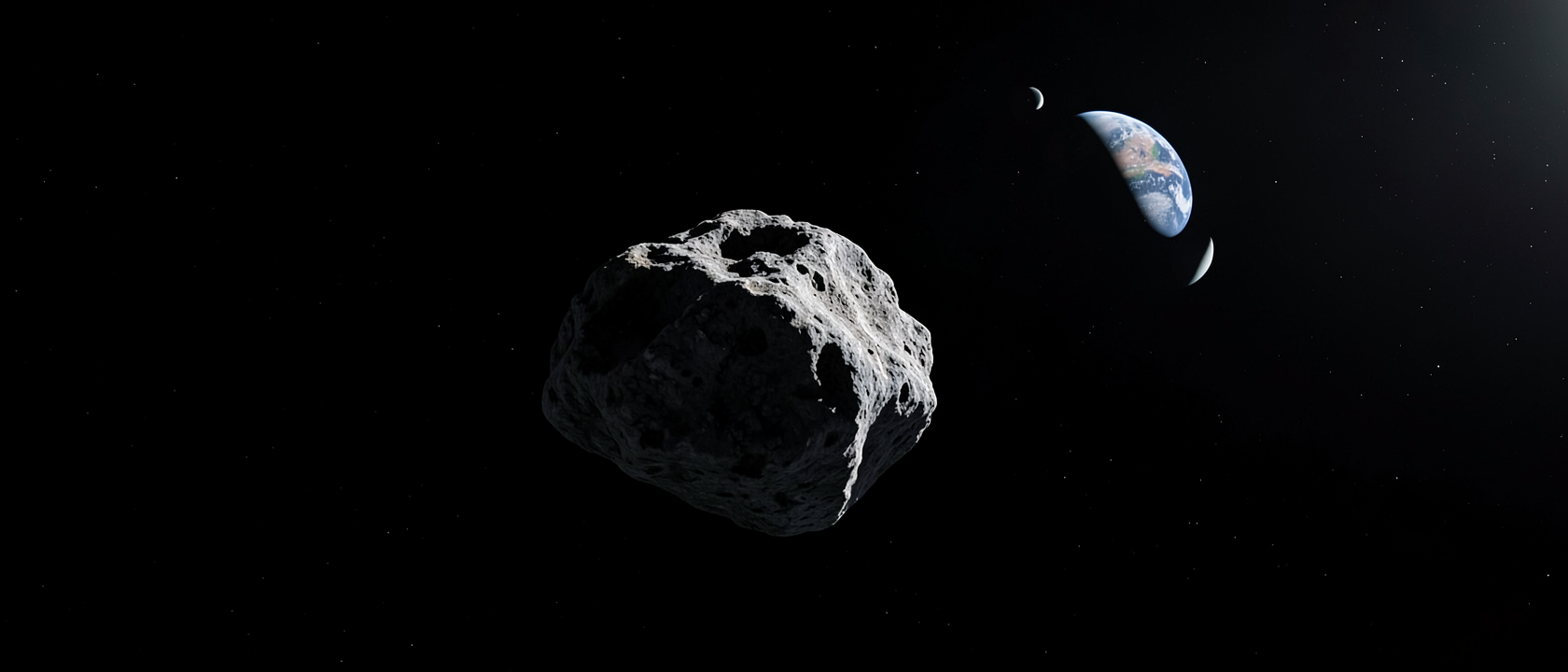
There’s no photograph of 2009 SK, and this pass didn’t produce one, it’s too small and too distant for ground-based telescopes to resolve as anything but a point of light. What exists is an orbit diagram: a plotted line, built from the same tracking data behind the distance and timing above, showing the asteroid’s path threading past Earth and the Moon. It isn’t a picture of a rock. It’s a picture of where the rock went, for something this size, that’s the most honest image on offer.
What’s Still Open
The orbit and the timing are solid; that’s what years of telescopic tracking are built to deliver. The object itself is not. No radar bounce and no infrared reading exist to settle the tie between “smaller and shiny” and “bigger and dark.” Until a future approach puts 2009 SK within range of a radar dish, its true size stays somewhere inside that 82-to-187-foot band, and nobody has picked the number yet.