A Year Shorter Than an Eight-Hour Shift
Picture clocking in for a regular eight-hour shift. Somewhere out there, an entire planet completes its whole year, every season it has, well before that shift ends. You’d barely be through your first coffee break before that world had already lived out one full year, with time still on the clock.
The planet is called ZTF J1828+2308 b, and its orbital period, the length of one full lap around its star, is 9,677.379 seconds. Convert that and you get about 2.7 hours. Set it against an eight-hour shift and this planet’s entire year is roughly a third of one workday. Set it against the year we live through, 365.25 days, and the ratio works out to about 3.07 x 10⁻⁴. Turn that around: for every year you get through, this planet gets through roughly 3,260.
Why measure a planet by its year instead of its size? Because a year means the same thing everywhere: one full trip around the star, nothing more. It doesn’t quietly smuggle in claims about heat, weather, or whether you could stand there. It’s orbital mechanics, plain and stated in hours.
How We Know: A Dip, Not a Snapshot
Nobody has photographed this system. What exists is a light curve, a plot of the star’s brightness over time, with a dip in it that repeats every 2.7 hours like clockwork. That regular dimming was first caught in Zwicky Transient Facility survey data and reported by Kosakowski and colleagues in 2022: a deep, repeating eclipse of a white dwarf, timed at exactly the period above. Follow-up high-speed photometry from Brown and colleagues in 2023, using the ULTRACAM instrument, and another pass by Parsons and colleagues in 2025, refined the picture without moving that core number. The period itself is measured directly, from timing the same dip over and over. That part holds up.
What’s shakier is what’s actually casting the shadow. Even the deepest data collected on this target so far, a HiPERCAM run that goes fainter than the 2023 ULTRACAM follow-up, has still never picked up light from the companion itself in any band. Every mass and radius figure for it comes from how it blocks the white dwarf’s glow, not from its own light.
Why Your Gut Says “Impossible”
Mercury, the tightest orbit in our own solar system, takes about 88 Earth days to circle the sun. This companion does the equivalent job in 2.7 hours, which means the two bodies sit absurdly close together. An ordinary, sun-like star with something orbiting that near would likely have swallowed or torn it apart long ago. The numbers only work with a small, dense host, and the data point that way: the NASA Exoplanet Archive lists the primary star at 0.01 solar radii and 15,900 kelvin, the signature of a white dwarf, the compact leftover core of a star like the sun after it runs out of fuel. Oddly, NASA’s own plain-language catalog entry for this system calls the host a “B-type star” instead, at odds with its own detailed parameter table and with the published follow-up research. That mismatch is worth naming, not quietly resolving in either direction.
What the Companion Looks Like: An Estimate
These numbers come from fitting a model to the eclipse shape, not from weighing or measuring the object directly, so treat them as an estimate. Mass: around 3.796 x 10²⁸ kilograms, about 20 times the mass of Jupiter. Radius: about 0.993 Jupiter radii, roughly 11.14 Earth radii. Density: around 25,300 kilograms per cubic meter. Iron, the densest metal most people have actually handled, comes in around 7,870 kilograms per cubic meter. This object’s estimated density runs more than three times that figure. It’s too dense for a gas giant and too strange for a rocky planet, a puzzle the original research team points out rather than explains away.
What’s Still Open
The host star’s identity is unsettled by NASA’s own conflicting listings. The exact distance separating star and companion isn’t spelled out cleanly in this record either, unlike Mercury’s well-known distance from the sun. And the biggest question of all, whether this object is a planet, a brown dwarf, or something in between, remains open in the research itself. The 2022 study that first caught this eclipse says plainly that follow-up photometry and spectroscopy are still needed, and that a confirmed detection would raise the known count of eclipsing white dwarfs paired with brown dwarfs from four to six.
The Picture
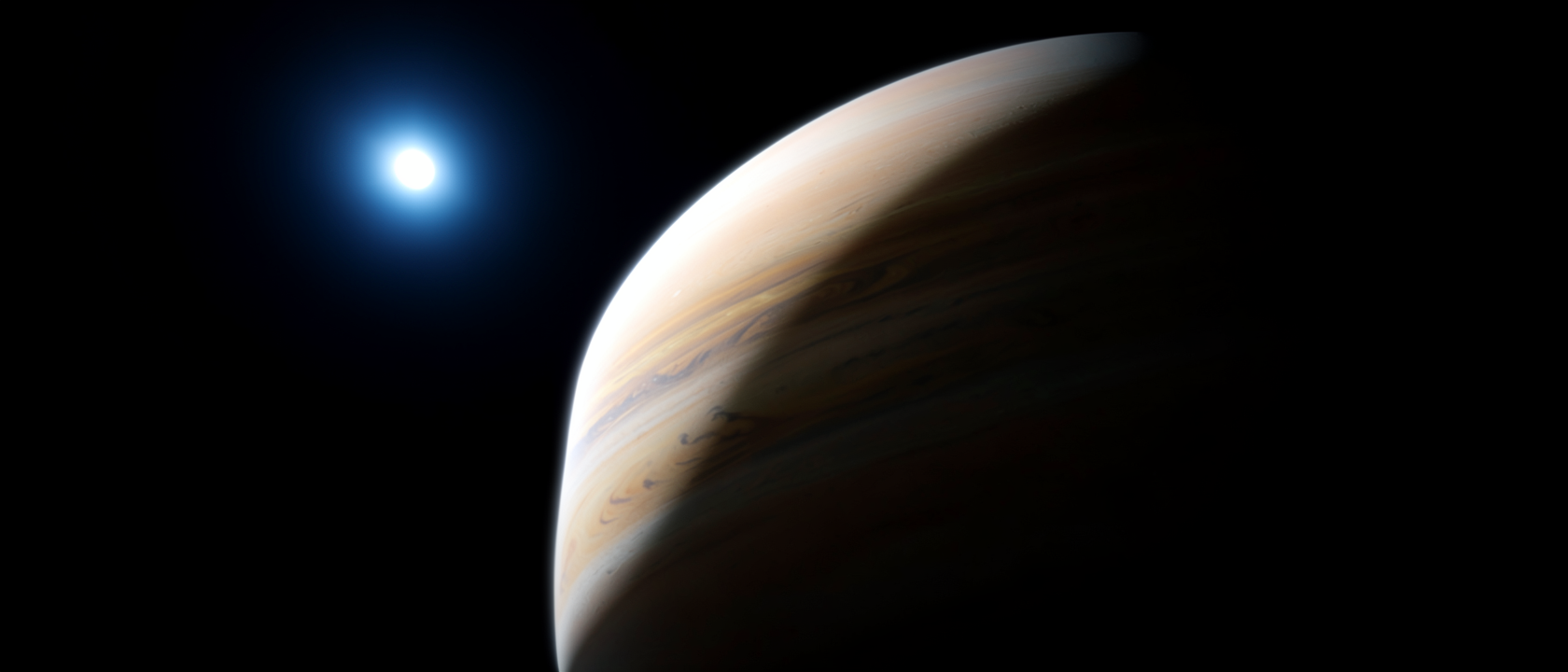
There’s no photograph of ZTF J1828+2308 b, and none is expected soon. It’s too small, too faint, and too close to its star for any current telescope to resolve directly. The real evidence is that light curve: brightness dropping and climbing back on a 2.7-hour clock, recorded survey after survey. If an illustration of this system appears alongside this piece, that’s exactly what it is, an artist’s rendering of a scene no camera has captured, labeled as such. The dip in the graph is the only real data anyone has.