
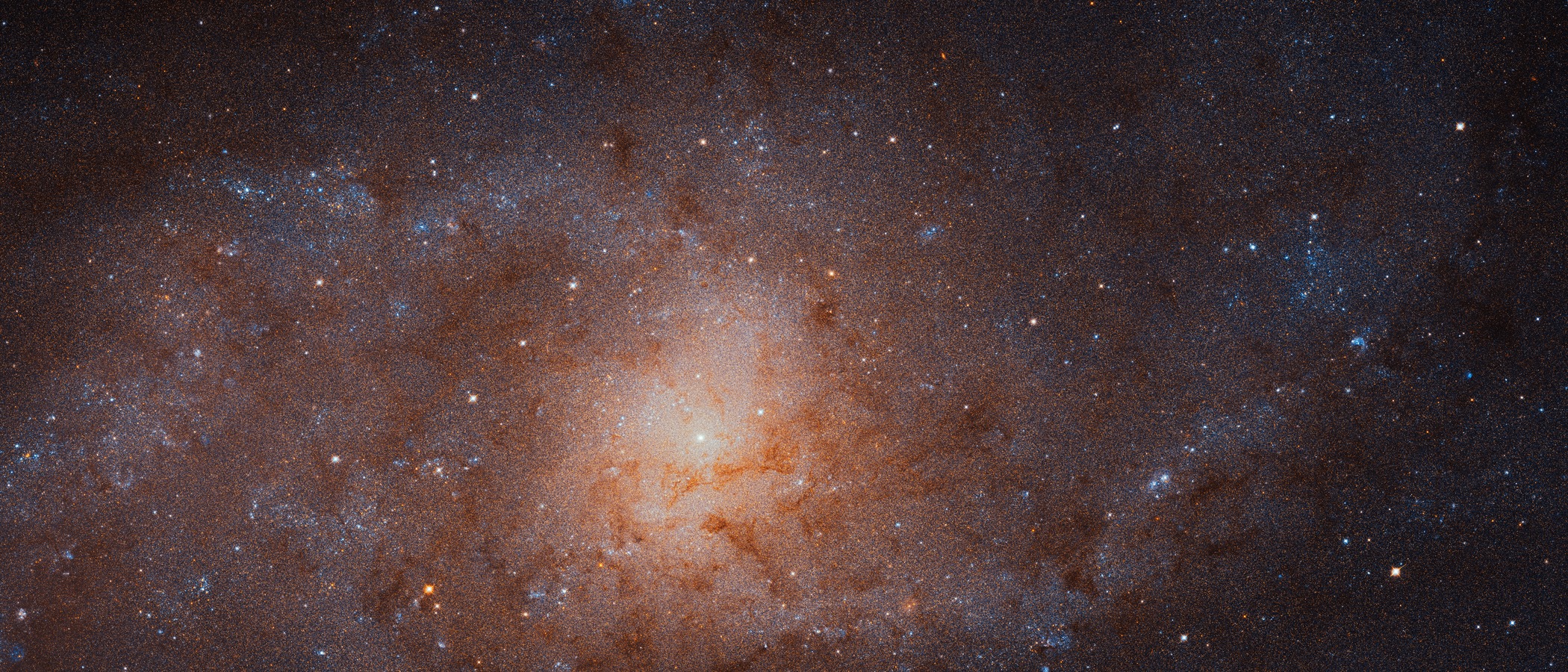
Object File heic1901a: The Triangulum Galaxy
A full spiral galaxy, caught in finer detail than any camera has managed before, fills the frame, and the light that built that picture left home long before you did. The galaxy is Messier 33, better known as the Triangulum Galaxy, and ESA/Hubble and NASA both publish its distance as roughly 3 million light-years from Earth. That number is a distance, not a stopwatch: a light-year is simply how far light travels in a year, so three million of them say how far the light crossed, not how long anything has been happening to the galaxy since.
A picture almost too big for its own telescope
You can’t hold this galaxy up against a building or a highway sign, so hold it up against the picture of it instead. The image is a mosaic stitched from 54 separate pointings of the Hubble Space Telescope’s Advanced Camera for Surveys, measuring 34,372 by 19,345 pixels, about 665 million pixels in total, covering a patch of sky 20.18 by 11.36 arcminutes across. That makes it the second-largest image Hubble has ever released. The only one bigger is its 2015 mosaic of the Andromeda Galaxy, Triangulum’s larger neighbor in the Local Group, the cluster of several dozen galaxies that also includes the Milky Way.
The galaxy itself has a plainer stat: it’s about half the size of the Milky Way. Even so, it ranks as the Local Group’s third-largest galaxy, behind Andromeda and the Milky Way, carrying roughly a tenth as many stars as our own galaxy, and a hundredth as many as Andromeda’s.
How we know
ESA released this mosaic from the Hubble Space Telescope archive on January 7, 2019, calling it the sharpest view ever taken of the Triangulum Galaxy. It’s a real photograph, not an illustration: the Advanced Camera for Surveys built it from stacks of long exposures shot through different filters, with the 54 pointings combined into one processed composite. Credit goes to NASA, ESA, and researchers M. Durbin, J. Dalcanton, and B. F. Williams of the University of Washington. The finished mosaic resolves around 15 million individual stars, sharp enough that the team could also measure star formation in the galaxy’s bright central region, where new stars are forming at a rate of about one solar mass every two years.
Distance is not a countdown
Three million light-years means the light making up this image left the Triangulum Galaxy three million years ago. It says nothing about what the galaxy is doing in this instant, because there’s no way from Earth to check that instant. And the scale needs to stay precise: this is million, not billion. Many of Hubble’s other well-known targets sit billions of light-years out, a thousand times farther. Next to those, the Triangulum Galaxy is a close neighbor, one of only a few dozen galaxies sharing our Local Group.
What’s still open
The “3 million light-years” figure is a published estimate, not a single fixed reading. Distance to M33 has been calculated by several independent methods, Cepheid variable stars, the Tully–Fisher relation linking a galaxy’s spin to its brightness, redshift (the stretch in light from galaxies moving away from us), and the tip of the red giant branch, a brightness marker in aging stars, and a compilation of those results spreads the galaxy’s distance from about 2.4 to 3.07 million light-years, depending on the method and dataset used. Astronomers also haven’t settled whether the Triangulum Galaxy is gravitationally bound to Andromeda in a slow orbit or simply drifting past it. Both questions stay open. The photograph doesn’t: it’s cataloged as heic1901a, and it remains the sharpest view of this galaxy on record.