
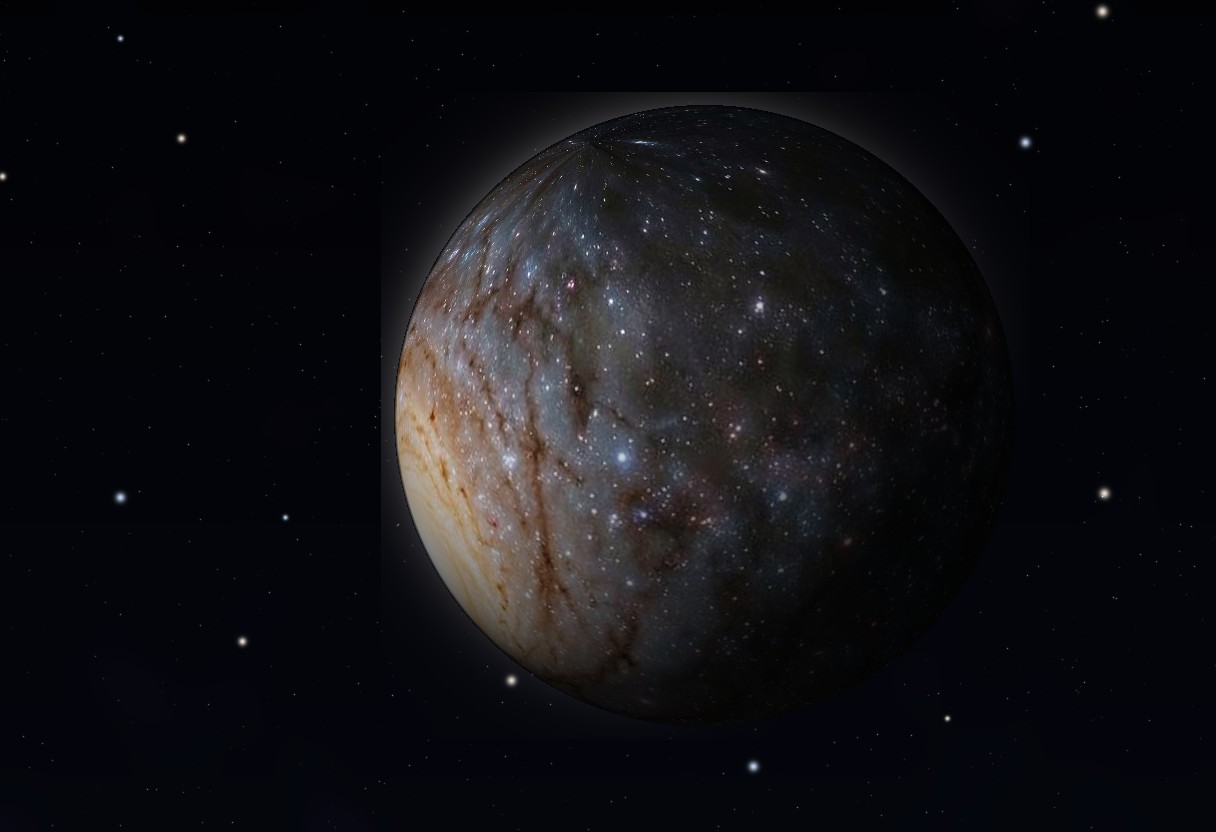
The Triangulum Galaxy is an unbarred spiral roughly 3 million light-years away — close enough that, under dark skies, it sits at the naked-eye limit — and at an estimated 40 billion stars it is nevertheless only about one-tenth the mass of the Milky Way. It ranks as the third-largest member of the Local Group of galaxies, behind the Andromeda Galaxy and the Milky Way, and is the second-nearest spiral galaxy to our own. Despite its modest size, its nucleus contains the most luminous X-ray source in the entire Local Group and one of the richest star-forming complexes known anywhere in the local universe, making it a key laboratory for understanding how galaxies grow and evolve.
Key facts
- Body type: galaxy
- Distance: 2,999,990.34 light-years
Structure and appearance
M 33 is classified morphologically as SA(s)cd — an unbarred spiral of loosely wound, flocculent arms with no central bar structure. Unlike most spirals, it also lacks a central bulge, leading astronomers to describe it as a pure disk galaxy. Its spiral arms are patchy and irregular rather than continuous, populated by abundant blue supergiants that give the galaxy an overall bluer integrated spectral color than the majority of spiral galaxies.
The disk spans approximately 60,000 light-years in diameter — roughly half the diameter of the Milky Way. The galaxy is inclined approximately 54 degrees to our line of sight, presenting a moderately face-on view that allows clear inspection of its internal structure. On the sky it subtends an apparent angular area of 70.8 × 41.7 arcminutes, yet its apparent visual magnitude of 5.72 means surface brightness is spread thinly across that area, making it a notoriously difficult naked-eye object even in ideal conditions.
The total mass of M 33 has been estimated at between 10 and 40 billion solar masses. The visible stellar component contributes roughly 8 billion solar masses, and the galaxy’s total luminosity is estimated at approximately 3 billion times that of the Sun. Its rotation velocity reaches approximately 100 km/s at the outer disk — less than half the Milky Way’s rotation velocity of about 220 km/s — consistent with its lower total mass. The dark halo mass inferred from the rotation curve, measured out to a radius of 16 kiloparsecs, is at least 5 × 10¹⁰ solar masses, meaning unseen matter dominates the total budget just as it does in larger spirals.
M 33’s nucleus is itself an ionized hydrogen (H II) region — an active zone of gas excited by hot stars rather than a quiescent core — and it hosts an ultraluminous X-ray source, the brightest such source in the Local Group. Dynamical models built from Hubble Space Telescope observations place an upper limit of just 1,500 solar masses on any central black hole, a remarkably low ceiling compared with the multi-million-solar-mass objects found at the centers of the Milky Way and Andromeda. The absence of evidence for a supermassive black hole is itself a significant finding: it suggests that central black hole growth is not an inevitable feature of all spiral galaxies.
Contents: clusters, nebulae, and star formation
M 33 contains at least 54 and possibly as many as 122 or more globular clusters, along with approximately 80 emission nebulae counted in its spiral arms. The most prominent of those nebulae is NGC 604, an H II region that William Herschel separately catalogued and which was later entered in the New General Catalogue. NGC 604 spans roughly 1,500 light-years, making it one of the largest H II regions known in the Local Group.
Age estimates for NGC 604 place the bulk of its stellar population at around 3.5 million years old, with O-type and Wolf-Rayet stars of approximately 3 million years and an older population of about 12 million years, suggesting that star formation there was not a single event but a sequence of triggered episodes. The region contains more than 200 of the hottest and most massive type of stars, all in the early stages of their lives — a concentration with no known counterpart inside the Milky Way.
In March 2024, the James Webb Space Telescope released two infrared images of NGC 604, captured with both its NIRCam and MIRI instruments. The images revealed structures that had not been resolved before: gas tendrils, cavities carved by stellar winds from massive stars, and emission from polycyclic aromatic hydrocarbons — complex carbon molecules that trace the interface between hot ionized gas and cooler surrounding material.
As of 2023, the James Webb Space Telescope identified over 790 young stellar objects across a southern spiral arm of M 33, marking the first detection of young stellar objects beyond the Milky Way and the Magellanic Clouds at that distance from Earth. The detection confirmed that star formation is active and ongoing throughout the galaxy, with particularly high efficiencies in the densest regions of gas.
Kinematics and relationship to neighboring galaxies
M 33 is approaching the Solar System at a radial velocity of 179–182 km/s and closing on the Milky Way’s galactic center at approximately 24 km/s, placing it on a trajectory directed broadly toward the Andromeda Galaxy. Several streams of neutral hydrogen gas and stars connect M 33 to Andromeda, interpreted as the remnants of a past tidal interaction between the two galaxies several billion years ago. Neither galaxy shows obvious structural disruption today, which constrains how close and how recent that encounter could have been. Simulations predict a more violent gravitational encounter between the two galaxies approximately 2.5 billion years in the future.
In 2005, a team measured M 33’s angular rotation and proper motion using the Very Long Baseline Array by observing two water masers on opposite sides of the galaxy. The technique yielded a geometric distance of 730 ± 168 kiloparsecs and a velocity of 190 ± 59 km/s relative to the Milky Way, providing one of the few direct geometric distance measurements to an external galaxy at the time.
Discovery and early study
The earliest known record of M 33 comes from Italian astronomer Giovanni Battista Hodierna, who listed a cloud-like nebulosity near ‘the Triangle’ in his work De systemate orbis cometici; deque admirandis coeli caracteribus, completed before 1654. That publication drew almost no attention outside of Sicily, and the galaxy was independently catalogued by Charles Messier in 1764, giving rise to its M 33 designation. William Herschel observed it approximately 20 years after Messier and separately catalogued NGC 604, its brightest and largest H II region.
William Parsons, the Third Earl of Rosse, identified M 33 as a spiral nebula in 1850, making it one of the first objects recognized as having a spiral structure. The spiral nature was a visual observation; its true character as an external galaxy independent of the Milky Way was not established until much later.
Edwin Hubble conducted the first detailed stellar study of M 33 in 1926, identifying 35 Cepheid variable stars within it. Cepheids pulsate with a period directly related to their intrinsic luminosity, allowing their distances to be calculated by comparing apparent brightness with known output. Hubble’s measurement placed M 33 far beyond the boundaries of the Milky Way, contributing to the then-emerging recognition that the universe contains many separate galaxies.
Modern observations and distance measurements
In January 2019, the NASA/ESA Hubble Space Telescope released a 665-million-pixel mosaic of M 33, assembled from 54 separate pointings with the Advanced Camera for Surveys. The mosaic resolved approximately 25 million individual stars — a figure that sounds large until set against the estimated 40 billion stars the galaxy contains, meaning the image captured only a small fraction of the total stellar population. At the time of release it was the second-largest mosaic ever published by Hubble.
In 2023, a team using Hubble Space Telescope Cepheid photometry improved the distance measurement to M 33 to a precision of 1.3 percent, establishing a new calibration anchor for the extragalactic distance ladder. That ladder is the chain of overlapping measurement techniques by which distances to remote galaxies are estimated; anchoring one of its lower rungs more precisely propagates improved accuracy to the Hubble constant, the number describing the universe’s expansion rate — a quantity that remains under active debate across different measurement methods.
The ESA/Hubble distance listed in the source database for M 33 is 2,999,990.34 light-years, consistent with the approximately 3 million light-year figure conventionally cited in the literature.
Did you know
- If NGC 604 in M 33 — a star-forming region spanning 1,500 light-years — were located at the same distance from Earth as the Orion Nebula, NASA has stated it would be the brightest object in the night sky after the Moon. (space.com)
- The Hubble Space Telescope’s 665-million-pixel mosaic of M 33, released in January 2019 and assembled from 54 separate pointings, resolved roughly 25 million individual stars in a single image — yet M 33 contains an estimated 40 billion stars in total. (esahubble.org)
- M 33’s star-forming nucleus hosts the most luminous X-ray source in the entire Local Group of galaxies, despite the galaxy being far smaller than the Andromeda Galaxy or the Milky Way. (astrojolo.com)
- The first record of M 33 was made by Italian astronomer Giovanni Battista Hodierna before 1654 in his book De systemate orbis cometici, but his publication attracted so little notice outside of Sicily that the galaxy was independently rediscovered at least twice — by Charles Messier in 1764 and by William Herschel approximately two decades later. (deepskycorner.ch)
- Radio observations using the Green Bank Telescope confirmed the existence of a neutral hydrogen bridge between M 31 and M 33, believed to be the remnant of a tidal tail from a close encounter between the two galaxies probably billions of years ago; the encounter had to be long ago because neither galaxy shows evidence of disruption today. (space.com)
- NGC 604 in M 33 is estimated to be only about 3.5 million years old and contains more than 200 of the hottest, most massive kinds of stars all in the early stages of their lives; had it formed in the Milky Way, astronomers have noted there is no similar region within our own galaxy. (science.nasa.gov)
Data sources
- esahubble.org
- messier-objects.com
- deepskycorner.ch
- arxiv.org
- astrojolo.com
- messier.seds.org
- constellation-guide.com
- iopscience.iop.org
- pubmed.ncbi.nlm.nih.gov
- science.nasa.gov
- grokipedia.com
Data updated: 2026-10-31