
The Planet That Shouldn’t Exist
Picture a beach ball that weighs less than the pool toy floating next to it. That’s the shape of the problem 1,181 light-years from Earth, where a planet called WASP-193 b measures 14.8 times Earth’s radius but carries only 35.6 times Earth’s mass. Something that big, built the way Earth is built, should weigh thousands of times more. It doesn’t, and the gap between what it should weigh and what it actually does is the whole story.
The measuring stick
Mass divided by volume gives bulk density, and for WASP-193 b that works out to about 60 kilograms per cubic meter, a figure derived from separately measured mass and radius, not read off any single instrument. Earth averages 5,510 kg/m³, so this planet sits at roughly 1% of that. The comparison that really lands is water: ordinary tap water is 1,000 kg/m³, and WASP-193 b still comes in at only about 6% of that figure. Drop it into an ocean big enough to hold it, and it would float the way an inflatable raft floats, not the way a swimmer treads water.
One correction worth making: online write-ups like to call this planet “lighter than Styrofoam.” Typical packing Styrofoam runs about 50 kg/m³. At 60 kg/m³, WASP-193 b is actually a touch denser than that, not lighter, close enough that it’s an order-of-magnitude comparison, not a precise one. Water is the cleaner stick: everyone has felt it, and the ratio holds up without any asterisks.
How we know
A team led by Khalid Barkaoui at the University of Liège announced WASP-193 b in the journal Nature Astronomy in July 2023, found by the transit method: ground-based cameras from the WASP survey (Wide Angle Search for Planets) caught the star dimming slightly every 6.25 days as the planet crossed in front of it. Observations from WASP-South between 2006 and 2012, later confirmed with the TRAPPIST-South, SPECULOOS-South, and TESS telescopes, gave the radius, about 58,600 miles (94,300 km), or 1.319 times Jupiter’s.
Mass came from an entirely different method: the HARPS, CORALIE, and Magellan/PFS spectrographs tracked the small back-and-forth wobble the planet’s gravity causes in its star. That gave a mass of 2.126 × 10²⁶ kilograms, or 35.6 Earths. Density itself was never measured directly; it’s calculated from those two numbers. A 2025 re-analysis by Mansfield and colleagues refined both figures, nudging the estimated density up from the discovery paper’s original figure of 49 kg/m³ to the current 60 kg/m³. Barkaoui has described WASP-193 b as the second-lowest-density planet found so far, trailing only Kepler-51d, a much smaller world.
Why intuition fails
Every rocky planet you’ve ever stood on trains the same instinct: bigger means heavier, because volume scales with the cube of the radius. A planet 14.8 times Earth’s radius, built from rock and metal like home, should weigh around 3,200 times as much. WASP-193 b weighs 35.6 times Earth’s mass, nowhere close.
The likely explanation is structure, not magic: a modest core wrapped in an enormous envelope of hydrogen and helium, puffed thin by heat. WASP-193 b circles its star, WASP-193, about 1.1 times the Sun’s mass, at a distance of just 0.0676 astronomical units (an AU, the Earth-Sun distance, is 149.6 million km), completing an orbit every 6.25 days. That closeness bakes the planet to an estimated 1,798°F (1,254 K), a figure modeled from the star’s output, not read off a thermometer. A 2025 interior model proposes the planet may carry roughly equal parts metal and light gas by mass rather than being a plain hydrogen-helium ball, a model, not a measurement.
What’s still open
The core’s real size and makeup aren’t settled. Researchers at the University of Liège have pointed out that no standard model of an irradiated gas giant, not even a coreless one, reproduces a density this low. Whether the planet, orbiting a star estimated at 6.8 billion years old, is actively losing its puffed-up atmosphere to space is also unresolved; that loss hasn’t been measured directly, only suspected.
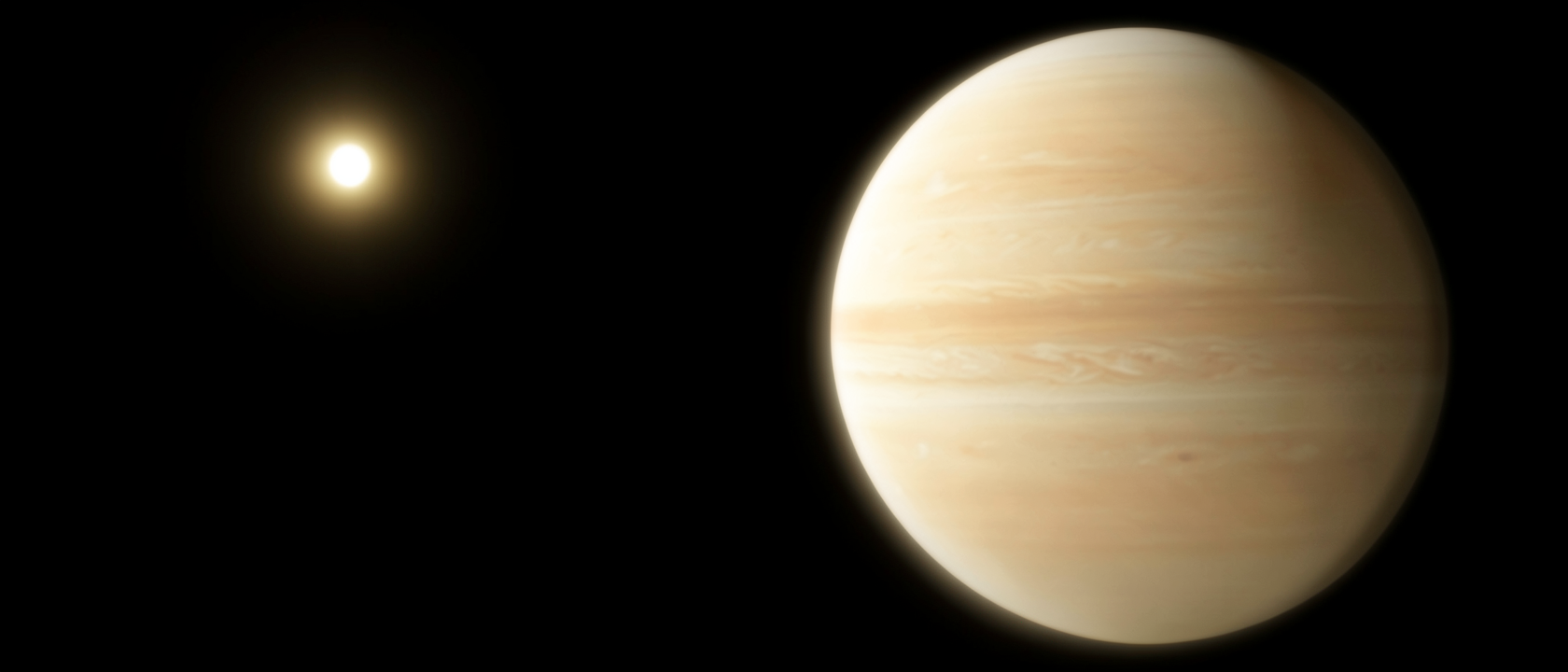
No camera has photographed WASP-193 b, and none will soon, transiting planets are found by the shadow they cast on starlight, not by direct imaging. Any picture attached to coverage of the 2023 discovery is an artist’s illustration, not a photograph of the real thing.