
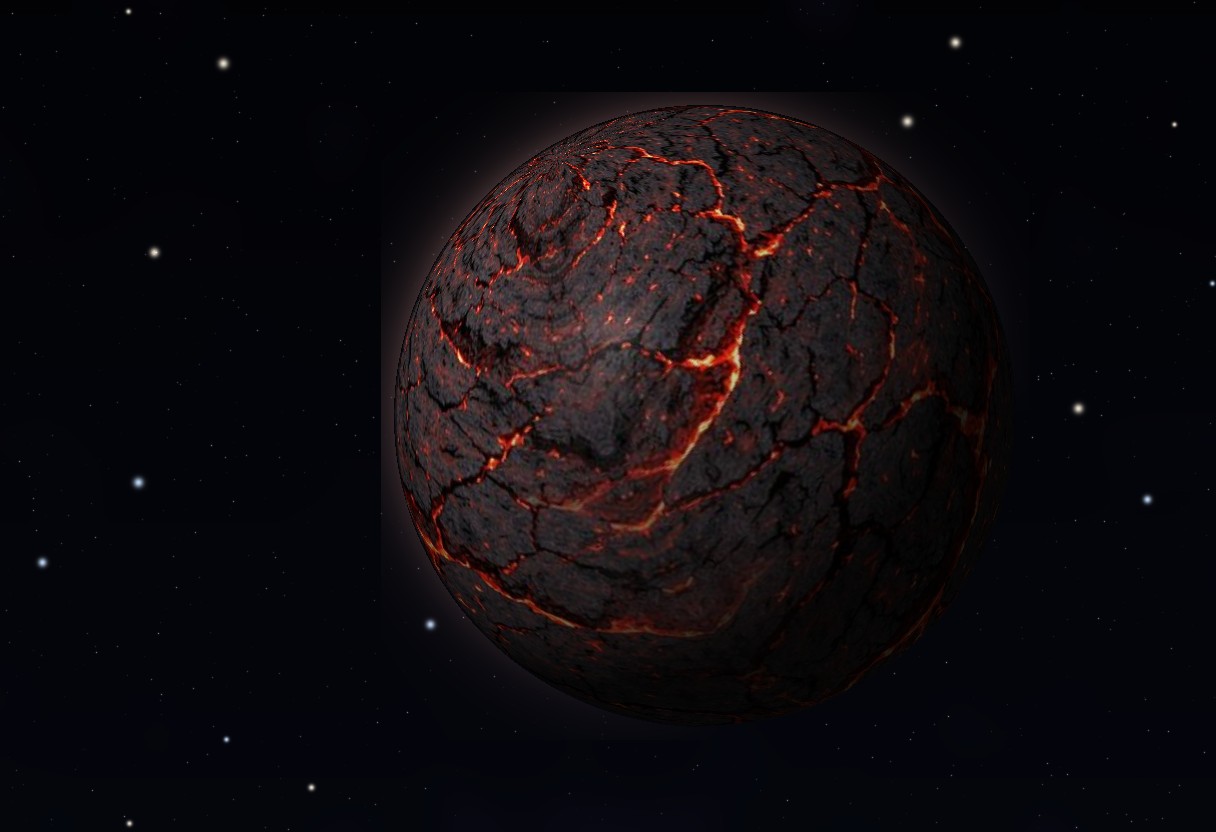
Kepler-78 b is a rocky exoplanet 405.66 light-years away in the constellation Cygnus, so close to its host star that it completes one full orbit every 8.5 hours — a year no longer than a typical human workday. Discovered in 2013, it became immediately notable for matching Earth almost exactly in radius, mass, and mean density while sitting on the edge of what planetary formation theory said was physically possible. Its surface temperature of 2,223 K (1,950 °C) ensures that rock does not simply heat up there — it melts, producing what researchers describe as a global ocean of molten rock.
Key facts
- Mass: 1.68 Earth masses (1.68× Earth)
- Body type: exoplanet
- Host star: Kepler-78
- Radius: 7,660 km (1.2× Earth)
- Density: 5,330 kg/m³ (0.97× Earth)
- Temperature: 2,223 K (1,950 °C)
- Orbital period: 8.5 h
- Semi-major axis: 1,347,877 km
- Orbital eccentricity: 0
- Distance: 405.66 light-years
- Insolation: 5,539,270 W/m²
- Discovered: 2013
- Discovery method: Transit
Physical characteristics
Kepler-78 b has a radius of 7,660 km, which is 1.2 times Earth’s radius. Its mass is 1.68 times Earth’s mass, and its mean density is 5,330 kg/m³, nearly the same as Earth’s own density. That combination of size, mass, and density points unambiguously to a composition dominated by rock and iron, the same broad recipe as the inner Solar System’s terrestrial planets.
The planet receives an insolation of 5,539,270 W/m² — an energy flux so extreme that no silicate atmosphere survives: Kepler-78 b’s proximity to its host star strips away any gaseous envelope and maintains the surface at 2,223 K (1,950 °C), well above the melting points of basalt and most iron-bearing minerals. The orbital eccentricity is measured at zero, meaning the orbit is effectively circular, so there is no seasonal variation in irradiation.
Detection of Kepler-78 b’s own emitted light during occultation — when the planet passes behind its star — was, at the time of the 2013 discovery, the first such measurement achieved for an exoplanet as small as this one. That occultation signal provides information about the planet’s surface composition and reflective properties beyond what transit geometry alone can supply.
Orbital dynamics
The planet’s semi-major axis is 1,347,877 km — a distance so small that the planet grazes its star’s outer atmosphere in terms of stellar radii. Kepler-78 b is classified as an ultra-short period (USP) planet, a category defined by orbital periods shorter than 12 hours. An 8.5-hour period places it comfortably within that group and gives it one of the shortest confirmed orbital periods of any known rocky planet.
The orbit is circular (eccentricity = 0), which is consistent with strong tidal forces from the host star having dissipated any original eccentricity over time.
Discovery and mass confirmation
The planet was first identified in August 2013 by Roberto Sanchis-Ojeda of MIT and colleagues, who published their finding in The Astrophysical Journal (Volume 774, Number 1, DOI: 10.1088/0004-637X/774/1/54). The identification relied on the transit method: Kepler-78 b periodically dims its host star, the G-type star also catalogued as KIC 8435766, as it passes across the stellar disk.
Mass confirmation arrived on October 30, 2013, when two independent teams published back-to-back in the journal Nature. Andrew Howard’s team at the University of Hawaii used the HIRES spectrograph at Keck Observatory, obtaining a mass of 1.69 Earth masses and a mean density of 5.3 g/cm³. Simultaneously, a team led by Francesco Pepe of the University of Geneva used HARPS-N at the Telescopio Nazionale Galileo in the Canary Islands, obtaining 1.86 Earth masses and a density of 5.57 g/cm³. Both results are consistent with an Earth-like composition of rock and iron, and the close agreement between two instruments on two different continents strengthened confidence in the measurement.
The formation problem
Kepler-78 b’s orbit poses a direct conflict with standard planetary formation models. When the Kepler-78 system was young, the host star was larger than it is now. The planet’s current orbital distance of 1,347,877 km would have placed it inside the stellar interior at that early epoch — meaning it could not have assembled there from a protoplanetary disk.
Inward migration from a more distant birthplace is equally difficult to reconcile with the orbit as observed. Standard disk-driven migration scenarios predict that a planet spiralling to such a short period would continue inward and be swallowed by the star rather than parking at a stable 8.5-hour orbit. As of 2013, no single mechanism fully accounted for both the planet’s existence and its precise location.
Several formation hypotheses have been proposed for the class of USP planets to which Kepler-78 b belongs. These include accretion from solid material at the innermost edge of the protoplanetary disk, inward Type I disk migration, eccentricity excitation followed by tidal circularisation, and photo-evaporation of a formerly gaseous planet that lost its envelope. One scenario put forward by Lee and Chiang suggests that USP planets form from material at the inner disk edge where the orbital period matched the stellar rotation period in the early system — approximately 10 days for Sun-like stars — and then gradually spiral inward through tidal orbital decay. None of these mechanisms has been definitively confirmed or ruled out for Kepler-78 b specifically.
Measurement technique
The mass of Kepler-78 b was pinned down using the radial-velocity method: the planet’s gravity pulls its host star in a tiny periodic wobble, and spectrographs measure the resulting Doppler shift in the star’s light. For Kepler-78 b, that wobble amounts to a radial velocity of only a few metres per second — comparable to a person walking. Detecting such a signal requires instruments of extraordinary stability; HARPS-N, one of the two spectrographs involved, operates inside a vacuum vessel at temperatures held steady to within a thousandth of a degree, with components manufactured to nanoscale tolerances.
Did you know
- Astronomers have described Kepler-78 b as a planet that “shouldn’t exist”: according to planetary formation theory as understood in 2013, it could neither have formed in its current location — which would have been inside the young, larger star — nor migrated to it without falling directly into the star. (sciencedaily.com)
- The wobble Kepler-78 b induces on its host star amounts to a radial velocity of only a few metres per second — roughly walking pace — yet two separate spectrographs operating on two different continents detected it independently and obtained closely agreeing mass estimates. (news.st-andrews.ac.uk)
- Kepler-78 b completes one full orbit in 8.5 hours — the length of a typical human workday or a full night’s sleep — giving it one of the shortest known years of any confirmed rocky planet. (sciencedaily.com)
- Despite having the most Earth-like bulk composition of any confirmed exoplanet at the time of its 2013 discovery, Kepler-78 b is at least 2,000 °C hotter than Earth because of its extreme closeness to its star, leaving its surface permanently covered by a global ocean of molten rock. (sci.news)
- The HARPS-N spectrograph used to measure Kepler-78 b’s mass operates inside a vacuum vessel at temperatures stable to within a thousandth of a degree, with parts built to nanoscale precision — engineering requirements imposed by the need to detect stellar wobbles no faster than a walking pace. (projects.research-and-innovation.ec.europa.eu)
Data sources
- NASA Exoplanet Archive
- sci.news
- iopscience.iop.org
- sciencedaily.com
- space.com
- nature.com
- centauri-dreams.org
- projects.research-and-innovation.ec.europa.eu
- arxiv.org
Data updated: 2026-10-30