
A Stadium-Sized Rock Crossed Our Doorstep at 45,000 Miles an Hour
A boulder big enough to fill a stadium tore past Earth at about 45,200 miles an hour (20.2 kilometers per second), and it never came anywhere close to hitting anything. That was asteroid 2026 OH3, at its nearest to Earth on September 11, 2026, at 04:23 UTC. The outcome was never in doubt. What’s worth a second look is exactly how close “nothing happened” turned out to be.
The Distance You Can Actually Picture
The close approach measured 0.0316 AU. An astronomical unit is the average Earth-to-Sun distance, about 93 million miles (149.6 million kilometers), so 0.0316 AU is a small slice of that yardstick, small on a solar-system scale, but the more useful stick here is the Moon. The asteroid passed about 12.3 lunar distances out: roughly 12.3 times the average 238,860-mile (384,410-kilometer) gap between Earth and the Moon. Stack up twelve Moons and a third, and that’s close to the space 2026 OH3 crossed on its way by, around 2.94 million miles (4.73 million kilometers) in total. At the asteroid’s own speed, closing a gap that size would take roughly 65 hours, just under three days. That “12.3” figure comes from a tracking aggregator that compiles NASA’s close-approach data; it lines up closely with the raw 0.0316 AU distance, but it should be read as “about 12.3,” not as a figure confirmed to the second decimal place.
How We Know
None of this came from a single photograph. NASA’s Jet Propulsion Laboratory runs the Center for Near-Earth Object Studies, known as CNEOS, which catalogs close approaches like this one, and the distance and speed figures used here are attributed to that pipeline through a live tracking aggregator that compiles CNEOS data rather than a direct pull from JPL’s own page. The method behind the numbers: telescopes catch the object at different points along its path, and an orbit-fitting model uses those sightings to calculate where the rock was, is, and will be, down to the minute. Repeated observation, not a single snapshot, is what produced these figures.
The Size Nobody Has Actually Measured
How big is 2026 OH3? That’s where the certainty runs out. A diameter estimate for objects like this is normally built from how bright the object appears combined with a guess at how much sunlight its surface reflects, its albedo. For 2026 OH3 specifically, that exact size range could not be verified against a primary JPL record in this pass, so no number is printed here as settled. No radar dish or infrared telescope has looked at this object directly, and shifting the assumed albedo alone can swing a brightness-based estimate by more than double. “Stadium-sized” is the honest way to describe it, a rough building-scale comparison, not a fixed figure.
Why 12.3 Moons Still Counts as Close
Twelve-plus lunar distances sounds like plenty of room: a dozen Moons’ worth of empty space between us and the rock. But among the thousands of near-Earth objects CNEOS tracks, a pass this close, at this speed, from something small and faint enough to stay hidden until shortly before its arrival, lands in the “close and worth logging” column, not the “distant curiosity” one. The size of the gap and the size of the surprise are two different measurements.
What’s Still Open
Several things aren’t settled. When 2026 OH3 was first spotted, and which survey found it, isn’t established in the record behind this piece. Its formal orbital classification, which family of near-Earth asteroids it belongs to, isn’t confirmed either. A tracking aggregator tags the object as “hazardous,” but that label comes from a secondary source, not directly from NASA’s own hazard-assessment criteria, so it remains an open question rather than a settled classification. And whether September 11, 2026, was 2026 OH3’s single closest approach to Earth, or one of several across its orbital history, sits in JPL’s fuller orbital record, not in this pass alone.
The Picture
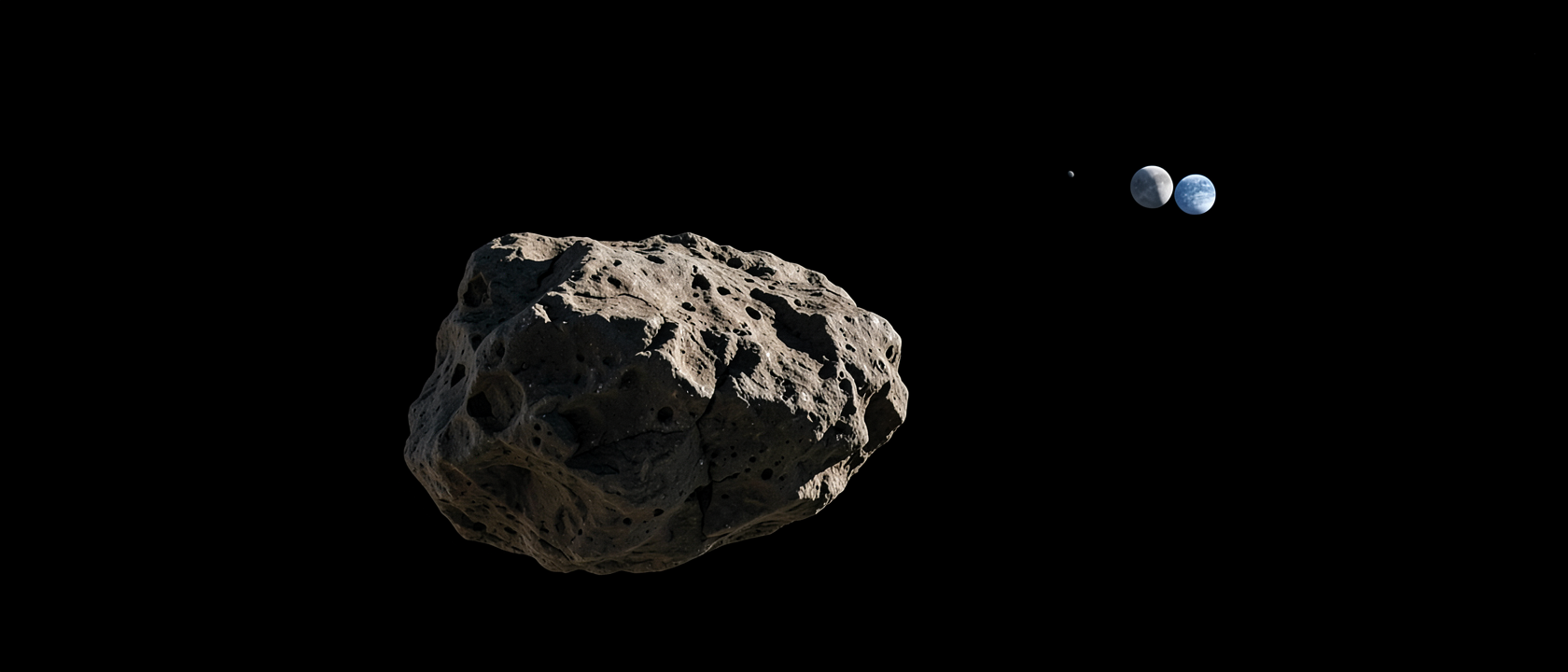
There’s no photograph of any of this. An object this small and this fast shows up in survey telescopes as a faint streak, if it shows up as more than a point of light at all. The real picture available is a diagram: an orbit line plotted against Earth and the Moon, built from the same tracking data as the numbers above. It’s an illustration of a computation, not a snapshot of a rock.