
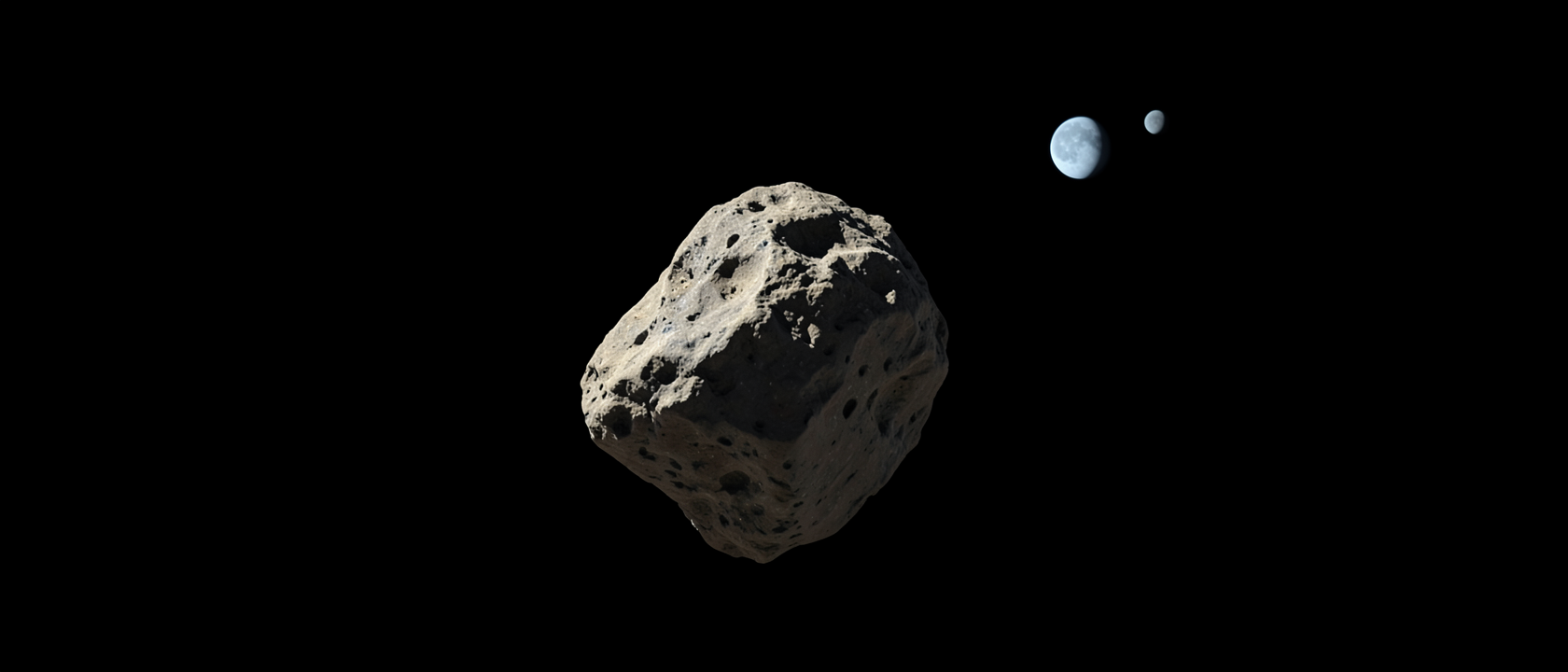
The Asteroid Pass We Couldn’t Confirm
Picture a rock roughly the length of a football stadium sliding past Earth without so much as a ripple, no warning, no danger, nothing that would ever make the local news.
That’s the shape of a claim now attached to an object designated 2026 OH3: a close approach said to have happened on September 11, 2026, at around 04:27 UTC, passing at roughly 2.94 million miles (about 4.73 million kilometers), described as 12.31 times farther from Earth than the Moon is, at a relative speed of 45,200 mph (about 20.2 kilometers per second), with an estimated diameter somewhere between 466 and 1,043 feet (142 to 318 meters). On paper, it reads like an ordinary week in near-Earth object tracking. Nothing alarming, nothing unusual.
Here’s the actual surprise: when we went looking for the primary record behind those numbers, we couldn’t find one.
Where a Real Close Approach Gets Written Down
Every confirmed pass follows the same path into the record. A telescope, usually part of a survey scanning the sky night after night, photographs a faint point of light shifting against the fixed background of stars. Repeated over hours or days, those position measurements are called astrometry. Fed into an orbit-fitting model, they produce a close-approach solution: a distance, a time, a velocity, each with a stated margin of error. That’s not a guess dressed up as a number. It’s the output of tracked positions run through celestial mechanics.
The results land in a small number of public places. NASA’s Jet Propulsion Laboratory keeps the Small-Body Database and, through its Center for Near-Earth Object Studies, a running table of close-approach solutions. The Minor Planet Center, the clearinghouse that assigns provisional designations like “2026 OH3,” a code built from the year and timing of discovery, used before any permanent number is issued, keeps a separate, independent set of listings. A genuine close approach, tracked and confirmed, should show up in at least one of these.
2026 OH3 doesn’t. No entry under that designation appears in the Small-Body Database, in the close-approach tables, or in the Minor Planet Center’s own records. That absence doesn’t prove nothing passed Earth on that date. It means the specific figures attached to this object, the distance, the speed, the size range, even the date and time, currently have no primary source behind them that we can check.
Why the Distinction Still Matters
It still helps to separate what each of those numbers would be, if confirmed. A close-approach distance is a MEASURED quantity: the direct output of tracked positions and orbital mechanics, with an instrument and a date behind it. A diameter almost never works that way. It’s an ESTIMATE, built from how bright an object appears, its absolute magnitude, combined with an assumed albedo, meaning how much sunlight its surface reflects. A dark, sooty surface has to be physically larger than a pale, rocky one to shine at the same brightness, which is exactly why size estimates for small asteroids come as a range and not a single figure. That’s genuinely how the math works for any near-Earth object with a real orbit on file. It just isn’t math we can run here, because the inputs for 2026 OH3 aren’t sitting in a catalog we can check against.
So the honest version of this story isn’t “a stadium-sized asteroid passed twelve Moon-distances from Earth.” It’s that a specific, plausible-looking set of figures is circulating under that description, and the databases built to confirm exactly this kind of claim don’t currently show it. If 2026 OH3 turns up later with a dated observation arc and a confirmed orbit, the numbers will get run properly, distance next to the Moon, size next to its uncertainty, survey and instrument named. Until then, the honest answer is the open one: unconfirmed.