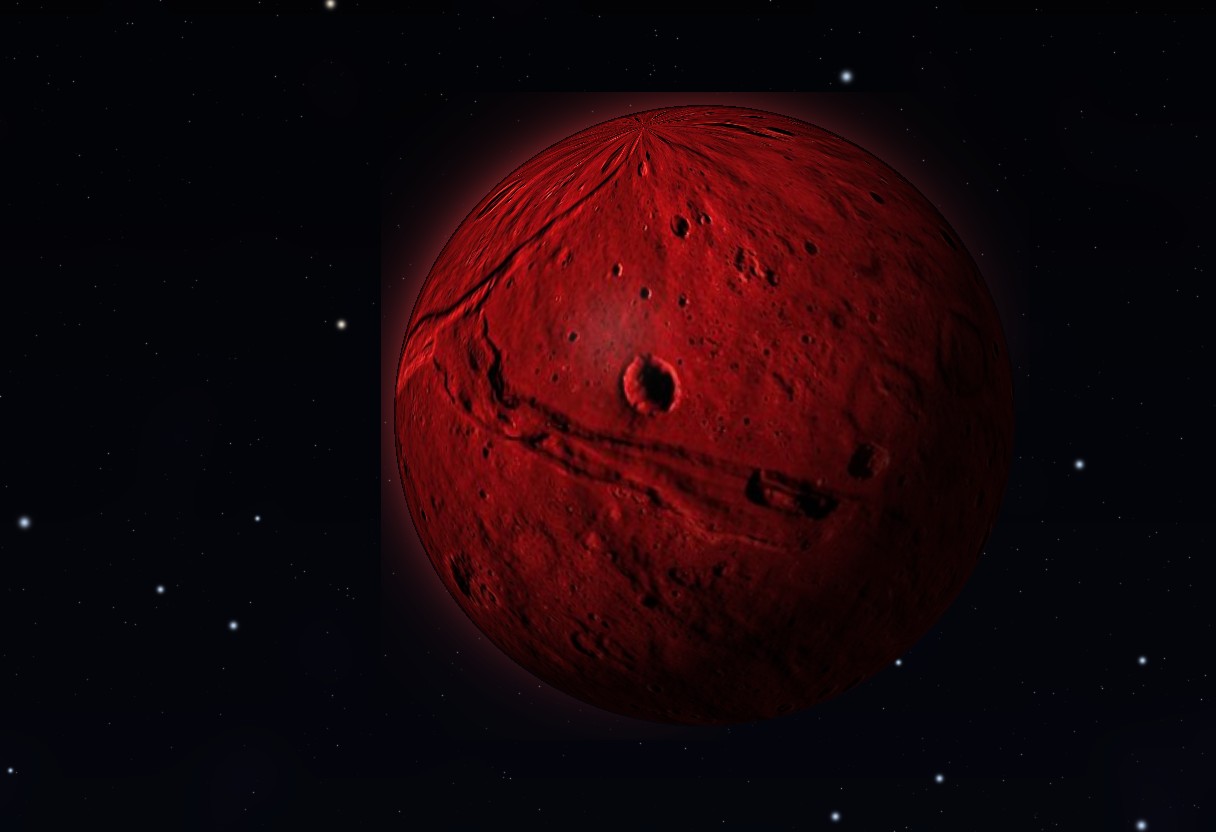
TOI-4552 b is a rocky exoplanet roughly the size of Earth but about 1.83 times its mass, completing one full orbit every 7.2 hours. It circles an M-dwarf star 88.94 light-years away, locked into a path so close that its equilibrium temperature reaches 1,122 K (849 °C).
Key facts
- Mass: 1.83 Earth masses (1.83× Earth)
- Body type: exoplanet
- Host star: TOI-4552
- Radius: 7,080 km (1.11× Earth)
- Density: 7,740 kg/m³ (1.4× Earth)
- Temperature: 1,122 K (849 °C)
- Orbital period: 7.2 h
- Semi-major axis: 841,563 km
- Orbital eccentricity: 0
- Distance: 88.94 light-years
- Insolation: 357,943 W/m²
- Discovered: 2026
- Discovery method: Transit
Physical characteristics
TOI-4552 b has a radius of 7,080 km — 1.11 times Earth’s — and a mass of 1.83 Earth masses squeezed into that modestly larger body, yielding a mean bulk density of 7,740 kg/m³, which is 1.4 times Earth’s average density. That elevated density points firmly at a large metallic core rather than a rocky mantle dominating the interior.
The planet’s orbital path is almost exactly circular: its eccentricity is measured at 0. Its semi-major axis — the average star-to-planet distance — is 841,563 km. At that separation, the planet absorbs an insolation of 357,943 W/m², an irradiation intense enough to drive the equilibrium temperature to 1,122 K (849 °C).
No atmosphere has been confirmed or ruled out from the discovery data alone. The temperature, density, and short orbital period all make retention of a substantial volatile envelope difficult to reconcile, though the question remains open pending further observation.
Host star
TOI-4552 is an M-dwarf star with a surface gravity of log g = 4.940 ± 0.028 cm s⁻² and an iron abundance of [Fe/H] = −0.07 ± 0.09, placing its chemical composition close to solar. Its apparent visual magnitude of V = 14.44 makes it faint by the standards of ground-based spectrographs designed for brighter targets; its TESS-band magnitude is 11.9251 ± 0.0073 and its Gaia G-band magnitude is 13.2136 ± 0.0004.
The BANYAN Sigma kinematic algorithm, run on Gaia DR3 astrometry, assigns TOI-4552 a 99.9 % probability of being a field star — meaning it shows no association with any known young moving group or stellar cluster. A field-star classification implies the system is not anomalously young, which bears on how its planetary architecture has had time to evolve.
Discovery and detection
The first hint of TOI-4552 b appeared on October 28, 2021, when the TESS Science Processing Operations Center (SPOC) pipeline at NASA Ames Research Center flagged the signal as a Level 1 planetary candidate from TESS photometry. Formal publication followed in 2026 — more than four years later — after ground-based follow-up at multiple facilities closed enough loopholes to elevate the candidate to a confirmed planet.
Measuring the mass required radial-velocity spectroscopy, and this is where TOI-4552 b broke new ground. The host star’s faintness at visual wavelengths (V = 14.44) meant that HARPS, a high-precision visible-light spectrograph, could not produce high-quality measurements. The mass was instead pinned down primarily through NIRPS, a near-infrared spectrograph that operates where the M-dwarf emits more flux.
The full detection effort drew on space-based photometry from TESS, four separate ground-based photometric facilities, two spectrographs (HARPS and NIRPS), and a high-resolution speckle imager. The discovery paper listed 60 co-authors at institutions across Canada, Switzerland, France, Spain, Portugal, and Brazil. The NASA Exoplanet Archive formally added TOI-4552 b’s data on April 9, 2026.
Formation and context
Ultra-short-period planets — broadly defined as planets with orbital periods under one day — are unlikely to have formed in place at such small separations. Proposed formation routes include disk-driven inward migration, in which tidal interactions with the protoplanetary disk push the planet inward; high-eccentricity tidal migration, in which gravitational perturbations from an outer companion stretch the orbit before tidal forces circularise it close in; and obliquity-driven tidal runaway, a less widely invoked mechanism involving the damping of axial tilt. None of these channels is confirmed for TOI-4552 b specifically, and the zeroed eccentricity of its present orbit is consistent with any channel that ends in tidal circularisation.
That sample size is still small enough that each new addition shifts statistical trends — particularly regarding bulk density distributions and core mass fractions — in ways that affect inferences about the whole population.
Prospects for follow-up
The high irradiation TOI-4552 b receives means it radiates a detectable thermal signal even if it has no atmosphere at all. Phase-curve and secondary eclipse observations with the James Webb Space Telescope (JWST) have been identified as a path to constraining the planet’s dayside and nightside temperatures, its albedo, and potentially its surface mineralogy — information that would distinguish, for example, between a dark basaltic crust and a reflective silicate lava field. These constraints would carry scientific weight regardless of whether an atmosphere is present.
The planet’s inferred interior structure is also under active discussion. Its modelled core mass fraction of 0.54 is substantially above Earth’s estimated value of roughly 0.33, raising the possibility that TOI-4552 b belongs to the loosely defined ‘super-Mercury’ category — planets whose interiors are dominated by iron to a degree that resembles Mercury rather than Earth. The mass uncertainty in the current data is large enough that this classification remains open, not settled.
Did you know
- The discovery paper for TOI-4552 b listed 60 authors in total — a number that reflects the infrastructure a single exoplanet confirmation now demands. The find required space-based photometry, four different ground-based photometric facilities, two spectrographs, and a high-resolution speckle imager, with contributing teams spread across multiple continents. (arxiv.org)
- Models of TOI-4552 b’s interior yield a core mass fraction of 0.54, well above Earth’s estimated value of roughly 0.33. If accurate, that places the planet in the ‘super-Mercury’ category — bodies so iron-rich that Mercury is the closer Solar System analogue than Earth. The current mass uncertainty is large enough that the classification stays open rather than confirmed. (arxiv.org)
- TOI-4552 b was flagged as a planetary candidate on October 28, 2021, yet its discovery paper was not published until 2026 — more than four years later. The gap was filled by ground-based photometric observations, near-infrared spectrograph campaigns, and speckle imaging, each step needed to rule out false-positive scenarios before the signal could be called a planet. (arxiv.org)
Data sources
Where it appears
- TOI-4552 b completes a full orbit in just 7.2 hours October 29, 2026
Data updated: 2026-10-27