
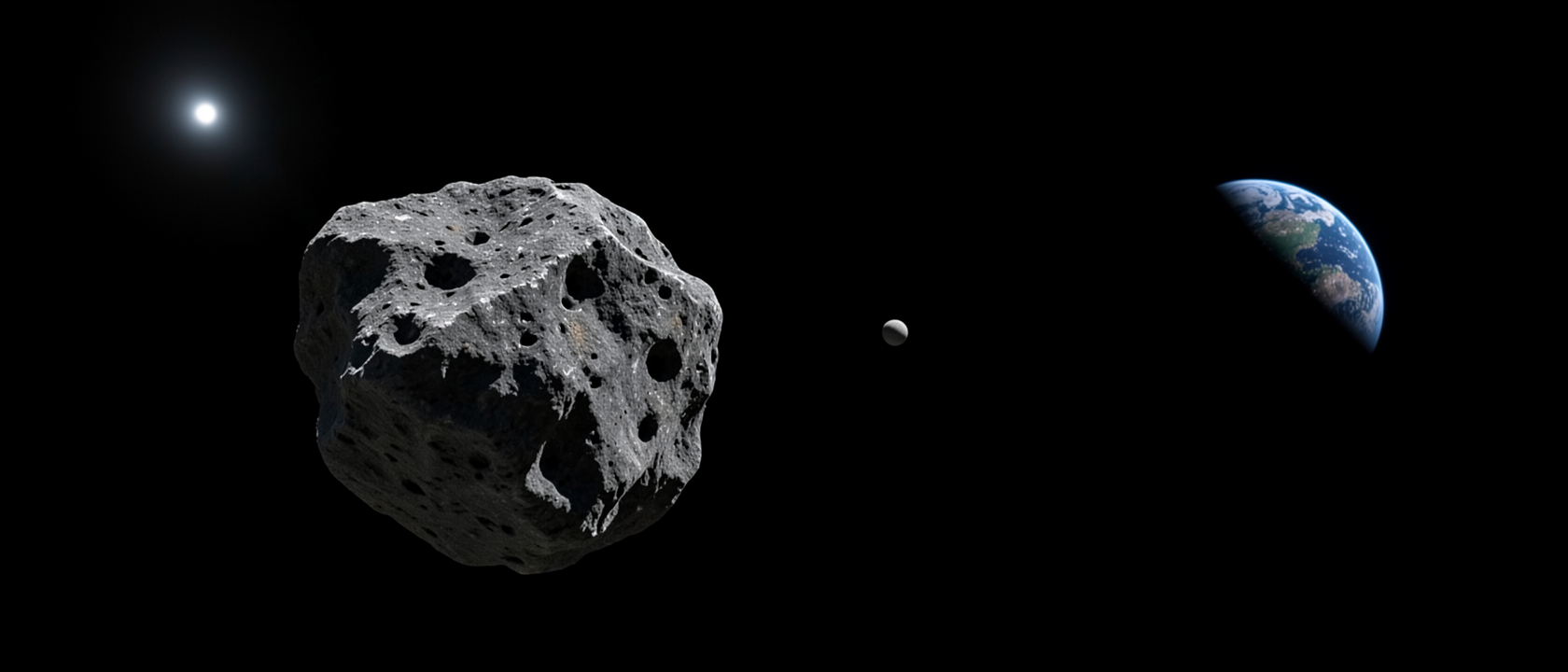
Nine and a Half Moons from Home
A rock somewhere between 66 and 230 feet across swept past Earth at nine-and-a-half times the Moon’s distance, and a telescope in the Arizona mountains caught it on the way in, eighteen months before it arrived.
The rock is asteroid 2025 CL3. On September 1, 2026, at 04:24 UTC, it reached its closest point to Earth: a measured miss distance of 0.02448 AU, AU meaning the mean Earth–Sun separation, 149,597,870 kilometers, which works out to 9.53 lunar distances, or roughly 3,663,000 kilometers of open space between the asteroid and the ground. No scramble, no last-minute alert. Pure geometry, computed well in advance.
The Measuring Stick
One lunar distance, the mean Earth–Moon gap, is 384,399 kilometers. Stack 9.53 of those gaps end to end and you have the distance 2025 CL3 kept from Earth: 3,663,000 kilometers. That figure is roughly 1/41 of the Earth–Sun distance.
One more frame, in time rather than distance: 2025 CL3 was closing on Earth at 13.5 kilometers per second relative to our planet. At that speed it covered one full lunar distance, 384,399 kilometers, in about eight hours. The entire 3,663,000-kilometer gap took fewer than four days to traverse at that rate. Far, in an absolute sense. Immediate, on a solar-system clock.
How We Know
The 9.53 lunar-distance figure is not a reconstruction assembled after a surprise. It is the output of a tracking pipeline that had been running on 2025 CL3 since its discovery, more than eighteen months before the flyby.
It started on February 7, 2025. The Mt. Lemmon Survey, a 1.5-meter reflector operating as part of the Catalina Sky Survey in Arizona (observatory code G96), recorded the first positions of a faint moving point against the background stars. Follow-up astrometry came in from G. J. Leonard at Steward Observatory Mt. Lemmon Station and from G. Hug at Sandlot Observatory in Scranton (observatory codes I52 and H36). The Minor Planet Center, the International Astronomical Union’s clearinghouse for this data, collected those measurements and issued discovery circular MPEC 2025-C144 on February 8, 2025.
JPL’s Center for Near Earth Object Studies, CNEOS, ran an orbital solver on the accumulated positions. The published nominal approach distance of 0.02448 AU is the closest point on that calculated orbit to Earth’s center. “Nominal” means the single most probable trajectory given all observations in hand. A small uncertainty ellipsoid surrounds it; for a well-tracked object, it is narrow.
The Size: An Estimate With an Honest Range
The one number for 2025 CL3 that comes directly from the photons is its absolute magnitude: approximately H = 25.3, as published in MPEC 2025-C144. Converting that to a physical size requires knowing albedo, the fraction of sunlight the surface reflects. Albedo is not directly measured for most small asteroids, so the diameter is an estimate derived by bracketing two physically plausible extremes. A bright, rocky surface with an albedo of 0.25 gives a diameter of roughly 66 feet (20 meters). A dark, carbonaceous surface with an albedo of 0.05 gives roughly 230 feet (70 meters). The honest answer is somewhere between 66 and 230 feet (20 to 70 meters), a factor-of-three range that exists entirely because the surface type is unknown.
The upper end of that range puts 2025 CL3 in the same size neighborhood as the object that entered the atmosphere over Tunguska, Siberia, in June 1908, flattening an estimated 2,000 square kilometers of forest. The comparison is worth making because the ranges overlap, and worth keeping in proportion: a rock that passed at 9.53 lunar distances and one that detonated in an atmosphere are entirely different scenarios.
The instrument that would collapse that 66–230-foot (20–70-meter) range into a single number is planetary radar, a high-power beam bounced off the surface, with the echo’s time delay and Doppler spread read back to give physical size, shape, and rotation rate directly. Absent a radar measurement confirmed in publicly available records, 66 to 230 feet remains the correct answer, and both ends of it belong in the sentence.
What Remains Open
The orbit carries an Earth MOID, the minimum possible separation between the two orbital paths, regardless of when they are occupied, of 0.0011 AU, roughly 164,600 kilometers, about 43% of the Earth–Moon distance. That figure describes the geometry of the orbits alone, not a prediction of future encounters. Whether 2025 CL3’s path places it on any closer approach to Earth in future years is not established in the sources at hand.
Nobody knows how big it is. That is the correct answer.
, Theo Marlow, Null Horizons